
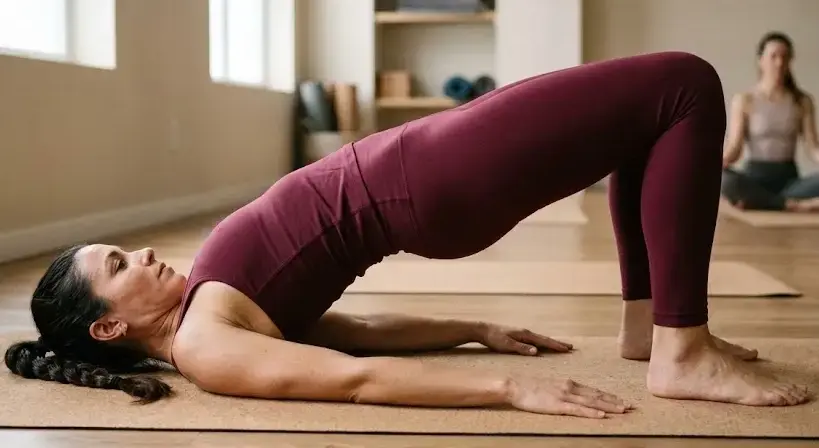
Types of yoga refer to structured systems of movement, breath, and attention that differ in how they organise load, pacing, and muscular engagement. For practitioners experiencing recurring lower back stiffness, the distinction between these systems matters less than how each one sequences stabiliser activation before spinal movement. Misaligned sequencing—not pose selection—is the primary reason stiffness returns within hours of practice.
Key Takeaways
- Types of yoga differ functionally by activation timing, not style labels
- Stabiliser engagement must precede spinal movement by 2–4 minutes
- Vinyasa compresses activation time, increasing stiffness recurrence
- Hatha supports control but requires deliberate sequencing adjustments
- Stiffness returning within hours indicates premature spinal loading
- Sequence redesign is more effective than switching yoga styles
What defines types of yoga structurally rather than stylistically?
Types of yoga differ in how they organise spinal loading relative to muscular activation, not in surface-level pacing or intensity. A slow class can still overload the lumbar spine if stabilisers are not activated before movement begins.
Three structural variables determine how a yoga type affects your lower back:
| Variable | Low-Control Example | High-Control Example | Impact on Lumbar Spine |
| Activation timing | Movement begins immediately | Activation precedes movement by 2–3 minutes | Early loading increases stiffness recurrence |
| Breath integration | Passive or delayed | Breath-led bracing before motion | Improves spinal support |
| Load progression | Continuous flow | Gradual increase in range and demand | Reduces shear stress |
In home practitioners (30–55 age group), stiffness often returns because movement starts before neuromuscular readiness is established.
How do different types of yoga sequence activation before movement?
Different types of yoga vary in whether they prioritise activation before spinal motion, which directly affects stiffness outcomes.
| Yoga Type | Activation Phase | Movement Entry | Practical Outcome |
| hatha yoga | Present but often brief | Controlled, slower transitions | Moderate support if activation is extended |
| vinyasa yoga | Minimal or skipped | Immediate flow-based loading | Higher risk of repeated stiffness |
| Yin yoga | No activation phase | Passive loading | Temporary relief without stability |
| Restorative yoga | No activation phase | Supported stillness | No improvement in load tolerance |
| Ashtanga yoga | Fixed sequence | Rapid progression | Requires pre-conditioning to avoid overload |
For example, in a typical morning vinyasa session, spinal flexion and extension begin within the first 60–90 seconds. Without prior stabiliser engagement, this creates repeated low-grade strain that presents as stiffness later in the day.
What is hatha yoga and where does it support or fail?
Hatha yoga operates on controlled pacing and static holds, which allows time for muscular engagement, but it does not guarantee correct sequencing.
Where it supports:
- Slower transitions allow conscious activation
- Static positions enable breath regulation before movement
- Suitable for inserting a 2–4 minute pre-load activation phase
Where it fails:
- Activation is often assumed, not structured
- Beginners are not guided to engage deep stabilisers explicitly
- Movement may still precede full readiness
In practical terms, a home practitioner performing hatha yoga at 6:30 AM may still experience stiffness by 10 AM if the session begins with movement rather than preparatory activation.
What is vinyasa yoga and why does it amplify stiffness patterns?
Vinyasa yoga prioritises continuous movement linked with breath, which compresses or eliminates the activation phase required for spinal stability.
Key structural issue:
Movement begins before stabiliser recruitment is complete.
Observed pattern in home practitioners:
- Immediate transition into dynamic sequences
- Breath follows movement instead of leading it
- Lumbar spine absorbs load due to inactive deep stabilisers
This creates a cycle where flexibility increases temporarily, but load tolerance does not. The result is recurring stiffness despite regular practice.
Which types of yoga align with stabiliser-first sequencing?
Types of yoga that support stabiliser-first sequencing either allow or enforce a preparatory phase before movement.
More compatible structures:
- Hatha (when modified with activation phase)
- Iyengar (precision-based, slower loading)
- Somatic yoga (neuromuscular focus before movement)
Less compatible structures:
- Vinyasa (continuous flow)
- Power yoga (intensity prioritised over sequencing)
- Hot yoga (heat-driven range without stability control)
Non-obvious insight:
A slower yoga type is not inherently safer. Safety depends on whether stabiliser activation occurs before spinal loading, not on pacing.
How should you restructure your morning practice sequence?
Types of yoga become effective only when the sequence is adjusted to prioritise neuromuscular readiness before movement.
Apply this 3-phase structure:
- Activation phase (2–4 minutes)
- Low-load engagement of deep stabilisers
- Breath-led abdominal and pelvic control
- No spinal movement
- Controlled loading phase (5–10 minutes)
- Small-range movements under active control
- Gradual increase in spinal range
- Integrated movement phase
- Full sequences (including hatha or modified flow)
- Load distributed across stabilised structures
Example: A practitioner replacing immediate flow with a 3-minute activation phase typically reports reduced stiffness duration from 4–6 hours to under 1–2 hours within two weeks.
When does this sequencing approach not resolve stiffness?
Types of yoga structured correctly still fail when stiffness is not load-related.
Limitations:
- Does not address stiffness driven by prolonged sitting without interruption
- Ineffective if activation is performed incorrectly (no measurable engagement)
- Limited impact if total daily movement variability is low
For instance, a desk-based professional sitting for 8+ hours without positional change will continue to experience stiffness regardless of morning sequencing quality.
Conclusion
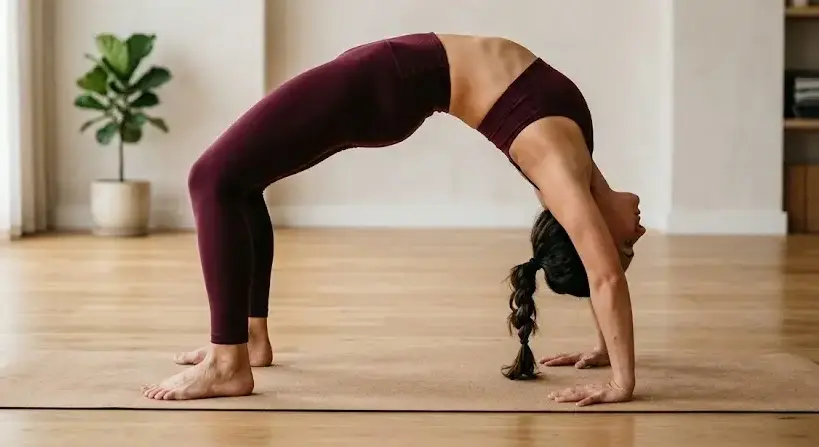
Types of yoga only influence lower back outcomes through how they sequence activation before spinal loading. A yoga must begin with stabiliser engagement, not movement, to prevent recurring stiffness. The decision is structural: adjust the sequence, not the style.
FAQ
What are the five major types of yoga?
Hatha, Vinyasa, Ashtanga, Iyengar, and Kundalini are commonly classified based on structure and method.
What are the 4 main yogas?
Karma, Bhakti, Raja, and Jnana yoga are traditional paths defined by action, devotion, discipline, and knowledge.
What are 7 types of yoga?
Hatha, Vinyasa, Ashtanga, Iyengar, Kundalini, Yin, and Restorative are widely recognised modern classifications.
What are the 8 types of yoga?
An expanded list includes Hatha, Vinyasa, Ashtanga, Iyengar, Kundalini, Yin, Restorative, and Power yoga.
Sources
https://yogamedicine.com/guide-types-yoga-styles/
https://www.yogapoint.com/info/typesofyoga.htm
https://www.medicalnewstoday.com/articles/286745
https://www.doyogawithme.com/types-of-yoga
https://liforme.com/blogs/blog/15-popular-types-of-yoga-explained
https://www.dabur.com/blog/yoga/what-yoga-history-and-types-yoga