
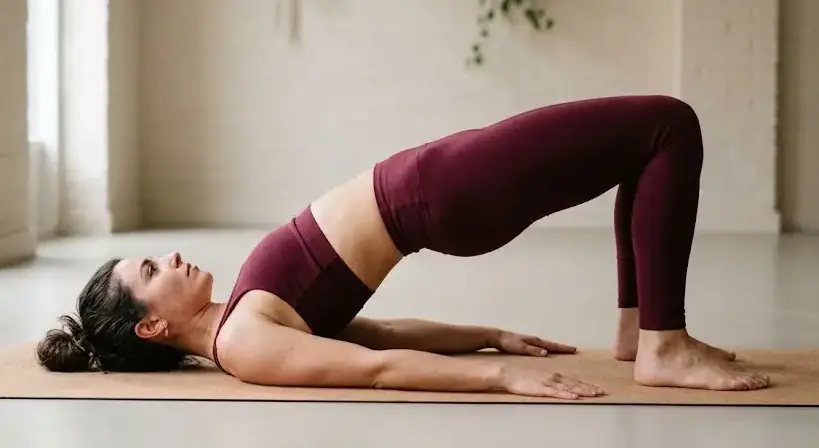
Yoga for flexibility refers to the controlled increase of joint range through coordinated muscular activation and regulated loading. In practice, most routines emphasise passive lengthening before establishing stabiliser control. This creates a mismatch: mobility is introduced into a system that cannot yet regulate it. The result is short-lived flexibility followed by recurring stiffness, especially in the lumbar region after morning sessions.
Key Takeaways
- Flexibility depends on stabiliser timing, not just tissue length
- Morning stiffness is often a control deficit, not a mobility limitation
- Breath mechanics regulate spinal support before movement begins
- Sequence order determines whether flexibility persists or regresses
- Reducing early stretching improves long-term range retention
What does yoga for flexibility actually require at a structural level?
Yoga for flexibility depends on pre-loading stabiliser engagement before introducing range. Without this, stretching increases excursion without control.
Three components determine whether flexibility persists beyond practice:
- Segmental stabilisation
Local muscles (e.g., multifidus, transverse abdominis) must activate before global movement. In home practitioners, delayed activation is common after sleep due to reduced neural readiness. - Controlled breath mechanics
Diaphragmatic expansion regulates intra-abdominal pressure. Example: a 4-second nasal inhale expanding the lower ribcage increases spinal support before movement begins. - Progressive loading order
Movement must transition from low-load activation to higher-load range. Skipping this step leads to passive tissue strain instead of controlled mobility.
If these are absent, increased flexibility during practice does not transfer to functional movement later in the day.
Why does stiffness return within hours after yoga stretching?
Yoga stretching fails when it targets perceived tightness instead of the stabilisation deficit causing it. The nervous system restricts range when it detects insufficient control.
This pattern is measurable in morning practitioners:
| Factor | Symptom-Focused Stretching | Stabiliser-Led Approach | Outcome Timeline |
| Initial range increase | High | Moderate | Immediate |
| Stability during movement | Low | High | Within session |
| Stiffness recurrence | 2–4 hours | 6–10 hours | Same day |
Example: A practitioner performs forward-fold variations immediately after waking. Range increases temporarily, but lumbar stiffness returns by mid-morning because spinal support was not established prior to flexion.
The restriction is protective, not pathological.
How should yoga stretches be sequenced before spinal loading?
Yoga for flexibility becomes effective when sequencing follows a neurological-to-mechanical progression rather than a pose-based structure.
A corrected morning sequence:
- Breath-led activation (2–3 minutes)
Supine or low-load position. Focus: ribcage expansion and controlled exhale.
Outcome: restores diaphragm-pelvic floor coordination. - Local stabiliser engagement (3–5 minutes)
Minimal movement patterns targeting deep core activation.
Example: slow limb movement while maintaining spinal neutrality. - Controlled mobility introduction (5–8 minutes)
Gradual increase in range with active control.
Constraint: no end-range loading until stability is maintained. - Global movement integration (optional)
Only after stability is consistent. Movement becomes dynamic but regulated.
This sequence mirrors protocols used in rehabilitation settings for non-specific lower back stiffness, where loading is delayed until control is measurable.
What is the most common sequencing error in best yoga stretches?
The most common error is initiating range before establishing pressure control. This is subtle but consistent across home routines.
Non-obvious insight:
Flexibility is often limited by timing, not tissue length.
When stabilisers activate 200–300 milliseconds late (common after waking), the body compensates by restricting movement. Stretching does not correct this delay.
Comparison of sequencing approaches:
| Sequence Order | Activation Timing | Range Quality | Retention Duration |
| Stretch → Activate | Delayed | Unstable | Short |
| Activate → Stretch | Immediate | Controlled | Longer |
| Activate → Load → Expand | Optimised | Stable | Sustained |
Application: In adults aged 30–55 working desk-based jobs, delayed activation is compounded by prolonged sitting. Morning stretching without activation reinforces instability patterns rather than correcting them.
When does this method work — and when does it not?
Yoga for flexibility structured around stabiliser sequencing works under specific conditions and fails under others.
Works when:
- Stiffness is non-specific and fluctuates throughout the day
- Morning routines are consistent (3–5 sessions weekly)
- No acute injury or structural pathology is present
Does not work when:
- Pain is sharp, localised, or progressively worsening
- Structural issues (e.g., disc pathology) limit loading tolerance
- Fatigue reduces neuromuscular coordination (e.g., poor sleep)
Trade-off:
Slower initial flexibility gains. However, retention improves because the system can regulate range.
Related context: many readers exploring flexibility also search for mobility-focused routines such as “morning mobility drills.” These often face the same limitation when stabilisation is not prioritised.
How should you redesign your current routine starting tomorrow?
Yoga stretching should be reduced, not increased, in the first phase of your session. The restructuring point is the first 5–8 minutes.
Implement this adjustment:
- Remove immediate deep stretching on waking
- Insert breath + stabiliser phase before any range work
- Delay end-range loading until control is consistent
- Monitor stiffness return time as your primary metric
Example: If stiffness previously returned within 3 hours, an effective sequence extends this window progressively over 1–2 weeks.
The change is procedural, not positional. The poses are not the issue. The order is.

Conclusion
Yoga for flexibility improves only when stabiliser activation precedes spinal loading, not when stretching volume increases. This framework applies directly to morning home routines where stiffness returns within hours. For a contrasting application focused on regulation rather than loading, see yoga for stress relief.
FAQ
What type of yoga is best for flexibility?
Methods that prioritise controlled activation before range work, rather than immediate stretching, produce more stable flexibility outcomes.
Can yoga increase flexibility?
Yes, when stabiliser activation and breath regulation precede mobility, allowing the nervous system to permit sustained range.
Which yoga is best for IBS?
Low-intensity, breath-focused practices that regulate the nervous system are typically used, not flexibility-driven sequences.
Can yoga help with kyphosis?
It can support postural control if sequencing emphasises spinal stabilisation before extension-based mobility.
Sources
https://www.popsci.com/health/yoga-moves-to-gain-flexibility/
https://www.youtube.com/playlist?list=PLP7Ou7uUiYzDpBP4KDuB4aJFnw5bg0d2q
https://www.healthline.com/health/exercise-fitness/yoga-for-flexibility
https://www.webmd.com/balance/the-health-benefits-of-yoga
https://www.yogajournal.com/poses/yoga-by-benefit/flexibility/
https://www.womenshealthmag.com/fitness/g31143417/yoga-stretches/
https://liforme.com/blogs/blog/yoga-for-flexibility?srsltid=AfmBOor8UwC3bobc-vyOYRzbryKf01DeTmkD2ly_uuta84kCU8dolyk0
https://www.onepeloton.com/blog/yoga-for-flexibility