
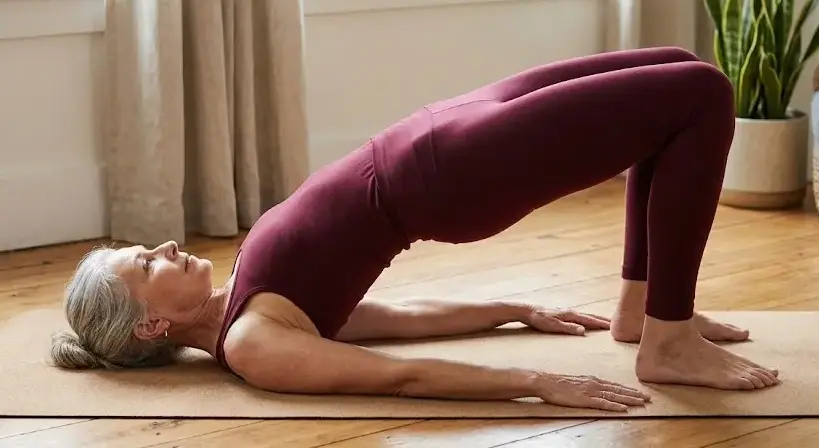
Yoga for seniors refers to a structured, low-load movement system designed to maintain spinal function, joint integrity, and neuromuscular coordination with age. In practice, many routines emphasise flexibility before stability, which alters how load transfers through the spine. For adults practising at home 3–5 mornings per week, this sequencing error results in temporary relief followed by stiffness returning within hours.
Key Takeaways
- Stabiliser activation must precede any spinal movement to prevent stiffness recurrence
- Breath mechanics regulate intra-abdominal pressure and determine spinal support quality
- Sequence structure—not pose selection—defines outcomes in morning routines
- Symptom return within hours indicates load mismanagement, not lack of flexibility
- Activation phases of 5–8 minutes produce more durable results than extended stretching
Why does yoga for seniors fail to reduce recurring stiffness?
Yoga for seniors often fails because stabiliser muscles remain underactive when the spine is first loaded. This creates a mismatch between mobility and control.
Most home routines begin with elongation-based movements that reduce perceived tightness. However, without prior activation of deep stabilisers—specifically the transverse abdominal system and multifidus—the lumbar spine absorbs load passively. For example, a practitioner may complete 15 minutes of stretching and feel immediate ease, but stiffness returns by mid-morning because segmental support was never established.
Common structural errors:
- Stretching before stabiliser activation → increases range without control
- Breath held or shallow → reduces neuromuscular signalling
- Early spinal flexion under low support → shifts load to passive tissues
- Repetition without progression → reinforces inefficient motor patterns
The issue is not intensity but sequence logic.
What stabilisation components are missing in most routines?
Yoga for seniors requires a defined activation phase before any spinal movement begins. This phase is often skipped or compressed.
Stabilisation depends on three coordinated components:
| Component | Function | Measurable Indicator | Application Context |
| Deep core activation | Segmental spinal support | Ability to maintain neutral spine under slow movement | Early morning routines at home |
| Breath-pressure regulation | Intra-abdominal pressure control | Consistent nasal breathing without rib flare | Low-load transitions |
| Motor pattern priming | Neural readiness for load | Smooth, controlled initiation of movement | First 5–7 minutes of practice |
For example, in clinical movement settings for adults aged 40–60 with non-specific stiffness, activation phases lasting 5–8 minutes reduce symptom recurrence more effectively than longer stretching phases.
Without these components, movement becomes compensatory rather than controlled.
How should the sequence be restructured for morning spinal loading?
Yoga and seniors require a sequence that delays spinal loading until stabilisation is established.
A corrected structure follows a three-phase model:
- Neurological Priming (3–5 minutes)
Slow, controlled breathing with minimal movement.
Example: maintaining neutral spine while coordinating inhale–exhale cycles without visible rib lift. - Stabiliser Activation (5–7 minutes)
Low-range movements with strict control.
Example: small-range limb movements while maintaining trunk stability—no visible spinal shift. - Progressive Loading (10–15 minutes)
Gradual introduction of larger ranges.
Example: controlled transitions where spinal movement occurs only after stability is maintained.
This sequencing ensures that load is distributed through active support systems rather than passive structures.
What role does breath mechanics play as a neurological primer?
Yoga for seniors depends on breath as a regulatory mechanism, not a relaxation tool.
Breath directly influences intra-abdominal pressure, which stabilises the spine before movement begins. When breathing is shallow or chest-dominant, pressure is insufficient, and stabilisers fail to engage.
Breath mechanics comparison:
| Pattern | Pressure Control | Spinal Stability | Outcome During Practice |
| Shallow chest breathing | Low | Unstable | Early fatigue, stiffness returns |
| Forced deep breathing | Inconsistent | Over-bracing | Reduced mobility |
| Controlled nasal breathing | Stable | Optimal | Sustained support during movement |
For example, maintaining consistent nasal breathing with controlled exhalation increases abdominal pressure by measurable margins, improving spinal support during low-load movement.
This is why breath must precede movement, not accompany it casually.
When does this restructuring work—and when does it not?
Yoga for seniors improves stiffness only when the issue is load mismanagement, not structural pathology.
Works effectively when:
- Stiffness appears within 2–4 hours post-practice
- No sharp or radiating pain is present
- Movement temporarily relieves symptoms
Limited effectiveness when:
- Pain persists regardless of activity level
- Structural degeneration significantly restricts movement
- Neurological symptoms (numbness, tingling) are present
The trade-off is time allocation. A 10-minute activation phase reduces time available for mobility work but produces longer-lasting results. Skipping it creates the opposite outcome—short sessions with short-lived relief.
How do you evaluate whether your current routine is incorrectly structured?
Yoga and seniors require outcome-based evaluation rather than session-based judgment.
Use the following criteria:
- Symptom latency: stiffness returning within 3 hours indicates poor stabilisation
- Movement quality: visible shaking or compensation during slow movement suggests underactivation
- Breath disruption: inability to maintain steady breathing during simple movements indicates poor pressure control
For example, if stiffness returns before midday despite consistent practice, the issue lies in sequence order, not effort level.
A related search context often includes “morning yoga for flexibility,” but flexibility without stabilisation explains why many routines plateau despite consistency.
Conclusion
Yoga for seniors must prioritise stabiliser activation before spinal loading to prevent recurring stiffness. This framework applies directly to home-based morning routines where symptoms return within hours. If your current sequence begins with stretching, it requires restructuring before considering alternatives like chair yoga.
FAQs
Which yoga is best for seniors?
Structured routines that prioritise stabilisation before movement are more effective than flexibility-focused formats.
Can yoga help with high cortisol?
Breath-regulated sequences can support nervous system regulation, but sequence structure determines effectiveness.
Is yoga good for lymph nodes?
Gentle movement supports circulation, but stabilisation sequencing remains the priority for spinal outcomes.
Which yoga is best for IBS?
Low-pressure, breath-controlled routines reduce abdominal strain, but sequence order still governs effectiveness.
Sources
https://www.onemedical.com/blog/exercise-fitness/yoga-for-seniors/
https://www.artofliving.org/in-en/yoga/yoga-sequences-for/yoga-for-senior-citizen
https://www.doyogawithme.com/content/yoga-seniors
https://www.youtube.com/playlist?list=PLdAl5SsVkdoc_Mi9mG8EHpJTtdgji-7Mk
https://www.goodrx.com/health-topic/senior-health/chair-yoga-for-seniors?srsltid=AfmBOoqcXq75GcWLz1ogBwFONE3GuVamJYer06j_4rgg0Z2TScM4xGjo
https://www.healthline.com/health/fitness-exercise/chair-yoga-for-seniors
https://yogawithadriene.com/yoga-for-seniors-slow-and-gentle-yoga/