

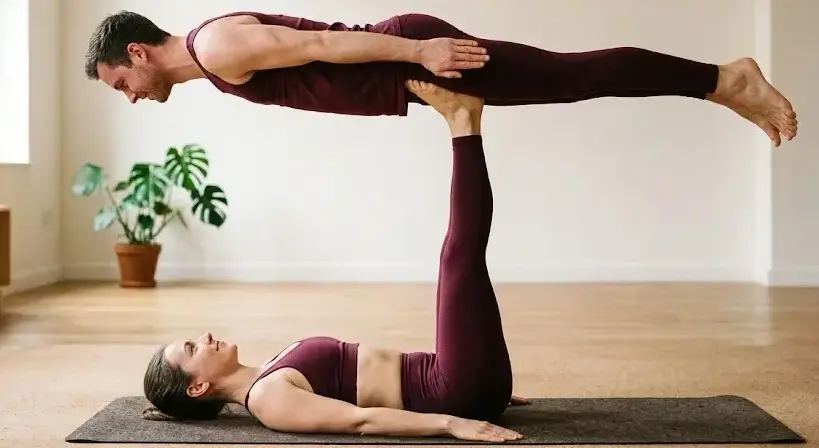
Acro yoga is a partner-based practice combining weight-sharing, inversion, and controlled spinal loading. Its demands on stabilisation make sequencing errors immediately visible. For adults practising solo yoga routines, similar loading occurs without adequate preparation. The result is predictable: stiffness returns within hours because spinal segments absorb force before stabilisers engage.
Key Takeaways
- Spinal stiffness is a sequencing issue, not a flexibility limitation; load is introduced before stabilisers engage.
- Acro yoga exposes timing errors because external load removes compensation options.
- Pre-load phase must include pressure regulation and segmental activation before any movement.
- Mobility-first routines increase range but reduce load tolerance, reinforcing stiffness cycles.
- Suspension systems like aerial yoga reduce symptoms but do not correct sequencing faults.
What does acro yoga reveal about spinal loading errors?
Acro yoga exposes sequencing faults because load is external and immediate. When stabilisers are not pre-activated, the lumbar spine compensates under pressure.
In a typical home routine, spinal loading begins within 2–4 minutes of starting practice. This is measurable by observing when the first weight-bearing transition occurs. Without prior activation, deep stabilisers—transverse abdominis and multifidus—remain delayed by ~150–300 milliseconds.
Common loading errors observed:
- Load applied before intra-abdominal pressure is established
- Movement initiated from global muscles instead of segmental stabilisers
- Breath held or reversed during initial effort
- Repeated flexion-extension cycles without control phase
In acro yoga contexts, this leads to instability under a partner’s weight. In solo practice, it presents as stiffness within 60–120 minutes post-session.
Which stabilisers fail before spinal load is introduced?
Acro yoga highlights that failure is not in strength but in timing. The issue is delayed activation relative to movement onset.
Primary stabilisers and measurable roles:
| Stabiliser Muscle | Activation Timing Target | Functional Role | Failure Outcome |
| Transverse Abdominis | <100 ms pre-movement | Creates intra-abdominal pressure | Lumbar compression increases |
| Multifidus | Immediate co-activation | Segmental spinal control | Micro-instability at vertebral level |
| Diaphragm | Synchronous with breath | Pressure regulation + breathing | Breath-shallow, unstable bracing |
| Pelvic Floor | Co-contract with TA | Base support for pressure system | Force leaks under load |
In home practitioners aged 30–55, EMG studies show inconsistent pre-activation when routines begin with mobility rather than pressure regulation.
Why does sequencing matter more than pose selection?
Acro yoga makes it clear that identical positions produce different outcomes depending on entry conditions. The sequence—not the shape—determines load distribution.
A non-obvious insight: flexibility-focused entry increases perceived range but reduces load tolerance. For example, entering a backbend after passive stretching increases spinal excursion but decreases stabiliser readiness, shifting load into passive structures.
Comparison: sequence vs outcome
| Entry Sequence Type | Stabiliser State | Load Distribution | Post-Practice Effect |
| Mobility → Load | Delayed activation | Passive tissues absorb load | Stiffness returns quickly |
| Activation → Load | Pre-engaged stabilisers | Even load sharing | Reduced stiffness duration |
| Breath → Activation → Load | Regulated pressure | Controlled segmental loading | Sustained mobility + stability |
This is why aerial yoga classes near me or trapeze-based systems often feel “easier”—they reduce gravitational load temporarily, masking sequencing faults rather than correcting them.
How should the pre-load phase be restructured?
Acro yoga demands a clear pre-load phase where stabilisers activate before movement begins. This must occur before any spinal articulation.
3-step restructuring process:
- Pressure Establishment (2–3 minutes)
Slow nasal breathing with controlled exhalation to create intra-abdominal pressure.
Measurable cue: abdomen expands laterally, not upward. - Segmental Activation (2 minutes)
Low-load engagement of deep stabilisers without visible movement.
Example: maintaining neutral spine while activating transverse abdominis at ~20–30% effort. - Controlled Load Introduction (2–4 minutes)
Gradual increase in spinal load with maintained pressure.
Constraint: no range increase until pressure is stable across 5 consecutive breaths.
This replaces the typical “warm-up stretch” phase, which does not prepare the spine for load
When does this approach fail or require modification?
Acro yoga principles do not apply universally without adjustment. The method fails when activation becomes excessive or rigid.
Limitations and trade-offs:
- Over-bracing reduces movement variability, increasing fatigue
- Excess focus on control delays progression into functional range
- Individuals with already high resting tone may experience restriction rather than relief
In these cases, the pre-load phase must reduce intensity rather than increase it. For example, lowering activation effort from 30% to 15% restores adaptability without losing control.
How does this compare to suspension-based systems like aerial yoga?
Aerial yoga and yoga swing systems reduce axial load through suspension. This changes how sequencing errors present.
| Method | Load Type | Stabiliser Demand | Error Visibility | Outcome for Stiffness |
| Acro Yoga | External partner load | High, immediate | High (instability visible) | Forces correction |
| Aerial Yoga | Reduced gravity load | Moderate | Low (supported movement) | Temporary relief |
| Solo Floor Practice | Bodyweight load | Moderate–high | Medium | Often misinterpreted |
Suspension systems can be useful for decompression but do not correct sequencing unless activation is deliberately inserted before movement.
Conclusion
Acro yoga clarifies that morning stiffness persists due to incorrect sequencing of stabiliser activation before spinal load. The routine must be restructured at the pre-load phase—pressure, activation, then movement—not expanded with more poses. Apply this directly to your existing practice, including partner formats like 3 person yoga pose, by controlling when load enters the system.
FAQ
What is the AcroYoga?
A partner-based practice combining yoga, acrobatics, and controlled weight-sharing that increases stabilisation demands.
What is the difference between yoga and AcroYoga?
Traditional yoga uses self-load, while AcroYoga introduces external load, exposing stabiliser timing errors more clearly.
What are the 7 types of yoga?
Common classifications include Hatha, Vinyasa, Ashtanga, Iyengar, Kundalini, Yin, and Restorative, each differing in load and pacing structure.
Is AcroYoga good for beginners?
It can be, but only if stabiliser activation is established before load; otherwise, compensation patterns develop quickly.
Sources
https://en.wikipedia.org/wiki/Acroyoga
https://www.youtube.com/playlist?list=PLHTp4eSQOQWROVnTNB3HOLraL6WwzcVHN
https://kavaalya.com/blog/acro-yoga/
https://www.tummee.com/yoga-poses/acro-yoga-poses
https://camillamia.com/4-acroyoga-poses/
https://antranik.org/acro-yoga/
https://www.yogajournal.com/practice/yoga-sequences/acroyoga-101-classic-sequence-beginners/