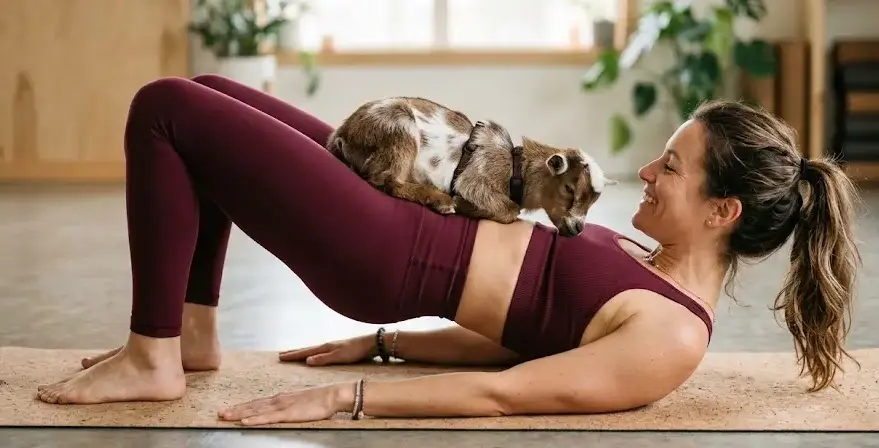
Goat yoga is a group practice where participants perform yoga movements while small goats move freely across the body and mat. The added variable is not intensity but instability—external, unregulated load applied to an unprepared system. For adults already experiencing recurring morning stiffness, this shifts the problem from mobility limitation to stabiliser timing failure.
Key Takeaways
- Goat yoga introduces unpredictable spinal loading, not increased intensity
- Stabiliser activation must precede any external load to prevent stiffness recurrence
- Breath length (≥4 seconds exhalation) is a measurable control marker
- Sequence structure—not pose selection—determines outcome
- Variable-load formats should be applied only after baseline control is established
Why does goat yoga increase stiffness despite movement?
Goat yoga increases spinal loading variability before stabilisers are active, which leads to compensatory tension rather than controlled movement.
In a standard home routine, loading is predictable. In yoga with goats, load is intermittent and asymmetrical. A 4–6 kg goat stepping onto the lower thoracic region introduces sudden compression without pre-activation of deep stabilisers.
Observed pattern in home practitioners (30–55 age group):
- Stiffness returns within 1–2 hours post-session
- Increased reliance on lumbar extensors during transitions
- Reduced control during slow spinal flexion under load
This is not a flexibility issue. It is a sequencing issue—stabilisers are introduced after load instead of before.
Which stabilisers fail under unpredictable external load?
Goat yoga exposes underactivation of deep stabilisers responsible for segmental control, not global movement.
Primary structures affected:
- Transversus abdominis → fails to regulate intra-abdominal pressure under sudden load
- Multifidus → delayed activation reduces segmental spinal control
- Pelvic floor → inconsistent engagement under reflexive response
- Diaphragm → breath becomes reactive instead of regulatory
Measurable indicator:
If exhalation length drops below 4 seconds during unexpected load (e.g., goat contact), stabilisation is not maintained.
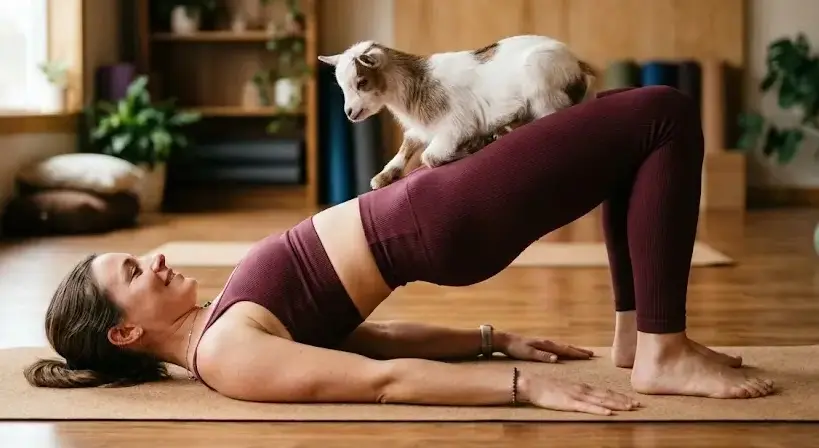
In baby goat yoga, the load is lighter (2–3 kg), but the unpredictability remains. Reduced weight does not eliminate sequencing failure.
How does breath sequencing regulate spinal loading?
Goat yoga becomes structurally manageable only when breath is used as a neurological primer before any load is introduced.
A controlled exhalation activates the deep stabiliser system through intra-abdominal pressure regulation. Without this, external load transfers directly to passive structures.
Application sequence (pre-loading protocol):
- 5–6 controlled exhalations (4–6 seconds each) in a neutral spine
- Maintain abdominal tension at ~20–30% contraction (not maximal bracing)
- Introduce movement only after breath rhythm stabilises
- Sustain exhalation during any external contact (e.g., goat stepping on torso)
Contrast with common behaviour:
In puppy yoga, participants often hold breath during interaction. This creates rigidity, not stability, and shifts load to the lumbar spine.
Where does routine sequencing break down in practice?
The failure point in goat yoga is the transition from passive positioning to active loading without stabiliser preparation.
Most home practitioners follow this order:
- Stretching or passive mobility
- Immediate loading (movement or external interaction)
- Late stabiliser engagement
This sequence is structurally incorrect.
Corrected sequence logic:
| Phase | Timing | Function | Outcome |
| Stabiliser activation | First 3–5 minutes | Establish intra-abdominal pressure | Prepares spine for load |
| Controlled movement | Next 5–10 minutes | Introduce low-load motion | Maintains stability |
| Variable load (goat interaction) | Final phase | Apply unpredictable forces | Tests control, not creates it |
The sequence—not the movement—determines whether stiffness resolves or returns.
When does goat yoga work and when does it fail?
Goat yoga is effective only when used as a variability layer after control is established. It fails when used as the primary stimulus.
Operational boundaries:
- Works when:
- Stabiliser activation precedes all movement
- External load is introduced progressively
- Breath remains controlled under interaction
- Fails when:
- Used as a substitute for structured practice
- Performed immediately after waking without preparation
- Treated as passive stretching with distraction
Trade-off:
The variability introduced by goats improves reflexive control but reduces precision. This makes it unsuitable as a primary method for individuals with unresolved stabiliser deficits.
How should you restructure your morning routine?
Goat yoga should be repositioned as the final phase of a sequence, not the starting point.
Practical redesign for home practitioners:
- Begin with breath-led stabiliser activation (3–5 minutes)
- Introduce controlled, low-load spinal movement
- Add variability (e.g., yoga with goats) only after control is consistent
- End session before fatigue reduces stabiliser response timing
Non-obvious insight:
Stiffness returning after practice is not due to insufficient stretching—it indicates stabilisers were bypassed before loading occurred.
Related context: Practices like animal-assisted formats (e.g., cat or puppy yoga) follow similar interaction patterns, but only goat-based formats introduce vertical loading on the spine, making sequencing more critical.
Conclusion
Goat yoga requires stabiliser activation before any external load to prevent recurring stiffness. The correct application places it at the end of a sequence where control is already established. For home practitioners managing morning stiffness, restructuring this order is more effective than modifying intensity or duration—even when compared to formats like hot yoga.
FAQ
What is goat yoga good for?
It introduces variable external load, which can improve reflexive stabilisation if foundational control is already present.
Which yoga is best for diabetic patients?
Structured, low-intensity routines focusing on consistency and metabolic regulation are typically recommended over variable-load formats.
What is goat yoga called?
It is commonly referred to as goat yoga or animal-assisted yoga involving goats.
What is the origin of goat yoga?
It began in the United States as a farm-based group activity combining movement practice with animal interaction.
Sources
https://www.kidsyogastories.com/goat-yoga/
https://www.npr.org/sections/goatsandsoda/2018/09/03/643470824/goat-yoga-is-preposterous-says-goat-yoga-teacher-it-s-also-terrific
https://www.theguardian.com/lifeandstyle/shortcuts/2018/dec/03/goat-yoga-the-greatest-of-all-time-or-a-passing-fad
https://ashleyflowersyoga.com/2017/08/03/goat-yoga/
https://www.humnutrition.com/blog/goat-yoga/