
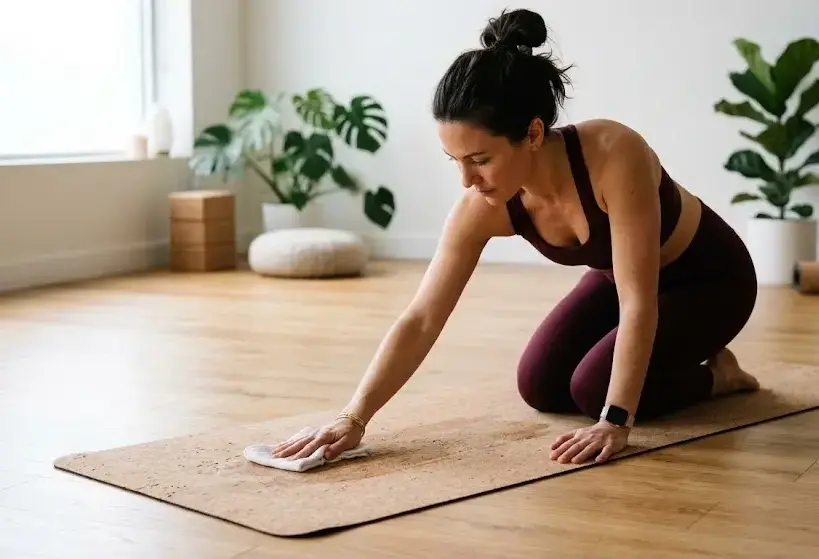
How to clean a yoga mat refers to the controlled removal of sweat residue, oils, and particulate matter without altering the mat’s friction coefficient or structural integrity. This matters because early-morning spinal loading depends on stable ground contact. If the surface becomes inconsistent, stabiliser recruitment patterns shift, and stiffness returns despite correct movement sequencing.
Key Takeaways
- Surface friction consistency directly affects stabiliser activation during early loading phases
- Sweat salts and oil residue are primary disruptors of grip, not visible dirt
- Cleaning must include a residue removal step to avoid film-based instability
- Optimal frequency is light daily maintenance plus weekly structured cleaning
- Surface preparation should occur before practice to support neuromuscular sequencing
What does cleaning a yoga mat actually regulate in practice?
How to clean a yoga mat determines the friction consistency under load, which directly influences how force transfers through the hands and feet during early activation phases. Surface instability forces compensatory gripping, increasing global muscle dominance instead of local stabiliser engagement.
Three measurable variables define this:
| Variable | Clean Mat (Controlled Surface) | Poorly Cleaned Mat (Residue Present) | Overcleaned Mat (Degraded Surface) |
| Friction consistency | Stable across full contact | Patchy grip zones | Slippery or uneven |
| Load distribution | Even across limbs | Shifts to dominant side | Micro-sliding under pressure |
| Stabiliser activation | Localised, efficient | Delayed or bypassed | Overcompensated globally |
In a home setting, this becomes visible when palms subtly slide during initial weight-bearing, forcing shoulder bracing instead of controlled engagement.
Which contaminants interfere most with mat performance?
How to clean a yoga mat begins with identifying what disrupts its surface, not applying generic cleaning routines. Sweat salts and skin oils are the primary destabilisers because they alter surface texture at a microscopic level.
The most relevant contaminants:
- Salt residue (post-sweat crystallisation)
Forms a thin abrasive layer that reduces uniform grip. Common in humid climates or high-sweat morning sessions. - Sebum (skin oil accumulation)
Creates slick patches, especially where hands and feet repeatedly load. - Dust adhesion to moisture film
Builds uneven friction zones. Frequently observed in floor-based home practice areas. - Cleaning agent residue (improper rinsing)
Leaves a film that mimics oil, even when the mat appears clean.
In practical terms, a practitioner in a warm indoor environment practising 4 mornings per week will accumulate measurable grip inconsistency within 5–7 days if the mat is only wiped superficially.
What is the correct cleaning process that preserves grip?
How to clean yoga mat effectively requires sequencing the cleaning process so that residue is removed without saturating or degrading the material.
Structured method (used in studio hygiene protocols):
- Dry removal phase (pre-clean)
Wipe with a dry cloth to remove loose particulate matter.
This prevents mud-like smearing during wet cleaning. - Diluted cleaning phase (controlled solution)
Use a mild solution (water + minimal soap or vinegar dilution at ~1:20 ratio).
Avoid concentrated agents; they alter surface chemistry. - Distributed application (no soaking)
Apply with a damp cloth, not direct pouring.
Target high-contact zones (hands, feet). - Residue extraction (critical step)
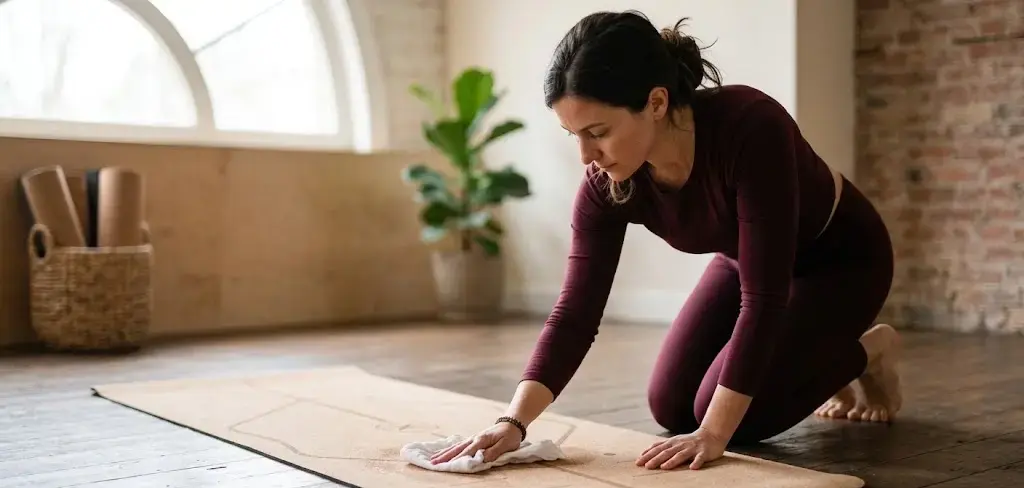
Wipe again with clean water to remove cleaning agent film. - Air-dry under tension-free conditions
Lay flat or hang evenly. Avoid folding during drying.
Skipping step 4 is the most common error; it leaves a thin film that reduces grip despite visible cleanliness.
How does cleaning frequency affect spinal loading outcomes?
How to clean a yoga mat is incomplete without defining frequency relative to practice intensity. Cleaning too infrequently or too aggressively both degrade surface performance.
Frequency vs outcome comparison:
| Cleaning Frequency | Surface Outcome | Impact on Morning Practice |
| After every session (light wipe) | Stable, minimal buildup | Consistent stabiliser activation |
| Weekly deep clean | Controlled reset | Maintains friction baseline |
| Infrequent (2–3 weeks) | Residue accumulation | Grip variability, compensation |
| Overcleaning (daily harsh agents) | Material breakdown | Reduced traction, instability |
A practitioner doing short daily sessions benefits from light daily maintenance + weekly structured cleaning, not repeated deep cleaning.
When does standard mat cleaning fail to solve instability?
Sanitizing yoga mats does not resolve instability when the issue originates from sequencing errors rather than surface conditions. A clean mat cannot compensate for incorrect activation order.
This method works when:
- Surface slippage is visibly present
- Hands or feet shift during initial loading
- Grip varies across mat zones
It does not work when:
- Stiffness appears despite stable contact
- Movement begins without breath-regulated activation
- Global muscles engage before local stabilisers
Non-obvious insight:
Many practitioners attribute instability to flexibility limitations when the actual cause is inconsistent surface feedback. However, correcting the surface without correcting sequencing only partially resolves the issue.
How should cleaning integrate into a morning routine redesign?
How to clean a yoga mat becomes structurally relevant when positioned before—not after—practice. Surface preparation is part of the loading sequence, not maintenance.
Implementation framework:
- Phase 1: Pre-practice surface check (30–60 seconds)
Hand press test — detect micro-slippage. - Phase 2: Targeted wipe if needed
Only high-contact zones, not full saturation. - Phase 3: Breath-led activation begins after surface confirmation
Ensures stabilisers engage against a predictable base. - Phase 4: Weekly full cleaning separate from practice time
Avoid fatigue-based shortcuts.
This aligns surface readiness with neuromuscular readiness, preventing early compensatory patterns.
Conclusion
How to clean a yoga mat is a structural input into stabiliser activation, not a hygiene routine. The correct method preserves friction consistency, enabling controlled spinal loading in early practice phases. Apply this framework directly to your morning setup using your existing yoga mat to remove surface-driven instability from the sequence.
FAQs
What is the best way to clean a yoga mat?
Use a diluted cleaning solution, wipe without soaking, and remove all residue with a clean water wipe before air-drying.
Is it OK to use a wet wipe to clean my yoga mat?
Only for temporary surface cleaning; most wet wipes leave residue that reduces grip over time.
Can I clean a yoga mat with dish soap?
Yes, but only in a highly diluted form and always followed by a clean water wipe to prevent film buildup.
How to dry clean a yoga mat?
Use a dry cloth or brush to remove dust and salt residue before any wet cleaning phase.
Sources
https://www.adidas.com/us/blog/612712-how-to-clean-a-yoga-mat
https://www.rei.com/learn/expert-advice/how-to-clean-yoga-mat.html
https://www.nike.com/id/a/how-to-clean-yoga-mat
https://www.drbronner.com/pages/how-clean-yoga-mat
https://ishalife.sadhguru.org/in/how-to-clean-yoga-mat
https://www.reddit.com/r/yoga/comments/11l6krr/how_do_yall_clean_your_mats/