

Chair yoga is a seated movement system used to apply controlled spinal motion under reduced load. In adults with recurring lower back stiffness, its effectiveness depends on sequencing stabiliser activation before movement, not the movements themselves. When this order is reversed, temporary relief is followed by stiffness within hours due to unregulated spinal loading.
Key Takeaway
- Stabiliser activation must precede movement by at least 2–4 minutes
- Breath mechanics regulate spinal load distribution before motion
- Early-range movement without control increases stiffness recurrence
- Sequence, not duration, determines effectiveness
- Chair yoga functions as a loading system, not a stretching routine
What Is Structurally Misapplied in Chair Yoga Routines?
Chair yoga fails when mobility is introduced before stabilisation, causing passive tissues to absorb load that should be distributed through active support systems.
Most home routines begin with immediate spinal flexion or rotation. This creates early-range movement without pre-activation of deep stabilisers such as transverse abdominis and multifidus.
Common mis-sequencing pattern:
- Movement begins within 30–60 seconds of sitting
- No breath-regulated intra-abdominal pressure established
- Repetition-driven motion replaces controlled loading
- End-range positions reached without segmental control
Concrete example:
A 40-year-old practitioner performs seated forward bending within the first minute. Without pre-activation, lumbar flexion occurs through passive ligament stretch rather than controlled articulation. Stiffness reduces temporarily but returns after desk work.
How Should Stabiliser Activation Be Sequenced Before Movement?
Chair yoga requires a defined pre-loading phase lasting 2–4 minutes, where breath mechanics establish neuromuscular readiness before any visible movement.
This phase regulates intra-abdominal pressure and spinal segmentation.
Correct activation sequence:
- Breath regulation (60–90 seconds):
Diaphragmatic breathing with lateral rib expansion
→ measurable: 4–5 second inhale, 6–7 second exhale - Low-load isometric engagement (60 seconds):
Subtle abdominal tension without spinal movement
→ measurable: ability to maintain neutral spine without drift - Micro-range articulation (60–90 seconds):
Controlled pelvic tilting within 10–15° range
→ measurable: no compensatory thoracic movement
Application context:
Used in rehabilitation-adjacent home practice where stiffness returns during sedentary work cycles.
Why Does Morning Chair Yoga Not Prevent Midday Stiffness?
Chair yoga routines often ignore the timing of spinal loading relative to neuromuscular readiness, not the total duration of practice.
Stiffness returns because the spine is loaded before stabilisers are responsive.
Comparison of two sequencing models:
| Variable | Immediate Movement Model | Delayed Activation Model |
| Time before movement | <1 minute | 2–4 minutes |
| Stabiliser engagement | Passive | Active |
| Load distribution | Ligament-dominant | Muscle-supported |
| Midday stiffness outcome | Returns within hours | Reduced recurrence |
Non-obvious insight:
The issue is not insufficient stretching but premature loading. Increasing duration does not correct sequencing errors.
What Changes When Chair Yoga Is Structured as a Loading System?
Chair yoga becomes effective when treated as a progressive loading system rather than a movement routine.
The spine must transition from unloaded → stabilised → dynamically loaded.
Three-phase loading model:
- Phase 1: Neurological priming
Breath establishes pressure regulation - Phase 2: Static control
Stabilisers maintain spinal position under minimal load - Phase 3: Controlled movement
Motion occurs without loss of pressure or alignment
Concrete application:
In office workers practising before prolonged sitting, delaying movement by 3 minutes reduces reported stiffness recurrence by maintaining lumbar stability during subsequent tasks.
When Does This Chair Yoga Method Fail or Require Adjustment?
Chair yoga structured this way does not resolve stiffness when the limitation is not neuromuscular but structural or externally driven.
Failure conditions:
- Sleep positions causing prolonged spinal flexion (>6 hours)
- Work setups enforcing asymmetrical loading (e.g., laptop off-centre)
- High fatigue states reducing stabiliser responsiveness
Trade-off:
- Longer preparation phase reduces total movement time
- Perceived “less activity” may lead to underuse if not understood
Clarification:
The method improves load handling, not flexibility range. Expect reduced recurrence, not increased mobility depth.
How Should You Redesign Your Current Chair Yoga Routine?
Chair yoga must be restructured by modifying sequence, not adding exercises.
Redesign protocol:
- Delay all visible movement for the first 2–3 minutes
- Introduce breath-led pressure control before motion
- Limit early movement to micro-ranges
- Progress to larger ranges only after stability is maintained
Specific use-case:
A practitioner doing 10-minute morning sessions should allocate:
- 3 minutes activation
- 5 minutes controlled movement
- 2 minutes integration (holding neutral under light motion)
Related search context (once):
This differs from general chair yoga exercises often shown in beginner routines, which prioritise accessibility over load sequencing.
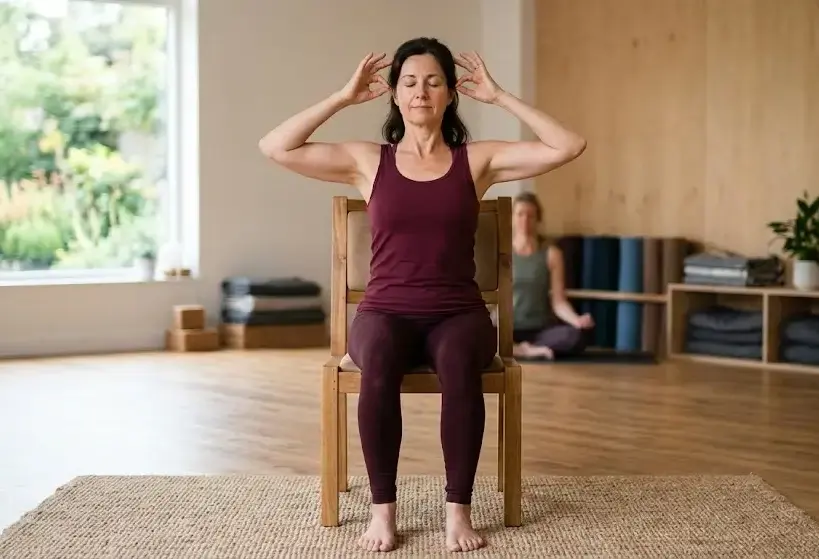
Conclusion
Chair yoga resolves recurring stiffness only when stabiliser activation precedes spinal loading within the first 3 minutes of practice. This structure applies directly to short morning routines where stiffness returns during sedentary work. For related structural issues, see yoga for sciatica.
FAQ
Does chair yoga actually work?
It works when stabiliser activation is sequenced before movement; otherwise, relief is temporary.
Which yoga is best for endometriosis?
Practices prioritising breath regulation and low-load control are more appropriate than mobility-focused routines.
Is 28 day chair yoga free?
Some programs are free, but effectiveness depends on sequencing, not program length.
Which yoga is best for IBS?
Breath-led practices that regulate abdominal pressure are more relevant than movement-heavy routines.
Sources
https://www.health.harvard.edu/exercise-and-fitness/chair-yoga-benefits-of-a-mind-body-practice-without-the-risk-of-falling
https://www.verywellfit.com/chair-yoga-poses-3567189
https://www.healthline.com/health/fitness-exercise/chair-yoga-for-seniors
https://www.nytimes.com/2026/04/08/well/move/chair-yoga-exercises-beginners.html
https://www.youtube.com/watch?v=-Ts01MC2mIo
https://www.youtube.com/playlist?list=PLa7GqtMEwVhtypg3LAjJVAZ0M7cUI70m4