
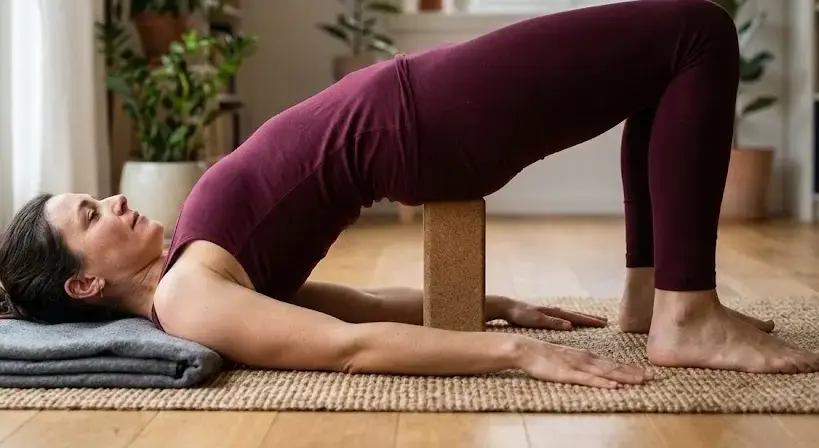
Yoga for sciatica refers to the structured application of movement and breath to reduce neural irritation and mechanical strain along the sciatic pathway. In home practitioners, recurring stiffness after practice indicates a sequencing fault—specifically, spinal movement layered onto an unprepared stabilisation system. The issue is not insufficient stretching but premature loading of the lumbar spine without neuromuscular preparation.
Key Takeaways
- Stabiliser activation must precede spinal movement to prevent recurring stiffness.
- Early stretching reduces support structures and increases lumbar load later in the day.
- Breath regulation sets neurological tone; measurable exhalation control improves stability.
- Sequence, not pose selection, determines whether relief persists.
- Immediate flexibility gains often trade off against long-term load tolerance.
What defines yoga for sciatica at a structural level?
Yoga for sciatica operates as a load-management system rather than a mobility routine. The defining variable is when spinal movement occurs relative to stabiliser activation.
A typical plateau case: a 42-year-old practitioner performs forward bends within the first 5 minutes of practice. Lumbar flexion occurs before deep stabilisers—transverse abdominis and multifidus—are engaged. The result is temporary decompression followed by rapid stiffness return within 2–3 hours.
Structural components:
| Component | Function | Measurable Indicator |
| Stabiliser activation | Prepares spine for load | Ability to maintain neutral spine under slow movement |
| Breath regulation | Modulates nervous system tone | Exhalation length ≥ inhalation by 1–2 seconds |
| Load sequencing | Determines stress distribution | Spinal flexion introduced after activation phase |
Without these three components aligned, flexibility work increases strain variability instead of reducing it.
Why does stiffness return after morning practice?
Yoga for sciatica fails when movement is prioritised over control. The nervous system interprets early spinal loading as instability, triggering protective tightening.
In practitioners doing gentle yoga stretches for lower back and sciatica, the issue is not intensity but timing. For example, stretching hamstrings early reduces posterior chain tension temporarily but removes passive support from the pelvis. Without active stabilisation, the lumbar spine absorbs more load during daily tasks like sitting or walking.
Common sequencing error pattern:
- Begin with spinal flexion (forward folds)
- Follow with passive stretches
- Introduce stabilisation too late or not at all
This sequence reverses the required order. Stabilisation must precede movement to maintain load distribution.
How should stabiliser activation be sequenced first?
Yoga poses for sciatica pain relief only become effective when preceded by a defined activation phase lasting 3–6 minutes.
The objective is not strength but neuromuscular readiness—low-load, high-awareness engagement.
Activation sequence (pre-movement phase):
- Supine diaphragmatic breathing
- Target: rib cage expansion without spinal movement
- Measurable: 6–8 controlled breaths with stable pelvis
- Abdominal bracing (low intensity)
- Target: 20–30% contraction of core without breath holding
- Measurable: able to speak a full sentence while maintaining tension
- Segmental pelvic control
- Target: isolate pelvic tilt without lumbar collapse
- Measurable: smooth transitions across 5–8 repetitions
This phase establishes baseline stability before any spinal motion. Without it, even beginner yoga exercises for sciatica nerve pain reinforce instability patterns.
What is the correct order of morning spinal loading?
Yoga for sciatica becomes structurally effective when spinal loading follows a progression from stable to dynamic.
Correct sequence model:
| Phase | Duration | Purpose | Application Example |
| Activation | 3–6 min | Stabiliser engagement | Supine breath + bracing |
| Controlled mobility | 5–8 min | Low-load movement | Slow spinal articulation |
| Loaded movement | 5–10 min | Functional integration | Standing transitions |
| End-range work | Optional | Flexibility exposure | Only if stability maintained |
Contrast this with common routines where end-range work appears in the first phase. That inversion explains why relief is short-lived.
A practical case: office workers practicing at 6 AM report stiffness by 10 AM. When activation is extended to 5 minutes and forward bending delayed until minute 12, stiffness duration reduces significantly because load tolerance improves.
When does this method fail or require modification?
Yoga for sciatica structured around activation sequencing does not resolve all presentations. It is limited when structural pathology dominates over motor control.
Failure conditions:
- Persistent radiating pain below the knee during activation phase
- Loss of motor control in foot or ankle (e.g., foot drop)
- Pain triggered even in neutral spine positions
In these cases, sequencing alone is insufficient because neural compression or disc pathology may require clinical intervention.
Trade-off:
Delaying stretches may initially feel less relieving. However, immediate relief is replaced by sustained stability. This shift prioritises load tolerance over temporary decompression.
How do you redesign your current routine effectively?
Yoga for sciatica improvement depends on restructuring the first 10 minutes—not adding more poses.
Redesign framework:
- Remove all early spinal flexion from minutes 0–8
- Insert a fixed activation block (minimum 3 minutes)
- Delay flexibility work until stabilisation is established
- Monitor stiffness return time post-practice (target: extension beyond 4–6 hours)
This aligns with patterns seen in those searching for yoga for sciatica beginners, where initial routines lack structural sequencing rather than effort or consistency.
Related context (used once):
Similar sequencing principles appear in mobility protocols for nerve tension, often searched alongside “sciatic nerve glides,” where movement is introduced only after baseline control is established.

Conclusion
Yoga for sciatica must be treated as a sequencing problem: activation precedes movement, not the reverse. This framework applies directly to morning home routines where stiffness returns within hours. For comparison with digestive-system sequencing approaches, see yoga for constipation.
FAQs
Can you fix sciatica with yoga?
It can reduce symptoms when the issue is load mismanagement, but not when structural compression is present.
What vitamin deficiency causes sciatica?
Vitamin B12 deficiency can affect nerve health, but it is not a primary cause of mechanical sciatica.
What is the number one exercise for sciatica?
No single exercise is effective without correct sequencing; stabiliser activation is the priority phase.
Is yoga good for L4 L5 disc bulge?
It can help manage load if movements are controlled and introduced after stabilisation.
Sources
https://www.healthline.com/health/yoga-for-sciatica
https://www.ibji.com/blog/back-spine/sciatica-pain-relief/
https://yogainternational.com/article/view/7-poses-to-soothe-sciatica/
https://www.nhs.uk/live-well/exercise/exercises-sciatica-problems/
https://www.instagram.com/reel/DNX-dKYI2lk/
https://manflowyoga.com/blog/yoga-for-sciatica/
https://www.spine-health.com/blog/best-yoga-poses-sciatica-relief