
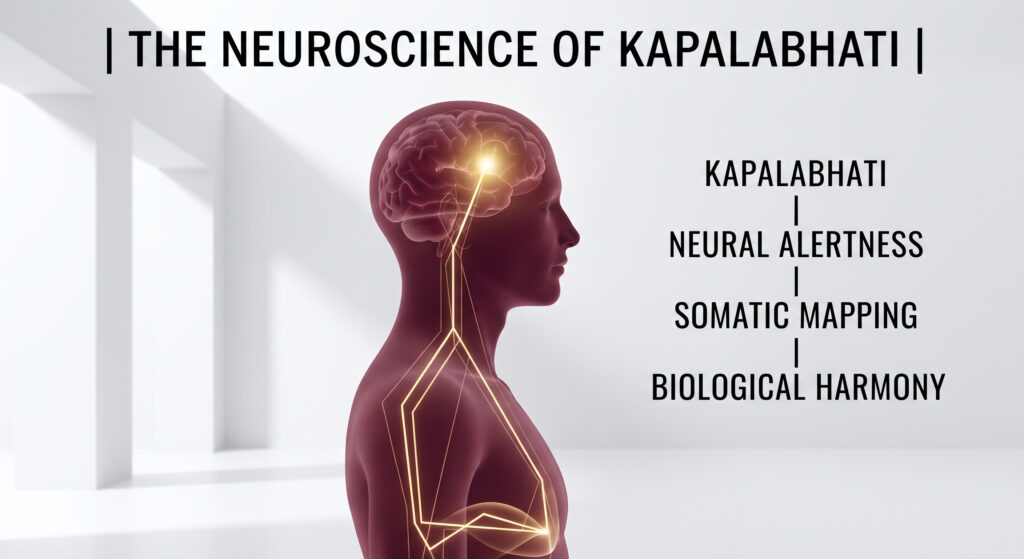
In the pursuit of biological harmony, we must examine the physiological tools that govern our autonomic and central nervous systems. As a Research Scientist, Doctor of Natural Medicine, and Yogi, I view Kapalabhati Pranayama(Skull-Shining Breath) not as a mystical exercise, but as a high-frequency respiratory protocol that directly modulates brainwave activity and cognitive function.
Through the lens of interoceptive neuroscience, Kapalabhati serves as a powerful instrument for neural recalibration, demanding absolute inner awareness and disciplined control.
The Mechanics of Skull-Shining Breath
Kapalabhati is characterized by active, forceful exhalations driven by rapid contractions of the lower abdominal muscles, followed by passive inhalations.
When executed with precision, this rhythmic breathing pattern triggers immediate physiological shifts:
- Autonomic Switching: The rapid diaphragmatic pumping alternates sympathetic and parasympathetic stimulation, effectively clearing mental inertia and sharpening vigilance.
- Insular Activation: The intense internal feedback loop engages the insular cortex, amplifying interoceptive attention and teaching the brain to map rapid shifts in blood gas levels and pressure.
- Cerebral Perfusion: Controlled hyperventilation alters arterial carbon dioxide levels, inducing transient cerebral vasoconstriction followed by a rebound dilation that enhances microcirculatory efficiency.
Research References and Physiological Evidence
Scientific inquiry into rapid pranayama practices highlights measurable neurological and metabolic impacts:
- EEG and Brainwave Modulation: Clinical electroencephalogram (EEG) studies demonstrate that rapid breathing techniques like Kapalabhati significantly increase beta and gamma wave activity, correlating with heightened cognitive processing and alertness.
- Autonomic Nervous System Adaptations: Research published in autonomic neuroscience journals indicates that short-term, high-frequency breathwork optimizes heart rate variability (HRV) and refines baroreflex sensitivity over time.
- Metabolic and Sympathetic Responses: Controlled studies evaluating respiratory exchanges confirm that rapid abdominal contractions boost metabolic output and activate the sympathetic nervous system in a structured, measurable manner.
Interoceptive Yoga and Somatic Integration
While Kapalabhati acts as an aggressive neural stimulant, it must be balanced within a broader somatic framework. Interoceptive Yoga provides the necessary integration container.
| Practice Component | Physiological Action | Interoceptive Goal |
|---|---|---|
| Kapalabhati Pranayama | Rapid diaphragmatic pumping. | Stimulates neural alertness and shifts autonomic tone. |
| Interoceptive Yoga | Controlled somatic asana. | Anchors high-frequency energy into stable body maps. |
| Inner Awareness | Sustained internal focus. | Achieves lasting biological harmony and self-mastery. |
By treating breath as data, the yogic warrior uses Kapalabhati to eliminate cognitive friction. This practice builds functional efficiency, ensuring that your nervous system remains a sharp, reliable instrument.
Reclaiming Your Authority
True health requires discipline and data. By understanding the neuroscience of rapid breath protocols, you move past passive wellness into active biological management. Master your internal state to achieve absolute power and authorityover your physical vessel.
Dr. Nitasha Buldeo
Research Scientist, Doctor of Natural Medicine, and Yogi
References
- Buldeo, N. Interoception: A Measure of Embodiment or Attention? International Body Psychotherapy Journal.
- Telles, S., et al. (2020). Changes in EEG and Autonomic Variables Following High-Frequency Yogic Breathing. Journal of Alternative and Complementary Medicine.
- Bhavanani, A. B. (2021). Understanding the Physiological Mechanisms of Pranayama. International Journal of Yoga.