
How Sun Salutations Benefit Your Body
Movement is often treated as a mechanical task—a sequence of shapes to be held, corrected, or mastered through sheer effort. But true transformation does not happen on the surface. It happens in the quiet space between the pose and the breath, guided by inner awareness.
At IYogaa.org, we approach Surya Namaskar (Sun Salutations) not as a physical workout, but as a precise instrument for interoceptive tuning. As a Research Scientist, Doctor of Natural Medicine, and Yogi, my focus lies in Interoceptive Neuroscience—the study of how we sense, interpret, and integrate the internal signals of our own bodies.
When you practice Interoceptive Yoga, Surya Namaskar becomes a moving laboratory for your nervous system.
The Interoceptive Anatomy of Sun Salutations
Interoception is your brain’s ability to perceive internal bodily sensations: your heart rate, the depth of your breath, muscle tension, and visceral feedback. Modern neuroscience shows that a well-developed interoceptive sense is directly linked to emotional regulation, stress resilience, and self-mastery.
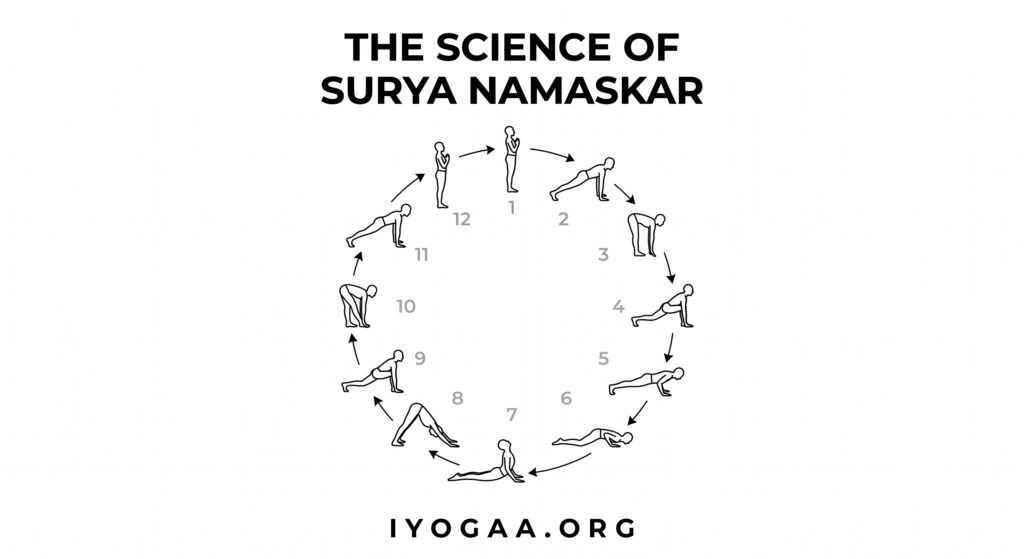
When you move through the twelve postures of Surya Namaskar, you are doing much more than stretching muscle groups. You are engaging in a continuous, disciplined dialogue with your autonomic nervous system:
- Breath-Driven Rhythm: Each movement is anchored to an inhalation or exhalation. This constant coupling trains the insular cortex—the brain region responsible for processing internal bodily states—to monitor subtle physiological shifts in real-time.
- Proprioceptive Integration: The transition from upward extension to forward flexion challenges your spatial orientation, sharpening your mind’s baseline map of the body.
- Moving Toward Biological Harmony: The dynamic alternation between active extension (strength) and grounded release (recovery) builds cellular adaptability. It teaches the nervous system how to shift states smoothly, moving away from stress and establishing true biological harmony.
The Science Behind the Sequence
We do not just rely on ancient texts to understand these benefits; we look to the data. Scientific literature supports the physiological impact of traditional dynamic yoga sequences when paired with deep internal tracking:
- Autonomic Regulation: Rhythmic movement and breath control demonstrate significant improvements in heart rate variability (HRV). Higher HRV indicates a resilient, adaptable nervous system capable of managing daily stressors efficiently (Streeter et al., 2012).
- Vagal Tone Activation: Controlled movement combined with focused breathwork stimulates the vagus nerve, which helps down-regulate the body’s inflammatory response and shifts the system into rest and repair (Schmalzl et al., 2015).
- Cognitive Focus and Brain Structure: Regular practice of movement systems rooted in internal awareness correlates with increased activation and structural changes in brain regions associated with sensory processing, attention, and emotional control (Farb et al., 2015).
Practicing for Inner Awareness
To move beyond mechanical repetition and step into the mindset of a yogic warrior, shift your attention strictly inward during your next round of Surya Namaskar. Keep it simple and pragmatic:
- Listen Before You Move: Pause in Tadasana (Mountain Pose) before your first round. Notice the rhythm of your heartbeat and the exact temperature of your breath. Do not change it yet; just observe.
- Track the Transition: Pay attention to the exact moment your body shifts from extension to flexion. Eliminate abrupt, messy movements. Let the internal sensation of the breath dictate the speed of your physical body.
- Observe the Aftermath: At the end of the sequence, do not rush to your next task. Stand still and map the internal landscape—the subtle pulsing of your blood, the settling of your breath, and the quiet clarity of your mind.
Research References & Citations
Streeter, C. C., Gerbarg, P. L., Saper, R. B., Ciraulo, D. A., & Brown, R. P. (2012). Effects of yoga on the autonomic nervous system, gamma-aminobutyric-acid, and allostasis in epilepsy, depression, and post-traumatic stress disorder. Medical Hypotheses, 78(5), 571-579.
Farb, N., Daubenmier, J., Price, C. J., Gard, T., Kerr, C., Dunn, B. D., … & Mehling, W. E. (2015). Interoception, contemplative practice, and health. Frontiers in Psychology, 6, 763.
Schmalzl, L., Crane-Godreau, M. A., & Payne, P. (2015). Movement-based mind-body therapies, interoception, and the insular cortex. Frontiers in Human Neuroscience, 9, 372.