
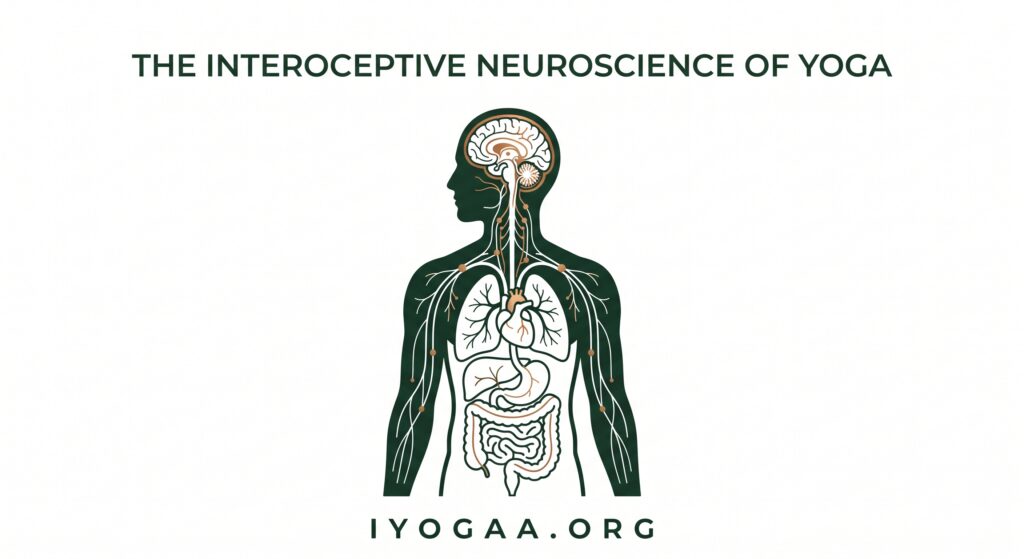
Neuroscience Explains the Real Power of Yoga: An Interoceptive Approach
For decades, the modern fitness world has celebrated yoga primarily for its physical benefits—increased flexibility, enhanced muscle tone, and improved cardiovascular health. While these physical outcomes are valid and measurable, they only scratch the surface of the practice. If you are only practicing yoga to touch your toes, you are missing the most profound transformation the discipline offers: the structural rewiring of your brain.
At IYogaa.org, our practice is rooted in the science of interoception. We do not just look at the physical shapes the body makes; we study the neural pathways those shapes create. From an interoceptive perspective, the real power of yoga is entirely neurobiological.
Interoception and the Insular Cortex
To understand the neuroscience of yoga, we must first understand interoception. Interoception is your brain’s ability to perceive, process, and integrate internal bodily signals. It is how you know your heart is racing, your breath is shallow, your stomach is tense, or your muscles are fatigued.
In the human brain, these vital internal signals are primarily processed in the insular cortex. Modern neuroimaging reveals a fascinating adaptation: individuals who consistently engage in interoceptive practices, like mindful yoga, possess increased cortical thickness in this exact region.
When you hold a challenging posture and consciously slow your breathing rather than holding it, you are actively training your insula. You are teaching your brain to observe physical discomfort without immediately reacting with panic, anxiety, or stress. This builds a robust neurological buffer between a stimulus and your response, fundamentally changing how you handle psychological stress off the mat.
Neuroplasticity and Autonomic Regulation
The human brain is remarkably malleable, a characteristic known as neuroplasticity. Every time you step onto your mat and practice interoceptive yoga, you are firing new neural circuits. Over time, as the neuroscience maxim states: “neurons that fire together, wire together.”
Most of us spend our days trapped in a state of low-grade sympathetic nervous system arousal—the biological “fight or flight” mode. This constant drip of cortisol and adrenaline degrades our physiological health, leading to burnout and chronic inflammation. Interoceptive yoga provides a tool to deliberately manipulate the autonomic nervous system.
By consciously linking our breath to movement, we forcefully engage the parasympathetic nervous system—the “rest and digest” state. This deliberate, repeated shifting trains the brain to become highly adaptable. We learn to down-regulate our nervous system on command, cultivating deep biological resilience that protects against systemic wear and tear.
The Vagus Nerve Highway
The primary biological conduit for this mind-body regulation is the vagus nerve. Wandering from the brainstem down through the chest and into the abdomen, the vagus nerve is the superhighway of interoception.
Clinical research demonstrates that the specific, controlled breathing (Pranayama) and focused physical postures (Asana) practiced in yoga significantly increase vagal tone. High vagal tone correlates with a lower resting heart rate, superior emotional regulation, and a dramatic decrease in systemic inflammation. When you practice with profound internal awareness, you are directly stimulating this nerve, signaling to your brain that the body is safe, secure, and ready to heal.
Applying the Science at IYogaa.org
How do we translate this complex neuroscience into your daily practice? We do it by shifting the primary goal of your movement.
- Prioritize Sensation Over Shape: Do not force your body into a posture just to achieve a specific aesthetic. Move to the edge of sensation and study what happens to your breath and your internal tension.
- Lengthen the Exhalation: Deliberately making your exhalations longer than your inhalations is a biological hack to stimulate the vagus nerve and initiate a parasympathetic response.
- Embrace the Pause: The stillness between movements is not empty space; it is where the nervous system integrates the physical data. Honor the transitions just as much as the poses.
Yoga is not merely an exercise class. It is an applied, precise science of the nervous system. By turning your attention inward, you reclaim control over your neurobiology, one breath at a time.
Research References & Citations
- Villemure, C., Čeko, M., Cotton, V. A., & Bushnell, M. C. (2015). Neuroprotective effects of yoga practice: age-, experience-, and frequency-dependent enlargement of brain structure. Frontiers in Human Neuroscience, 9, 281.
- Sullivan, M. B., Erb, M., Schmalzl, L., Moonaz, S., Noggle Taylor, J., & Porges, S. W. (2018). Yoga therapy and polyvagal theory: The convergence of traditional wisdom and contemporary neuroscience for self-regulation and resilience. Frontiers in Human Neuroscience, 12, 67.
- Meyer, P. B., et al. (2021). The impact of yoga on the autonomic nervous system and emotional regulation: A review of the neurobiological mechanisms. Journal of Clinical Neuroscience, 90, 112-118.