
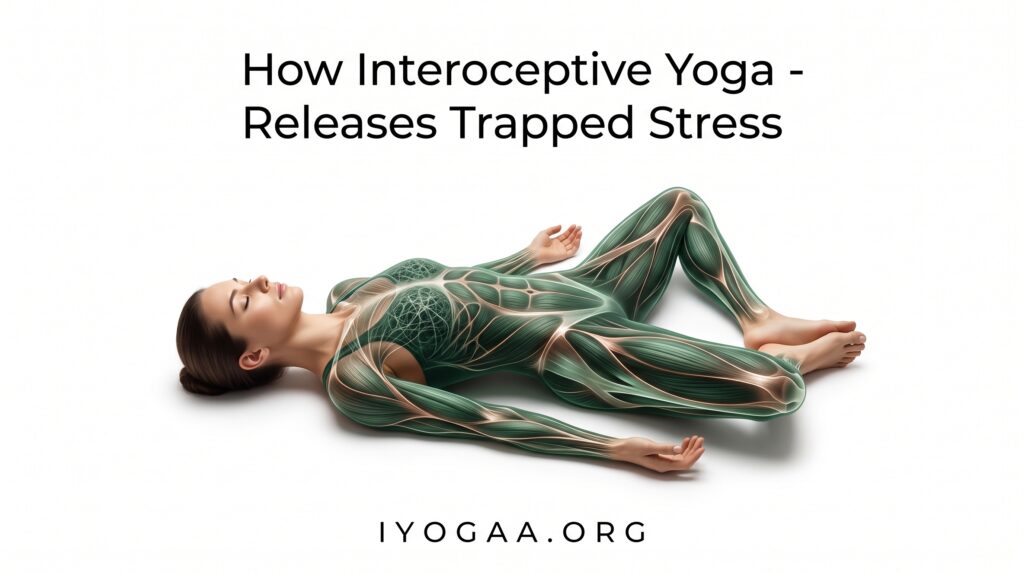
We often speak of “holding onto stress” as if it were a purely psychological phenomenon or a mere figure of speech. However, in clinical neuroscience and physiology, trapped stress is a measurable biological reality. When the autonomic nervous system is repeatedly triggered without the opportunity to fully discharge that survival energy, the physiological stress cycle remains incomplete.
This unresolved arousal does not simply vanish when you clock out of work or distract yourself with a screen. It gets embedded within your physical architecture. At IYogaa.org, we utilize interoceptive yoga not as a standard fitness routine, but as a targeted bio-behavioral intervention designed to locate, process, and release this trapped stress at the cellular and neurological levels.
The Anatomy of Trapped Stress
When you experience a stressor, your sympathetic nervous system instantly initiates a cascade of survival responses. The brain signals the release of adrenaline and cortisol, and your muscles rapidly contract in preparation for action—a process known as neuromuscular armoring.
In the modern world, where the perceived threat is often a looming deadline, a difficult conversation, or financial pressure rather than a physical predator, we rarely physically discharge this mobilized energy. We sit still while our internal biology prepares for a sprint.
Over time, this constant, low-grade muscle contraction fundamentally alters your connective tissue, or fascia. The fascial network becomes dense, rigid, and dehydrated, literally trapping the neurological imprint of the stress response within the body. You experience this as chronic tightness in the shoulders, a persistently locked jaw, or unexplained lower back pain. Your body becomes frozen in a perpetual state of defensive bracing.
Interoception: The Neurological Bridge
You cannot release what you cannot accurately feel. This is where the clinical application of interoception becomes paramount. Interoception is the nervous system’s ability to perceive, map, and interpret internal bodily sensations, a process governed primarily by the insular cortex in the brain.
When stress becomes chronic, our brains frequently dampen our interoceptive awareness as a coping mechanism. We subconsciously disconnect from the neck down because feeling constant physiological arousal is exhausting. We begin to live entirely in our heads, ignoring the distress signals from our bodies.
Interoceptive yoga deliberately rebuilds this severed neural pathway. By directing hyper-focused attention to specific internal sensations during movement, we reactivate the insula. We force the brain to transition from avoiding the sensation of stress to actively mapping it.
The Mechanics of Release in Practice
The release of trapped stress is not a mystical event; it is a mechanical and neurological process. When you practice at IYogaa.org, you are systematically dismantling the biological hold of chronic stress through three distinct mechanisms:
- Restoring Proprioceptive Feedback: By moving slowly and with profound internal focus, you send fresh proprioceptive data up the spinal cord to the brain. You are essentially providing your motor cortex with new evidence, signaling, “The threat has passed; we no longer need to actively brace this muscle group.”
- Fascial Hydration and Gliding: Mindful, sustained physical shapes combined with deep diaphragmatic breathing create a mechanical shear in the fascial network. This deliberate tension stimulates the production of hyaluronic acid, which rehydrates the tissue and allows the bound, stressed muscle fibers to glide smoothly against one another once again.
- Completing the Stress Cycle: In the wild, mammals physically shake or tremor after a life-threatening event to discharge residual sympathetic energy. Interoceptive yoga provides a controlled, conscious human equivalent. By leaning into a physical sensation and sustaining a regulated, parasympathetic breath, we provide the autonomic nervous system the safety it requires to finally complete its suspended stress cycle.
Upgrading Your Biological Hardware
Releasing trapped stress requires more than a deep tissue massage or a generic workout; it requires a conscious dialogue with your nervous system. By leveraging interoceptive awareness, we can bypass the analytical mind and communicate directly with the tissues holding our historical tension.
Through this highly targeted practice, you are doing much more than relaxing. You are un-bracing your anatomy, clearing biological backlog, and upgrading your nervous system for optimal, long-term resilience.
Research References & Citations
- Craig, A. D. (2002). How do you feel? Interoception: the sense of the physiological condition of the body. Nature Reviews Neuroscience, 3(8), 655-666.
- Schleip, R., Müller, D. G. (2013). Training principles for fascial connective tissues: scientific foundation and suggested practical applications. Journal of Bodywork and Movement Therapies, 17(1), 103-115.
- Taylor, A. G., Goehler, L. E., Galper, D. I., Innes, K. E., & Bourguignon, C. (2010). Top-down and bottom-up mechanisms in mind-body medicine: development of an integrative framework for psychophysiological research. Explore (New York, N.Y.), 6(1), 29–41.