
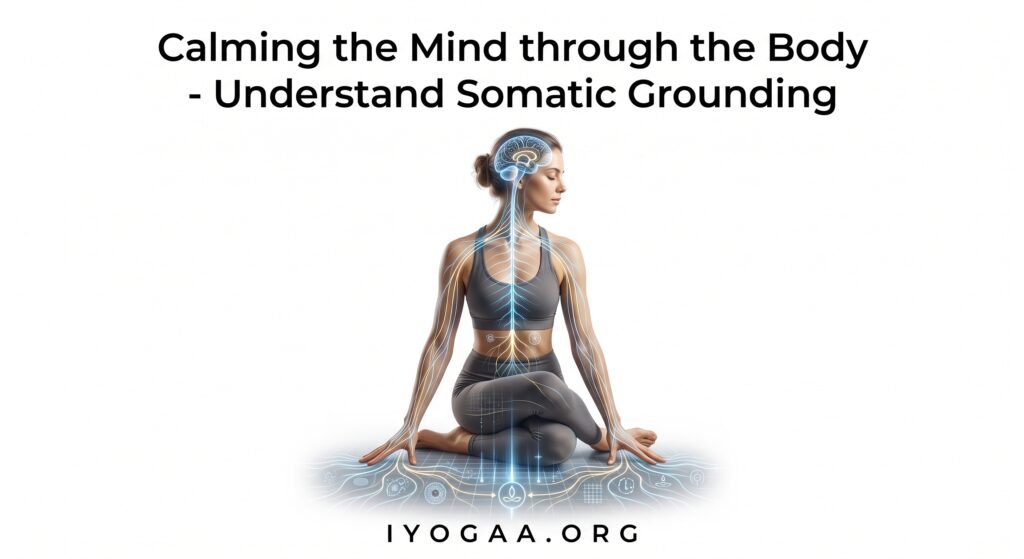
We live in a culture that treats the mind and body as two separate entities, heavily prioritizing cognitive intelligence over physical intuition. When we experience stress, anxiety, or a racing mind, our default response is often cognitive: we try to rationalise with ourselves, reframe our thoughts, or simply command ourselves to “calm down.”
If you have ever tried to logic your way out of a panic attack or severe anxiety, you already know that this cognitive, “top-down” approach frequently fails. At IYogaa.org, we rely on clinical neuroscience to offer a more effective solution. Through interoceptive yoga, we utilize somatic grounding—a bio-behavioral strategy that uses the body’s physical architecture to send profound biological safety signals up to the brain.
The Neuroscience of a Racing Mind
To understand why cognitive reasoning fails during high stress, we have to look at the brain’s architecture. When your nervous system detects a threat—whether that is a physical danger or a stressful email—your amygdala (the brain’s threat-detection center) activates the sympathetic nervous system.
During this fight-or-flight response, the brain literally reroutes energy away from the prefrontal cortex, which is responsible for logic, reasoning, and emotional regulation. In a state of sympathetic hyper-arousal, your brain’s logical centers are effectively taken offline. This is why telling yourself to calm down does not work; the part of your brain that needs to process that command is temporarily unavailable.
Therefore, trying to stop an anxious mind with more thinking is biologically counterproductive. You have to speak the language of the lower brain, and that language is physical sensation.
Bottom-Up Processing: The Science of Somatic Grounding
Somatic grounding relies on “bottom-up” processing. Instead of using the brain to change the body, we use the body to change the brain.
Your brain is constantly receiving data from your peripheral nervous system about the state of your physical environment and your internal biology. Somatic grounding deliberately alters this data stream. By shifting your attention to tangible, dense physical sensations—like the weight of your bones pressing into the floor or the mechanical expansion of your ribs during a breath—you feed the brain incontrovertible evidence of safety in the present moment.
When the insular cortex (the part of the brain responsible for interoception) registers these slow, heavy, regulated physical sensations, it communicates with the vagus nerve. This activates the parasympathetic nervous system (rest and digest), acting as a biological brake pedal. The heart rate slows, blood pressure drops, and the prefrontal cortex comes back online. You calm the mind by anchoring the body.
Interoceptive Yoga as the Ultimate Grounding Tool
At IYogaa.org, interoceptive yoga is engineered to be a precise laboratory for somatic grounding. We do not use yoga as a workout to escape the body; we use it as a clinical tool to deeply inhabit the body.
Here is how our practice mechanically facilitates somatic grounding:
- Proprioceptive Loading: By pressing into the floor and holding structured, weight-bearing shapes, we stimulate proprioceptors in the joints and muscles. This heavy, grounding feedback signals to the central nervous system that the body is stable, secure, and not currently fleeing a predator.
- Targeted Sensori-Motor Tracking: We train you to direct hyper-focused attention to specific internal sensations. By tracking the exact temperature, texture, or tension of a muscle, you force the brain to stop projecting into future anxieties and start mapping present-moment biological reality. This effectively interrupts neurological stress loops.
- Diaphragmatic Pacing: We utilize specific, slow-paced breathing techniques that physically massage the vagus nerve. Mechanically stretching the diaphragm through deep, lateral breathing directly lowers allostatic load and signals systemic safety to the brainstem.
Anchoring Your Autonomic State
Somatic grounding is not a metaphorical concept; it is a measurable neurological shift. When you feel unmoored, scattered, or overwhelmed by cognitive static, your body is the anchor that can pull your nervous system back to baseline.
By practicing interoceptive yoga, you are building robust neural pathways that allow you to rapidly exit a state of panic and re-enter a state of regulation. You are learning to biohack your own peace of mind, proving that the most direct path to mental clarity is often through the deliberate, conscious tracking of physical sensation.
Research References & Citations
- Payne, P., Levine, P. A., & Crane-Godreau, M. A. (2015). Somatic experiencing: using interoception and proprioception as core elements of trauma therapy. Frontiers in Psychology, 6, 93.
- Meyer-Lindenberg, A., Domes, G., Kirsch, P., & Heinrichs, M. (2011). Oxytocin and vasopressin in the human brain: social neuropeptides for translational medicine. Nature Reviews Neuroscience, 12(9), 524-538.
- Chen, W. G., Schloesser, D., Arensdorf, A. M., Simmons, J. M., Cui, C., Valentino, R., … & Langevin, H. M. (2021). The emerging science of interoception: sensing, integrating, interpreting, and regulating signals within the self. Trends in Neurosciences, 44(1), 3-16.