
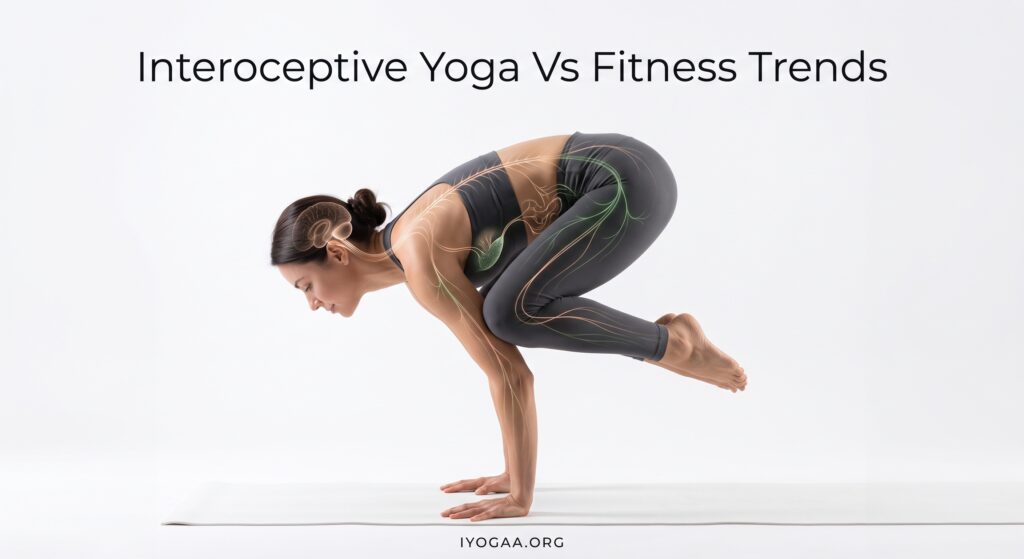
Walk into most modern wellness studios, and the scene is familiar: loud, thumping music; heat turned up to sweating point; and an instructor urging you through rapid-fire poses to “burn it out” or “sculpt your core.” Yoga has become a ubiquitous part of the fitness industry, often packaged as nothing more than an exotic way to get lean.
But at iyogaa.org, we ask a fundamental question: Is this actually yoga?
If you leave a class feeling physically exhausted but mentally still revved up, or if you found yourself dissociated, just trying to survive the sequence until Savasana, you haven’t experienced the actual power of the practice. While fitness class trends focus on external aesthetics and metabolic burn, ancient yoga was designed for something far more profound:nervous system regulation and self-mastery.
To reclaim the true source of yoga, we must shift our perspective from performance to interoception.
The Fitness Disconnect
Modern fitness trends thrive on external validation. It’s about how the pose looks in the mirror (or on social media), how many calories the wearable tracker says you burned, and pushing through discomfort to achieve an external metric. This approach often trains us to ignore the body’s internal signals.
When we approach yoga as just another workout, we miss the point entirely. Pushing the body into intense ranges of motion without internal awareness can spike cortisol levels and exacerbate the very sympathetic nervous system (“fight-or-flight”) dominance that modern practitioners are usually trying to escape.
The Interoceptive Shift: Yoga’s Original Intent
Interoception is the nervous system’s ability to sense, interpret, and integrate internal physiological signals—such as heart rate, respiration, muscle tension, and hunger cues. Modern neuroscience now recognizes that a healthy interoceptive sense is the bedrock of emotional regulation and resilience (Farb et al., 2015).
Ancient yogis did not know the word “interoception,” but their practices were explicitly designed to cultivate it. The primary definition of yoga from the Yoga Sutras of Patanjali is Citta Vritti Nirodaha—stillishing the fluctuations of the mind.
Ancient yoga uses physical postures (asanas) not to make the body perform, but to turn attention strictly inward. It is a “bottom-up” regulatory process: we use the body’s signals to change the brain’s state.
When you practice with an interoceptive focus, you aren’t just “doing a triangle pose.” You are using the shape of the triangle pose to track subtle internal data points:
- What is the temperature of the air on my skin?
- Where do I feel bracing or bracing in my hip, and can I breathe into it?
- What is the exact rhythm of my heart, right now?
The Science Behind the Source
Why does this ancient, internal focus “beat” the metabolic burn of a trendy fusion class? The difference is neurobiological.
Research demonstrates that slow, mindful yoga movement combined with focused breathwork stimulates the vagus nerve,increasing heart rate variability (HRV) (Sullivan et al., 2018). HRV is a critical biomedical marker; a higher HRV correlates with a more resilient nervous system that can easily shift into “rest-and-digest” (parasympathetic) states.
Fitness trends, which often emphasize rapid, intense bursts, keep you in a sympathetic state. While this might improve physical fitness, it degrades mental fitness. Interoceptive yoga, however, thickens the insula, the part of the brain that processes raw physical sensation and emotional intelligence (Schmalzl et al., 2014).
By slowing down and prioritizing “bottom-up” data, you are training your brain to handle stress off the mat. You learn that physical discomfort is just a passing sensation, not a cue to panic.
Reclaiming Your Practice
At iyogaa.org, we urge you to move away from the performative wellness industrial complex and back toward the experiential source. True yoga is a deeply private ritual of self-sensing, not a group-think fitness session.
If you are tired of the noise, the performance, and the constant demand to do “more,” we invite you to experience the radical act of just being with your body. Reclaim the source. The real benefits of yoga begin the moment you close your eyes and finally start to listen.
Research References
- Farb, N., et al. (2015). Interoception, contemplative practice, and health. Frontiers in Psychology, 6, 763. This seminal review connects interoceptive awareness to mental health and autonomic regulation.
- Schmalzl, L., et al. (2014). Movement-based embodied contemplative practices: definitions and paradigms.Frontiers in Human Neuroscience, 8, 205. This research explores how mindful movement changes brain structures,specifically the insula, which is responsible for self-sensing.
- Sullivan, M. B., et al. (2018). Yoga therapy and polyvagal theory: The convergence of traditional wisdom and contemporary neuroscience for self-regulation and resilience. Frontiers in Human Neuroscience, 12, 67. This paper links Polyvagal Theory to yoga therapy, demonstrating how slower practices are superior for nervous system regulation.