
For many modern practitioners, stepping into a yoga class involves a mental negotiation. We love the physical release of asana, but when an instructor begins speaking about “chakras” or “subtle energy flow,” our logical minds often tune out. It sounds poetic, but not precise; spiritual, but not scientific.
At iyogaa.org, we bridge the gap between traditional wisdom and modern biology. Our practice is rooted in interoceptive yoga—the science of sensing the internal state of the body.
From this perspective, we don’t look at chakras as invisible, floating wheels of light. We view them as ancient,sophisticated maps used to navigate the central nervous system. When we speak of awakening subtle energy, we are actually engaging in advanced high-fidelity sensory training.
Here is how modern science is beginning to validate traditional yogic “energy” work.
Mapping the Nerve Plexuses and Endocrine Glands
The traditional map of the seven main chakras runs along the spine, from the pelvic floor to the crown of the head.Historically, Western anatomy viewed this merely as spiritual allegory.
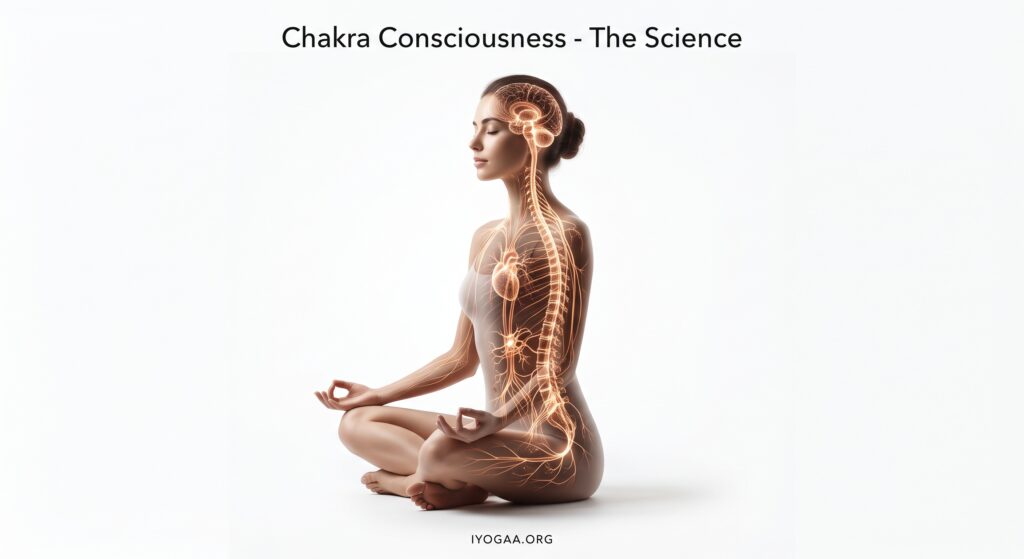
However, modern physiology reveals that the locations of these major chakras correspond almost perfectly to the largest clusters of nerves (plexuses) and the major endocrine glands in the physical body.
For example, traditional texts place the Manipura (solar plexus) chakra at the navel. Modern anatomy tells us this area is the home of the celiac plexus—often called the “abdominal brain”—and regulates digestion and the adrenal glands.Similarly, the Anahata (heart) chakra corresponds with the cardiac plexus, the thymus gland, and the physical heart.
When you direct your attention to a chakra during an interoceptive yoga practice, you aren’t focusing on an esoteric idea.You are bringing conscious awareness to a focal point of intense biological, hormonal, and neurological activity.
The Subtle Language of Interoception
To the rational mind, “subtle energy” feels abstract. But in your lived experience, subtle energy is the difference between a neutral body part and one that feels vital, heavy, warm, or fluttering.
Modern neuroscience calls this “interoception.” It is the sense that allows you to feel your heartbeat, notice tension in your stomach when you are anxious, or experience a sense of “openness” when you are calm. Interoception is the primary pathway the brain uses to monitor health and regulate emotions.
The ancient yogis used chakra visualization not to imagine something that wasn’t there, but to prime the brain to listen closer to interoceptive data.
By focusing on the “felt sense” of the throat (Vishuddha) or the brow (Ajna), you are widening the communication highway between that specific physiological cluster and your brain (specifically, the insular cortex). You are training your brain to detect higher-resolution data from your interior.
Shifting Consciousness via Autonomic Regulation
Traditional texts claim that awakening chakras changes your state of consciousness. Science now explains the mechanics of how this happens.
The central channel along which the chakras are located (Sushumna Nadi) corresponds biologically to the spinal cord and the pathway of the vagus nerve—the main highway of the parasympathetic (rest and digest) nervous system.
When we are stressed, our nervous system is “high-jacked” by the sympathetic mode. Our interoceptive map becomes foggy. chakra-based interoceptive yoga uses slow, controlled breath (pranayama), targeted asana, and focused attention to activate the vagal highway.
As you direct high-fidelity interoception to specific areas along this channel, you down-regulate the survival brain. This shifts your physiology from threat-detection (sympathetic) to safety and connection (parasympathetic). This physiological shift is the change in consciousness described by the ancient yogis—moving from reactive survival to grounded, clear self-awareness.
The iyogaa.org Approach
At iyogaa.org, we are not asking you to “believe” in the esoteric. We invite you to utilize these ancient maps as precise instruments for self-observation.
Awakening subtle energy through interoceptive yoga allows you to become a skilled cartographer of your own physiology. By refining your ability to sense these neural hubs, you gain the power to regulate your nervous system,harmonize your hormonal responses, and reclaim the source of your own vitality.
It is not magic. It is biology.
References
- Farb, N., Daubenmier, J., Price, C. J., Gard, T., Kerr, C., Dunn, B. D., … & Mehling, W. E. (2015).Interoception, contemplative practice, and health. Frontiers in Psychology, 6, 763. (Discusses the neuroscience of sensing the body’s interior).
- Motoyama, H. (1981). Theories of the chakras: Bridge to higher consciousness. New Age Books. (An early scientific attempt to measure chakra locations using electrical devices).
- Porges, S. W. (2011). The Polyvagal Theory: Neurophysiological foundations of emotions, attachment, communication, and self-regulation. W. W. Norton & Company. (Explains the mechanics of brain-body communication via the vagus nerve).
- Schmalzl, L., Crane-Godreau, M. A., & Payne, P. (2014). Movement-based embodied contemplative practices:definitions and paradigms. Frontiers in Human Neuroscience, 8, 205. (Links yoga practice to the refinement of insular cortex high-fidelity data processing).