
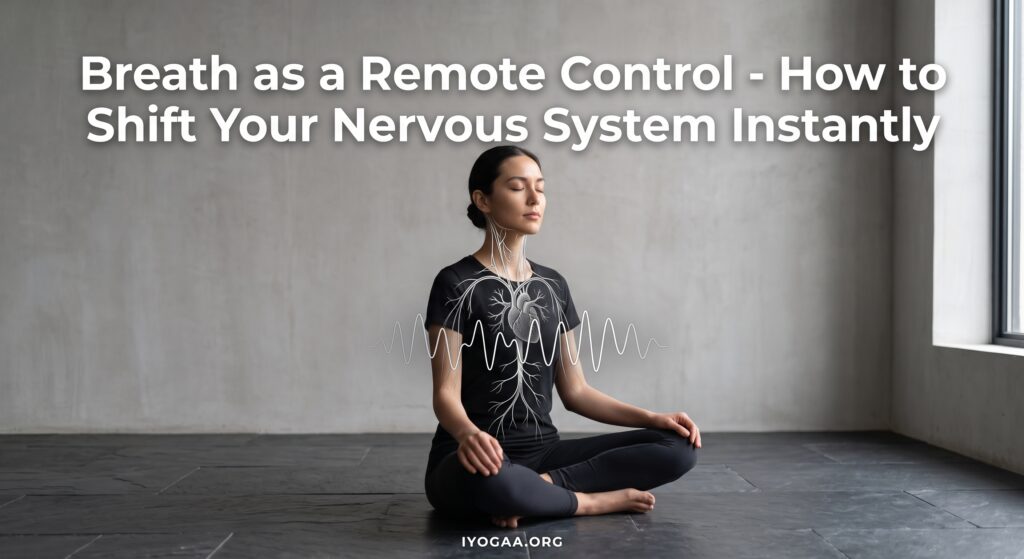
We often treat the nervous system like a runaway train. When a stressful email arrives, or when we are overwhelmed by the demands of daily life, our biology takes over. The heart rate spikes, digestion halts, and muscles flood with tension. In these moments, telling yourself to “just calm down” rarely works. You cannot out-think a biological stress response.
However, you can out-breathe it.
At IYogaa, our interoceptive approach to practice treats the body as a highly intelligent, programmable system. By understanding the mechanical and chemical reality of respiration, you can use your breath as a remote control, sending instantaneous signals of safety or alertness directly to your brain.
The Autonomic Autopilot
To understand how this remote control works, we must look at the Autonomic Nervous System (ANS). The ANS manages all the subconscious functions keeping you alive, operating primarily through two branches:
- The Sympathetic Nervous System (The Gas Pedal): Responsible for mobilization, alertness, and the “fight or flight” response.
- The Parasympathetic Nervous System (The Brake): Responsible for resting, digesting, repairing, and social engagement.
Most autonomic functions—like your heart rate, blood pressure, and cellular digestion—are completely automatic. You cannot simply decide to lower your blood pressure. But your breath is the evolutionary exception. It is the only function that is entirely automatic when you are not paying attention, yet 100% manual the moment you decide to take control.
The Biological Wiring: The Vagus Nerve
When you take manual control of your breath, you are communicating with your brain via the vagus nerve. This massive neural highway wanders from your brainstem down through your neck, chest, and abdomen, monitoring the state of your internal organs (Porges, 2011).
Every time you inhale, your heart rate slightly speeds up. Every time you exhale, your heart rate slightly slows down. This phenomenon is known as Respiratory Sinus Arrhythmia (RSA). When you intentionally lengthen your exhalations, you apply mechanical pressure to the vagal receptors in your lungs and diaphragm. This sends an undeniable, biological message to your brain: We are safe. Engage the brakes. (Gerritsen & Band, 2018).
Operating Your Internal Remote Control
You do not need an hour of meditation to change your state. You simply need to know which “button” to press. Here is how to use specific respiratory ratios to shift your nervous system on demand:
| The Goal | The Breath Ratio | The Biological Effect |
|---|---|---|
| The Brake (Down-Regulate) | Inhale 4, Exhale 8 | Lengthening the exhale heavily stimulates the vagus nerve, dropping heart rate and blood pressure. Use this for anxiety, panic, or to prepare for sleep. |
| The Gas Pedal (Up-Regulate) | Inhale 6, Exhale 3 | Emphasizing the inhale increases sympathetic tone, bringing more oxygen and alertness into the system. Use this to shake off fatigue, lethargy, or brain fog. |
| The Pause (Balance) | Inhale 4, Hold 4, Exhale 4, Hold 4 | Box breathing stabilizes the CO2/Oxygen exchange, balancing sympathetic and parasympathetic tone. Use this to find sharp, grounded focus before a demanding task. |
Feeling the Shift: An Interoceptive Practice
In Interoceptive Yoga, doing the breathing technique is only the first step. The real practice lies in sensing the biological shift. If you mindlessly count your breath while thinking about your grocery list, you miss the neural rewiring that happens when you pay close attention to your internal landscape.
Next time you use one of these breath protocols, hone your interoceptive radar:
- Sense the Cardiac Shift: As you extend your exhale, can you actually feel your heartbeat slow down in your chest or pulse?
- Track the Muscular Release: Notice the exact moment the micro-tension in your jaw, shoulders, and pelvic floor begins to dissolve as parasympathetic tone increases.
- Observe Mental Friction: When you deliberately slow your breath, your mind might initially rebel. Observe this friction neutrally, knowing it is simply your nervous system resisting a change in gears.
By treating your breath as a remote control, you reclaim agency over your own biology. You stop being a passive passenger to your stress response and become an active participant in your well-being. This is the ultimate promise of the practice: the profound, quiet power to regulate yourself from the inside out.
Scientific References
- Gerritsen, R. J., & Band, G. P. (2018). Breath of life: The respiratory vagal stimulation model of contemplative activity. Frontiers in Human Neuroscience, 12, 397.
- Porges, S. W. (2011). The Polyvagal Theory: Neurophysiological Foundations of Emotions, Attachment, Communication, and Self-regulation. W. W. Norton & Company.
- Zaccaro, A., et al. (2018). How breath-control can change your life: A systematic review on psycho-physiological correlates of slow breathing. Frontiers in Human Neuroscience, 12, 353.