
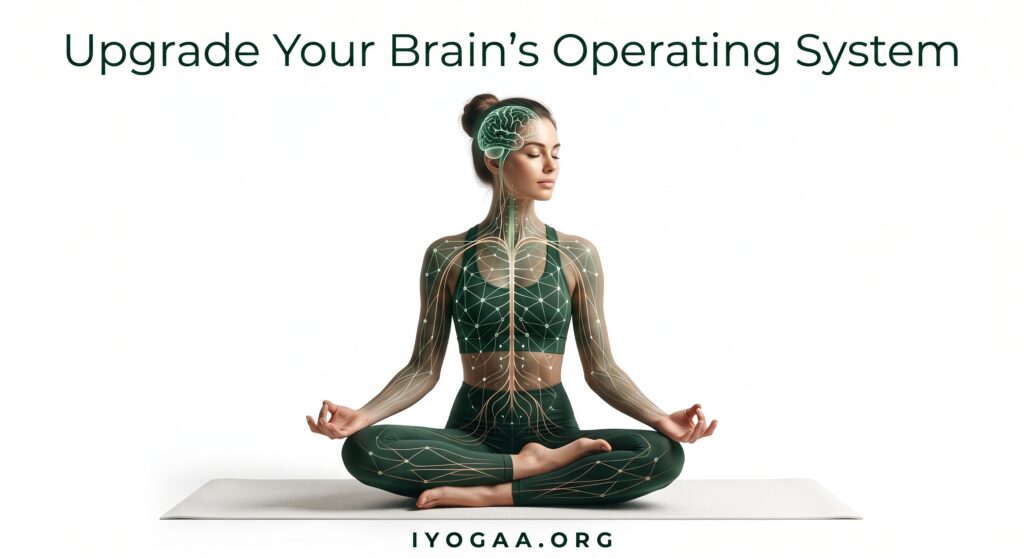
Think of your brain as a highly sophisticated computer. It governs every function in your body, processing millions of inputs every second to keep you alive, balanced, and moving. However, just like any complex operational system (OS), your brain is susceptible to lag. Over time, running too many background applications—chronic stress, poor sleep, emotional fatigue, and anxiety—drains your biological battery and severely slows down your processing speed.
Most people try to fix this systemic lag with external inputs: caffeine, distraction, or more intense physical workouts. But what if you could manually install a system-wide upgrade from the inside out?
At IYogaa.org, we view traditional yoga not merely as a physical exercise, but as a precise, interoceptive technology. Through the lens of neuroscience, we know that stepping onto your mat is one of the most effective ways to reboot, defragment, and structurally upgrade your brain’s operational system.
The Glitch: Losing Our Interoceptive Connection
To understand how yoga upgrades the brain, we have to look at the diagnostic software: interoception. Interoception is your brain’s ability to sense, interpret, and integrate signals originating from within your body, such as heartbeat, respiration, and muscular tension.
In a perfectly functioning OS, your brain reads these internal signals accurately and responds appropriately. But the chronic stress of modern life introduces a “glitch.” We learn to ignore our bodies. We push through pain, ignore shallow breathing, and tune out digestive distress. When our interoceptive accuracy degrades, our autonomic nervous system gets stuck in sympathetic overdrive (the “fight-or-flight” mode). Your system is essentially running a high-alert background program that drains your energy and degrades your physical hardware.
Installing the Upgrade: Neuroplasticity and the Insula
Traditional yoga, when practiced with a strict focus on internal awareness, patches this glitch through neuroplasticity—the brain’s ability to structurally reorganize itself.
When you move through a yoga sequence at IYogaa.org, you are asked to pay hyper-specific attention to your breath and internal physical sensations. This continuous, focused attention heavily activates the insular cortex, the region of your brain responsible for processing interoceptive data.
Neuroimaging studies show that consistent interoceptive practice physically thickens the insular cortex. You are literally upgrading your brain’s hardware. A thicker, more connected insula translates to higher emotional intelligence, faster recovery from psychological stress, and a profound ability to remain calm and analytical when your environment becomes chaotic. You stop reacting blindly to stress and start responding with precision.
Clearing the Cache: The Vagus Nerve Highway
Every good OS upgrade clears out the cache of junk data. In the human body, this is achieved by stimulating the vagus nerve. The vagus nerve acts as the primary data cable connecting your brain’s OS to your major organs, dictating your parasympathetic (rest-and-digest) response.
Traditional yoga postures (Asanas) paired with controlled, rhythmic breathing (Pranayama) send powerful, mechanical signals up the vagus nerve to the brainstem. By consciously maintaining a slow, steady breath while placing the body under the mild physical stress of a yoga posture, you override the brain’s panic response. You are writing new code that tells your brain, “We are under pressure, but we are entirely safe.” This actively clears out systemic inflammation and lowers your resting heart rate.
How to Run the Update at IYogaa.org
To ensure your yoga practice actually upgrades your nervous system rather than just stretching your muscles, you must shift how you practice:
- Make Sensation Your Primary Metric: Stop worrying about whether your pose looks “perfect.” Instead, analyze the data: Where is the tension? What is the temperature of your breath?
- Breathe to Override: When a pose becomes difficult, your instinct will be to hold your breath. Override this glitch. Smooth, elongated exhalations are the keystrokes that trigger vagal tone and parasympathetic dominance.
- Process in the Pause: The brief moments of stillness between postures are when your brain compiles the new data. Do not rush the transitions.
You already possess the most advanced biological technology on earth. Interoceptive yoga is simply the user manual you need to keep it running at peak performance.
Research References & Citations
- Farb, N., Daubenmier, J., Price, C. J., Gard, T., Kerr, C., Dunn, B. D., … & Mehling, W. E. (2015). Interoception, contemplative practice, and health. Frontiers in Psychology, 6, 763.
- Schmalzl, L., Crane-Godreau, M. A., & Payne, P. (2015). Movement-based mind-body therapies, interoception, and the insular cortex. Frontiers in Human Neuroscience, 9, 372.
- Sullivan, M. B., Erb, M., Schmalzl, L., Moonaz, S., Noggle Taylor, J., & Porges, S. W. (2018). Yoga therapy and polyvagal theory: The convergence of traditional wisdom and contemporary neuroscience for self-regulation and resilience. Frontiers in Human Neuroscience, 12, 67.