
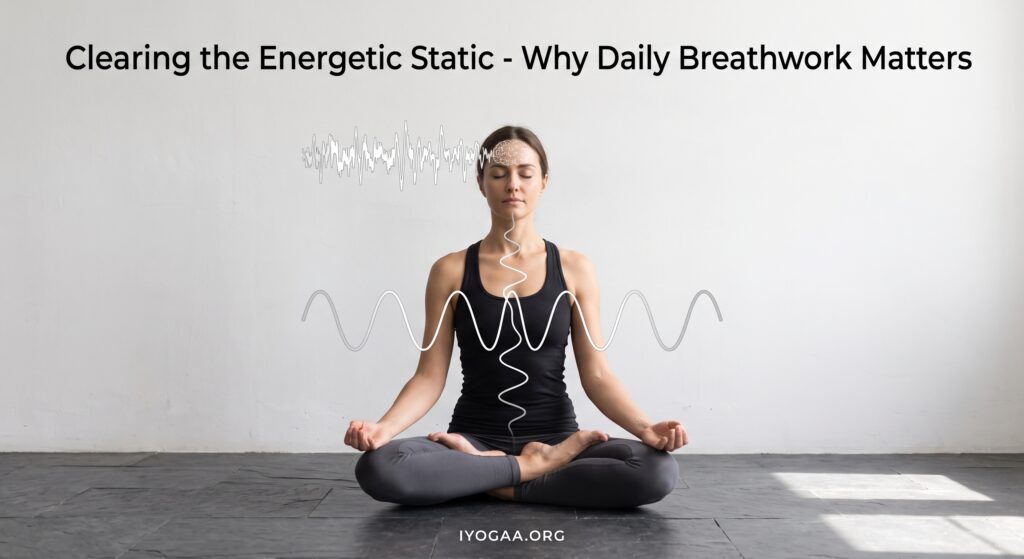
If you pay close attention to your body right now, what do you notice? Is your jaw slightly clenched? Is your breathing shallow, resting high in your chest? Is there a subtle, low-grade buzzing in your chest or shoulders?
This is what we call internal static.
In the modern world, our nervous systems are constantly bombarded by micro-stressors: breaking news, work messages, traffic, and screen time. Over time, this input accumulates in the body, creating a persistent layer of physiological noise. We get used to living with this background static, but it drains our energy, clouds our thinking, and disconnects us from our authentic selves.
At IYogaa, we use Interoceptive Yoga and daily breathwork as a precise, scientific tool to wipe the biological slate clean.
What Is Internal Static?
From an interoceptive perspective, “static” is not a metaphor—it is a physiological reality. It represents the accumulation of unresolved sympathetic nervous system tone (Porges, 2011).
When your brain perceives a constant stream of minor threats (like an overflowing email inbox), it maintains a state of low-grade fight-or-flight mobilization. This chronic state alters your internal environment:
- Elevated baseline cortisol and adrenaline circulating in the blood.
- Reduced Heart Rate Variability (HRV), signaling a rigid, less adaptable nervous system.
- Altered blood gas chemistry, caused by subtle, chronic hyperventilation (over-breathing).
- Persistent muscular micro-tension, particularly in the neck, shoulders, and diaphragm.
Your brain continuously maps these altered signals via the insular cortex (Craig, 2002). When the brain receives constant reports of muscular tightness and fast breathing, it concludes that you are in danger, keeping the cycle of stress alive.
The Case for a Daily Practice
Why does breathwork need to be a daily habit? Because stress is a daily intake.
Just as you brush your teeth every morning to prevent plaque buildup, daily breathwork acts as daily hygiene for your nervous system. You do not need hours of practice; even 5 to 10 minutes of intentional, slow-paced breathing creates an immediate shift in your autonomic tone (Zaccaro et al., 2018).
Consistent daily practice rewires your baseline. Instead of defaulting to chronic hyper-vigilance, your nervous system develops a higher “stress threshold.” You bounce back faster when life throws you off balance.
The Science of the Biological Reset
When you sit down to practice daily pranayama, you engage two powerful mechanisms that clear this internal static:
1. Mechanical Vagal Stimulation
Slow, deep diaphragmatic breathing expands the lungs and depresses the diaphragm. This movement exerts physical pressure on vagal nerve endings in the abdominal and thoracic cavities. This mechanical stimulation triggers the release of acetylcholine, a neurotransmitter that slows your heart rate and signals safety directly to the brainstem (Gerritsen & Band, 2018).
2. Restoring Blood Gas Balance
Subtle stress causes us to breathe slightly faster than necessary, blowing off carbon dioxide (CO2). Counterintuitively, we need a healthy level of CO2 to allow oxygen to break free from hemoglobin and enter our tissues (the Bohr Effect). Daily slow breathing allows CO2 levels to normalize, expanding blood vessels and optimizing cellular oxygen delivery throughout the brain and body.
Cultivating Daily Interoceptive Hygiene
To clear internal static, your practice must be felt, not just performed. Here is how to approach a quick daily reset:
| Step | Action | Interoceptive Focus |
|---|---|---|
| 1. The Scan | Sit quietly for 30 seconds. | Map the current “static.” Where is tension held? How fast is your pulse? |
| 2. The Shift | Breathe in for 4 seconds, exhale for 6 seconds. | Feel the mechanical drop of the shoulders and the softening of the ribcage on each exhale. |
| 3. The Pause | Practice a brief, 2-second hold after each exhale. | Tune into the profound stillness between breaths—the complete absence of physical noise. |
| 4. The Integration | Sit quietly for 1 minute post-practice. | Observe the contrast. Notice the clarity, warmth, and grounded presence in your limbs. |
By committing to a brief daily practice, you stop letting the world dictate your internal environment. You clear the static, dial in neural clarity, and anchor yourself in a deep, unwavering state of inner stability.
Scientific References
- Craig, A. D. (2002). How do you feel? Interoception: the sense of the physiological condition of the body. Nature Reviews Neuroscience, 3(8), 655-666.
- Gerritsen, R. J., & Band, G. P. (2018). Breath of life: The respiratory vagal stimulation model of contemplative activity. Frontiers in Human Neuroscience, 12, 397.
- Porges, S. W. (2011). The Polyvagal Theory: Neurophysiological Foundations of Emotions, Attachment, Communication, and Self-regulation. W. W. Norton & Company.
- Zaccaro, A., et al. (2018). How breath-control can change your life: A systematic review on psycho-physiological correlates of slow breathing. Frontiers in Human Neuroscience, 12, 353.