
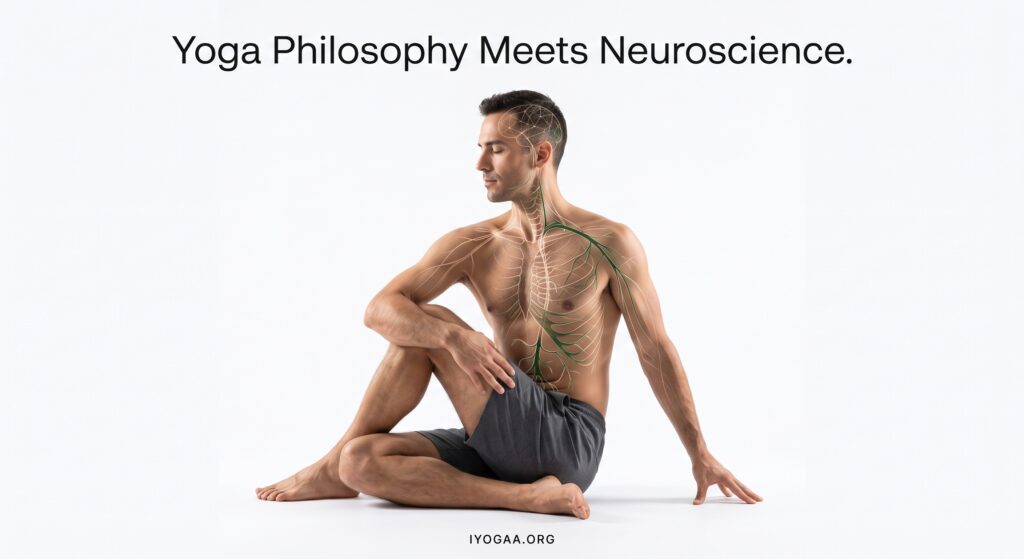
When we hear the phrase “yoga philosophy,” it is easy to picture ancient sages meditating in remote caves, detached from the demands of the modern world. For the busy professional, the exhausted parent, or the stressed student, studying thousands-of-years-old Sanskrit texts might seem irrelevant to the pressing realities of daily life.
At iyogaa.org, we approach yoga differently. We view the ancient texts not as rigid dogma, but as early, highly sophisticated blueprints for bio-behavioral optimization.
When viewed through the lens of clinical neuroscience and interoceptive awareness, the foundational principles of yoga philosophy transform from abstract moral codes into highly practical tools for nervous system regulation. Here is how ancient wisdom translates into modern biological resilience.
Ahimsa (Non-Violence): Cultivating Biological Safety
Ahimsa, typically translated as non-violence, is the first principle of yogic philosophy. Historically, it is interpreted as an ethical mandate to not harm others. However, in the context of interoceptive yoga, Ahimsa begins entirely internally.
Consider your inner dialogue when you are stressed. Harsh self-criticism, pushing your body past its limits, or ignoring physical pain are all forms of internal violence. Neurologically, this hostile internal environment is interpreted by your brain as a literal threat, triggering the sympathetic nervous system. Your amygdala fires, cortisol floods your system, and you enter a chronic state of “fight-or-flight.”
Practicing internal Ahimsa means consciously cultivating physiological safety. By observing your body with neutrality and compassion—rather than judgment—you signal to your vagus nerve that you are safe. This “bottom-up” signaling shifts your autonomic nervous system into a parasympathetic (rest-and-digest) state, laying the necessary biological groundwork for healing and stress recovery.
Pratyahara (Sense Withdrawal): The Shift to Interoception
In our hyper-connected modern world, our nervous systems are bombarded by external stimuli: notifications, emails, traffic, and endless streams of data. We are chronically trapped in exteroception—the sensing of the world outside of us.
The yogic concept of Pratyahara is usually translated as “withdrawal of the senses.” Rather than literally shutting off our senses, Pratyahara is the deliberate neurological shift from exteroception to interoception.
It is the act of turning the volume down on the outside world to tune into the internal landscape of the body. When we practice Pratyahara on the mat, we consciously direct our attention away from the visual aesthetics of a pose and toward the internal sensory data: the cadence of our breath, the temperature of our skin, or the beating of our heart. This practice acts as a reset button for a chronically overstimulated brain.
Svadhyaya (Self-Study): Mapping the Insular Cortex
Svadhyaya translates to “self-study.” In traditional philosophy, this meant studying sacred texts. In an interoceptive framework, the primary text you are studying is your own physiology.
When you practice Svadhyaya, you are actively engaging and thickening the insular cortex—the region of the brain responsible for internal body awareness and emotional regulation. By becoming a dedicated student of your own nervous system, you learn to read your body’s subtle, early warning signs of stress before they escalate into panic or burnout. You are no longer reacting blindly to your environment; you are using high-fidelity interoceptive data to respond with clarity and intention.
The Modern Application
At iyogaa.org, we believe that true yoga philosophy is lived through the nervous system. You do not need to memorize ancient texts to benefit from their wisdom. By treating your body with biological respect (Ahimsa), shifting your focus inward (Pratyahara), and studying your internal landscape (Svadhyaya), you bridge the gap between ancient tradition and modern science, reclaiming your innate capacity for calm, grounded resilience.
Research References
- Brewer, J. A., et al. (2011). Meditation experience is associated with differences in default mode network activity and connectivity. Proceedings of the National Academy of Sciences, 108(50), 20254-20259. (Demonstrates how traditional mindful practices neurologically quiet the mind’s distracting, stress-inducing loops).
- Craig, A. D. (2009). How do you feel—now? The anterior insula and human awareness. Nature Reviews Neuroscience, 10(1), 59-70. (Explains the critical role of the insula in translating interoceptive data into self-awareness).
- Porges, S. W. (2007). The polyvagal perspective. Biological Psychology, 74(2), 116-143. (Provides the scientific framework for how cultivating internal safety, akin to Ahimsa, regulates the autonomic nervous system).