
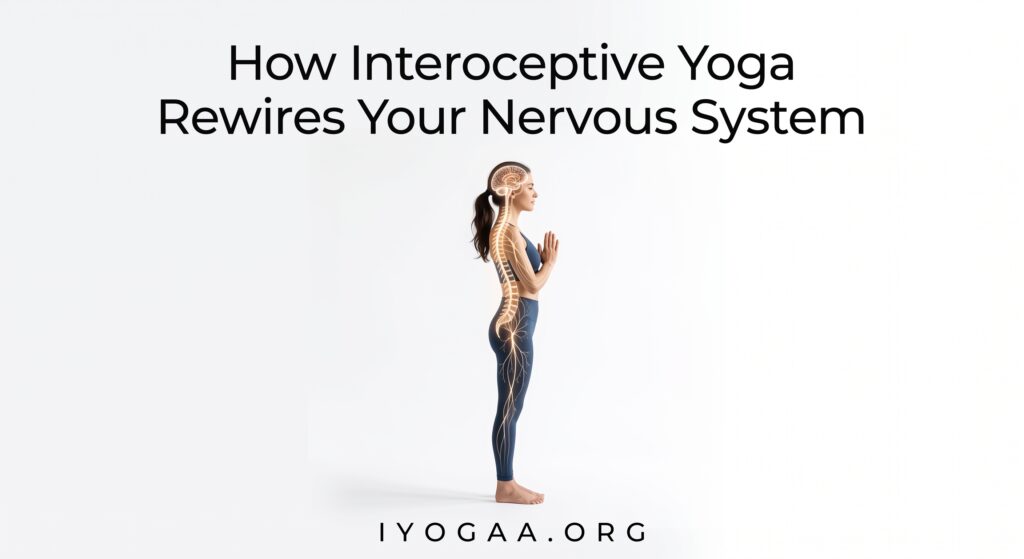
When you walk into a typical yoga class, the focus is often immediate and external: the alignment of your hips, the depth of your lunge, or the ability to reach your toes. Society has branded yoga as a sophisticated stretching routine. While physical flexibility is a wonderful byproduct of the practice, it is not the primary goal.
At IYogaa.org, we invite you to look beneath the surface. From the perspective of interoceptive neuroscience, the yoga mat is not a place to perform; it is a clinical environment for nervous system rehabilitation. The true power of the practice lies in its ability to physically rewire how your brain communicates with your body.
Interoception: The Missing Link in Movement
To understand how this rewiring happens, you need to understand interoception. Interoception is your brain’s continuous ability to perceive, interpret, and integrate internal bodily signals. It is the sensory system that lets you know when your stomach is empty, when your muscles are carrying tension, or when your heart rate is accelerating in response to stress.
For many of us, the demands of modern life have blunted this internal sense. We ignore our physical need for rest, push through tension, and live primarily in our heads. A weak interoceptive sense leaves us disconnected from our biological warning signals, making us highly reactive to stress and prone to emotional dysregulation. Yoga, when practiced with deep internal awareness, is a targeted intervention to rebuild this mind-body bridge.
Interrupting the Autopilot
Your autonomic nervous system operates largely on autopilot, shifting between the sympathetic (fight-or-flight) and parasympathetic (rest-and-digest) states. Chronic stress keeps the sympathetic nervous system locked in the “on” position, flooding the body with cortisol and maintaining high baseline anxiety.
Interoceptive yoga acts as a manual override for this autopilot system. When you move into a challenging posture like a deep twist or a balancing pose, your sympathetic nervous system naturally spikes. Your heart beats faster, and your muscles contract. However, instead of reacting with panic or abandoning the pose, interoceptive practice demands that you stay, observe the sensation, and consciously slow your breath.
The Science of Rewiring
This conscious observation during physical stress is where the neurological rewiring occurs. When you match controlled, rhythmic breathing to challenging physical sensations, you are actively engaging the vagus nerve. The vagus nerve acts as the primary communication highway between the body and the brain, carrying parasympathetic signals that tell the brain, “We are under pressure, but we are safe.”
Over time, this deliberate practice drives neuroplasticity—the brain’s ability to form new neural connections. Scientific research demonstrates that consistent interoceptive focus thickens the insular cortex, the region of the brain responsible for body awareness and emotional regulation. By repeatedly choosing to breathe calmly through physical discomfort on the mat, you are literally changing the physical structure of your brain. You are training your nervous system to respond to the unavoidable stresses of daily life with clarity and resilience rather than panic.
Practicing for Nervous System Health at IYogaa.org
To transition your practice from a physical workout to a neurological intervention, we encourage our clients to adopt a few simple, structural shifts on the mat:
- Feel the Posture, Do Not Force It: Let go of what the pose looks like in a mirror. Focus entirely on where you feel the tension and how your body responds to the shape.
- Let Breath Dictate Movement: Your breath is the remote control for your nervous system. Never sacrifice the depth and smoothness of your breathing to achieve a deeper stretch.
- Linger in the Transitions: Pay close attention to the sensory shifts that happen when moving out of one pose and into the next. This continuous tracking sharpens your interoceptive accuracy.
True flexibility is not just in the hamstrings; it is in the nervous system. By turning your attention inward, you can use movement to cultivate a resilient, adaptable, and deeply balanced biology.
Research References & Citations
- Farb, N., Daubenmier, J., Price, C. J., Gard, T., Kerr, C., Dunn, B. D., … & Mehling, W. E. (2015). Interoception, contemplative practice, and health. Frontiers in Psychology, 6, 763.
- Payne, P., Levine, P. A., & Crane-Godreau, M. A. (2015). Somatic experiencing: using interoception and proprioception as core elements of trauma therapy. Frontiers in Psychology, 6, 93.
- Streeter, C. C., Gerbarg, P. L., Saper, R. B., Ciraulo, D. A., & Brown, R. P. (2012). Effects of yoga on the autonomic nervous system, gamma-aminobutyric-acid, and allostasis in epilepsy, depression, and post-traumatic stress disorder. Medical Hypotheses, 78(5), 571-579.