
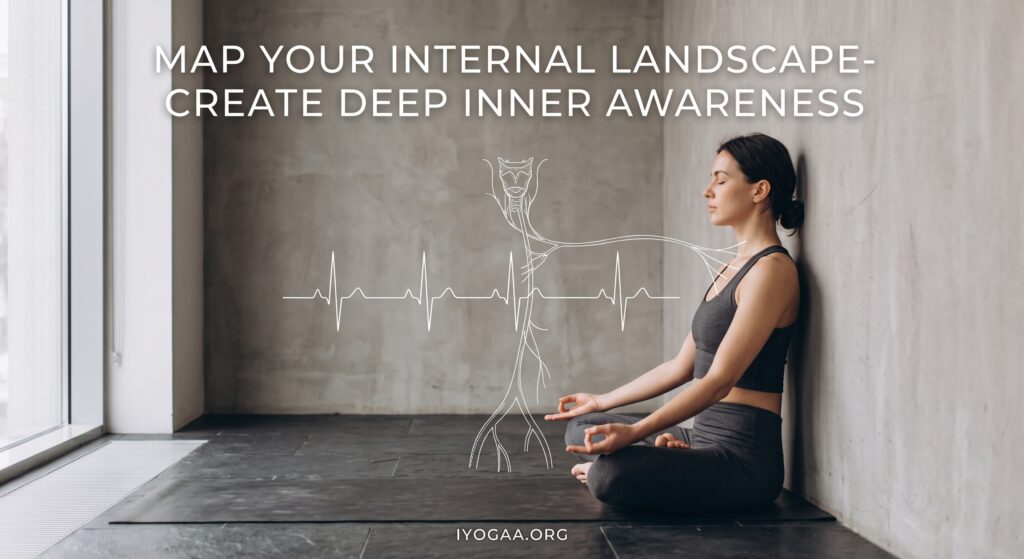
We live in a world designed to pull our attention outward. Screens, noise, and constant demands train the brain to focus on external targets. Over time, this constant outward focus cuts us off from the body’s internal signals. We miss the subtle signs of tension, altered breathing, or rising stress until they break out as physical pain or exhaustion.
Building true health requires turning your attention back inside. At IYogaa, we base our work on interoception—the nervous system’s sense of the internal state of the body. When you learn to map your internal landscape, movement stops being a workout and becomes a precise tool for self-regulation and inner awareness.
What Is Interoception?
Interoception is your body’s internal radar. It is the network of neural pathways that carries signals from your internal organs, muscles, and fascia up to the brain—specifically to a region called the insular cortex (Farb et al., 2015).
While sight and hearing tell you what is happening in the room, interoception tells you what is happening inside your skin:
- The rhythmic expansion and contraction of your lungs.
- The subtle shift in your heart rate when faced with stress.
- Muscle tension, thermal changes, and gut sensations.
When your interoceptive awareness is sharp, you notice these signals early. You do not wait for a full breakdown to rest. You adjust in real time.
The Science of the Internal Map
Your brain builds a continuous, real-time map of your internal physiological state. Neuroscientific research shows that the clarity of this internal map directly impacts emotional regulation and stress resilience (Craig, 2002; Khalsa et al., 2018).
When you practice Interoceptive Yoga, you actively refine this map. Instead of forcing your body into a pose based on how it looks from the outside, you use movement to feel how it functions from the inside.
Research demonstrates that targeted, somatic movement practices alter neural processing in the insular cortex, strengthening the connection between body sensations and conscious thought (Daubenmier et al., 2013). This neural strengthening makes your nervous system more adaptive. You recover faster from stress because your brain receives clear, uninterrupted data from your tissues.
Cultivating Inner Awareness on the Mat
Mapping your internal landscape does not require complex routines. It requires quiet, deliberate attention during basic movements.
1. Shift from Performance to Observation
Drop the goal of striking a “perfect” pose. Instead, treat every position as a test environment. When you bend or stretch, ask yourself: Where do I feel the first line of tension? What happens to my breath when the movement gets harder?
2. Track the Vagal Response
Your breath is the most direct control knob for your nervous system. Long, controlled exhalations stimulate the vagus nerve, signaling safety to the brain and lowering your heart rate (Gerritsen & Band, 2018). As you move, pay attention to the exact moment your breath catches or shortens. That is your boundary.
3. Build Interoceptive Precision
Try to feel specific internal markers during quiet holding poses:
- Feel the pulse in your fingertips or throat.
- Sense the weight shift across the soles of your feet without looking down.
- Notice the distinction between useful mechanical load and sharp joint strain.
The Warrior Mindset: Grounded in Biological Truth
Mastering your internal landscape is practical work. It gives you steady control over your own state. When you sharpen your inner awareness, you stop reacting blindly to external pressures. You gain the clarity to make calm, grounded decisions under stress—both on the mat and in daily life.
By treating the body as an intelligent system rather than a machine to push through fatigue, you build sustainable strength. You move with purpose, guided by clear internal biological feedback.
Scientific References
- Craig, A. D. (2002). How do you feel? Interoception: the sense of the physiological condition of the body. Nature Reviews Neuroscience, 3(8), 655-666.
- Daubenmier, J., et al. (2013). The relationship of interoceptive awareness, mindfulness, and emotion regulation to body responsiveness. Mindfulness, 4(4), 301-316.
- Farb, N., et al. (2015). Interoception, contemplative practice, and health. Frontiers in Psychology, 6, 763.
- Gerritsen, R. J., & Band, G. P. (2018). Breath of life: The respiratory vagal stimulation model of contemplative activity. Frontiers in Human Neuroscience, 12, 397.
- Khalsa, S. S., et al. (2018). Interoception and mental health: A roadmap. Biological Psychiatry: Cognitive Neuroscience and Neuroimaging, 3(6), 501-513.