
August 1st marks Lughnasadh, the precise cosmic midpoint between the Summer Solstice and the Autumn Equinox. While ancient pagan communities celebrated this as the first harvest—a time to cut the first grain and secure sustenance for the winter—this date is much more than a historical marker. It is a biological tipping point.
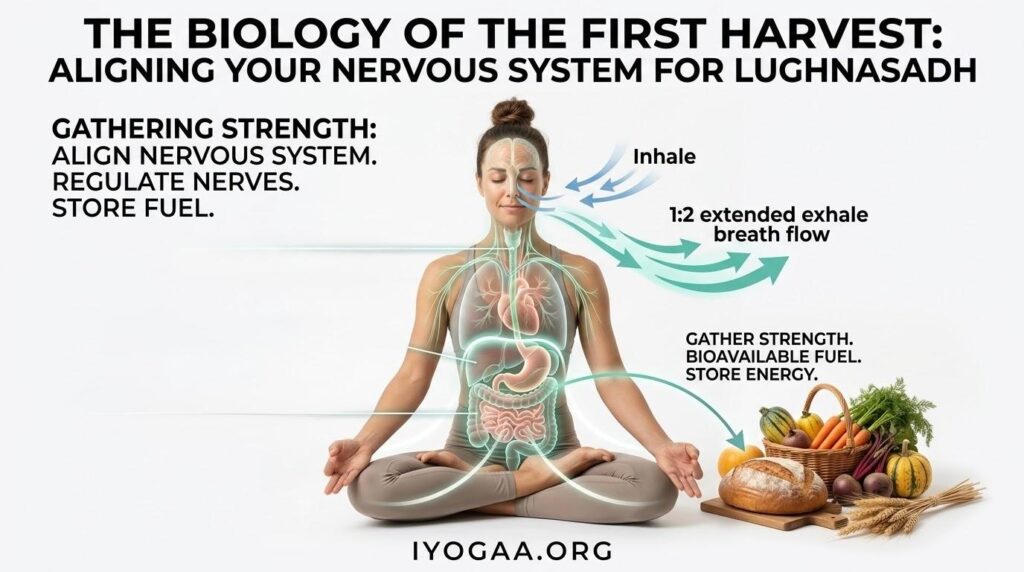
Table of Contents
When the sun reaches exactly 15 degrees in Leo, the earth’s tilt definitively steers us away from peak summer. As a Research Scientist, Doctor of Natural Medicine, and Yogi, I study how human biology mirrors these cosmic alignments through Interoceptive Neuroscience. The outward, explosive energy of the solar cycle must now be gathered, processed, and stored in the physical matter of your body.
Summer fire drives the sympathetic nervous system—the urge to build, push, and move. But as the daylight subtly begins to wane, your brain signals a pivot toward the parasympathetic state: rest, digest, and store. A warrior knows when to exert force and when to gather strength. If you fight this natural shift by maintaining high output, you invite systemic exhaustion.
This is where inner awareness becomes your most vital tool. Through Interoceptive Yoga, we map this cosmic shift within our own tissues.
Preparing for the Practice on Lughnasadh
Before you begin, set up your physical environment to support focus and minimize sensory distraction.
Gear: Wear natural, breathable fibers like linen, hemp, or cotton.
Focus: Pull your hair back to clear your face. The goal is a sharp, distraction-free environment for the mind.
Asana: The Architecture of Gathering
The physical practice for Lughnasadh is not about explosive movement. It is about taking the energy you have generated since spring and grounding it. The focus is on stability, structure, and directing your attention inward.
Malasana (Yogi Squat):
Drop your center of gravity close to the earth. This posture mechanically opens the hips and grounds the pelvis. Direct your inner awareness to the base of your spine. Notice the baseline tension in your pelvic floor and deliberately command the muscles to release.
Paschimottanasana (Seated Forward Fold):
This is the physical embodiment of turning inward. As you fold over your legs, you close off the front of your body from external stimuli. Do not pull or force the hamstrings. Instead, focus on the sensory feedback of your breath expanding into the back of your ribcage.
Virabhadrasana II (Warrior II) with a Yielding Focus:
A warrior must hold structure without unnecessary tension. Set your stance firm and wide. Once the physical architecture is stable, scan your body for wasted energy. Relax your jaw, soften your shoulders, and maintain the posture using only the muscles absolutely necessary.
Pranayama: Shifting the Nervous System
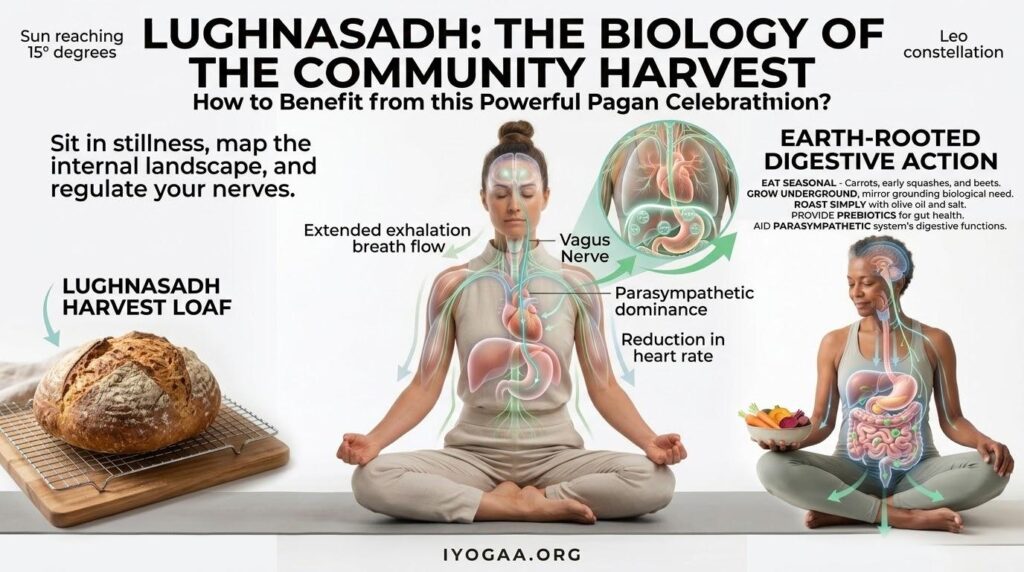
Breath is the most direct mechanism you have to control your nervous system. To match the cosmic pivot from sympathetic output to parasympathetic gathering, use a 1:2 breathing ratio to stimulate the vagus nerve.
Extended Exhale Practice:
- Sit with a straight, unsupported spine.
- Inhale sharply and cleanly through the nose for a count of 4.
- Exhale slowly and smoothly through the nose for a count of 8.
- Repeat for 3 to 5 minutes.
The prolonged exhale physically slows the heart rate and sends a neurological signal to the brain that the environment is safe, triggering the “rest and store” biological response.
Nutrition: Fueling the Harvest Pivot
Just as the seasons change, your fuel sources must adapt. The transition into autumn requires accessible, grounding foods that support sustained energy and optimal digestion.
The Lughnasadh Loaf Recipe (Easy Multigrain Bread)
The core tradition of Lughnasadh is baking the first grain. Bread represents the transformation of raw potential into usable energy. Complex carbohydrates anchor blood sugar and provide dense, slow-burning fuel that supports a calm nervous system.
How To Make the Lughnasadh Loaf
The Method:
In a large bowl, mix 3 cups of flour (a blend of whole wheat and all-purpose works well) with a handful of rolled oats and mixed seeds (sunflower, pumpkin, or flax).
Add 1.5 teaspoons of salt and 1/2 teaspoon of active dry yeast.
Pour in 1.5 cups of warm water and mix until a shaggy dough forms.
Cover and let it sit at room temperature for 12-18 hours.
Bake in a preheated Dutch oven at 230°C (450°F) for 30 minutes with the lid on, then 15 minutes with the lid off.
This bread requires minimal hands-on effort but yields highly bioavailable fuel.
Seasonal Root Vegetables
Carrots, early squashes, and beets are coming into season. These foods grow downward, mirroring the biological need to ground your energy. Roast them simply with olive oil and salt. They provide essential prebiotics for gut health, directly aiding the parasympathetic system’s digestive functions.
Mineral-Rich Hydration
As you shift away from the high heat of summer, maintain hydration but focus on cellular uptake. Adding a pinch of sea salt and a squeeze of fresh lemon to your water maintains your electrolyte balance naturally, keeping your nervous system firing cleanly without the need for processed supplements.
The IYogaa Assessment
Lughnasadh is the time to cut and store. Stop projecting energy out into the world. Sit in stillness. Look objectively at what you have built physically and mentally since the spring. Keep the habits, practices, and strengths that nourish you, and cleanly cut away what is useless.
Align your spine, regulate your nerves, and gather your energy.