
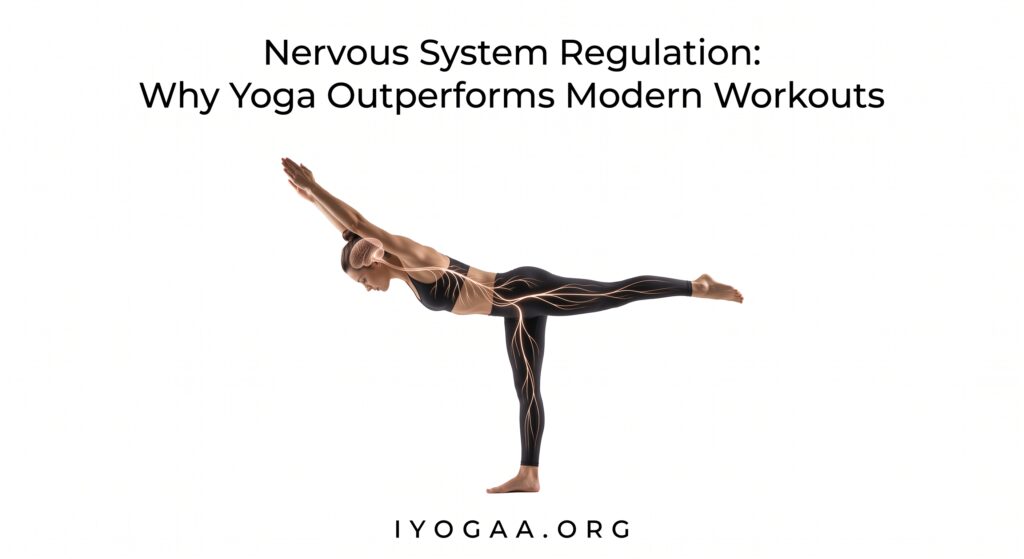
In today’s fast-paced world, the prevailing narrative around health and fitness is heavily biased toward intensity. We are told to crush our workouts, burn more calories, and push through the pain. High-Intensity Interval Training (HIIT), heavy weightlifting, and grueling spin classes dominate the fitness industry. While these modalities undoubtedly offer cardiovascular and muscular benefits, they completely overlook a critical component of human biology: the state of your autonomic nervous system.
If you are already navigating chronic stress, anxiety, or burnout, adding a high-intensity workout to your routine might be the biological equivalent of pouring gasoline on a fire. At IYogaa.org, we approach movement through the lens of clinical neuroscience. From an interoceptive perspective, true fitness is not just about how much physical stress your body can endure; it is about how efficiently your nervous system can recover and regulate.
The Biological Cost of High-Intensity Fitness
To understand why interoceptive yoga is often a superior choice for stressed individuals, we must look at how the body processes exercise.
Biologically, your brain does not differentiate between the stress of a looming work deadline, a physical threat, or a high-intensity workout. All of these triggers activate the sympathetic nervous system, plunging the body into a state of “fight or flight.” When you sprint on a treadmill or lift heavy weights, your amygdala signals the release of cortisol and adrenaline. Your heart rate spikes, your breath becomes rapid and shallow, and your body mobilizes energy for survival.
This acute stress response is perfectly healthy in small doses. However, modern humans are suffering from an unprecedented high “allostatic load”—the cumulative burden of chronic stress and life events. When your baseline is already locked in a state of sympathetic hyper-arousal, forcing your body through a grueling workout simply compounds that biological debt. It can lead to systemic inflammation, hormonal imbalances, and profound central nervous system fatigue.
Interoceptive Yoga: The Science of Down-Regulation
This is where interoceptive yoga diverges fundamentally from modern fitness paradigms. The goal of interoceptive yoga is not to burn calories or break down muscle tissue; it is to actively train the nervous system to down-regulate.
Instead of adding another stressor to your day, interoceptive practice at IYogaa.org provides a structured, clinical environment to discharge accumulated stress. We achieve this by shifting the focus from external performance (how a pose looks) to internal observation (how a pose feels).
When you practice interoceptive yoga, you are systematically dismantling the physiological stress response through targeted neurological feedback.
How Interoception Upgrades Your Neurobiology
The superiority of interoceptive yoga for stress management lies in its direct communication with the brain’s regulatory centers. Here is how it mechanically outperforms standard workouts for nervous system health:
- Activating the Vagal Brake: High-intensity workouts demand short, rapid breathing, which sustains sympathetic arousal. Interoceptive yoga deliberately utilizes slow, elongated exhalations. This mechanical action directly stimulates the vagus nerve—the primary neural pathway of the parasympathetic (rest and digest) system. It acts as a biological brake pedal, rapidly slowing the heart rate and lowering blood pressure.
- Strengthening the Insular Cortex: Standard workouts often encourage you to “zone out” or distract yourself with loud music and screens. Interoceptive yoga requires you to “zone in.” By continuously tracking subtle internal sensations—the stretch of a muscle, the expansion of the ribs—you stimulate the insular cortex. A robust insula allows the brain to accurately process bodily signals, helping you differentiate between a genuine threat and lingering residual anxiety.
- Neuromuscular Yielding vs. Bracing: Traditional strength training relies on creating tension and micro-tears in the muscle fibers. In contrast, interoceptive yoga maps and releases the chronic, subconscious bracing patterns that stress leaves in the fascial network. By maintaining conscious awareness while yielding into a posture, you teach the nervous system that it is safe to finally let go of its defensive posture.
Redefining True Fitness
A healthy body is not just one that can run fast or lift heavy; it is one that possesses autonomic flexibility. It is the ability to easily transition from a state of alert action back down to a state of profound, restorative calm.
If you are constantly exhausted, irritable, or battling brain fog, your body is begging for regulation, not more exhaustion. By choosing the mindful, somatic tracking of interoceptive yoga, you are making a scientifically backed choice to prioritize your nervous system. You are stepping off the treadmill of chronic stress and finally giving your biology permission to heal.
Research References & Citations
- Zou, L., Sasaki, J. E., Wei, G. X., Huang, T., Yeung, A. S., Neto, O. B., … & Hui, S. S. (2018). Effects of Mind–Body Exercises (Tai Chi/Yoga) on Heart Rate Variability Parameters: A Systematic Review and Meta-Analysis. Journal of Clinical Medicine, 7(11), 404.
- Farb, N., Daubenmier, J., Price, C. J., Gard, T., Kerr, C., Dunn, B. D., … & Mehling, W. E. (2015). Interoception, contemplative practice, and health. Frontiers in Psychology, 6, 763.
- McEwen, B. S. (2007). Physiology and neurobiology of stress and adaptation: central role of the brain. Physiological Reviews, 87(3), 873-904.