
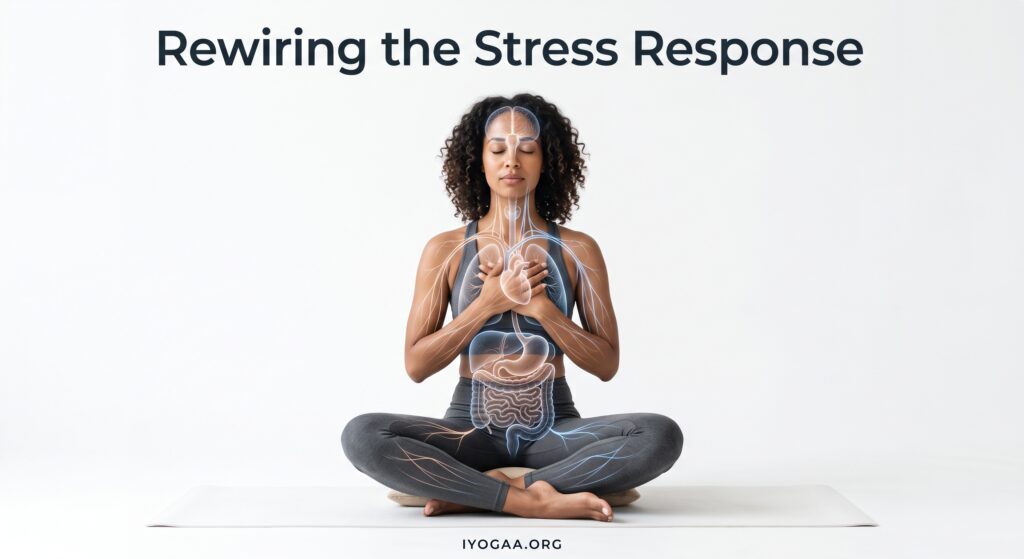
We often speak of stress as a psychological burden—a product of overcommitted calendars, cognitive overload, or relentless deadlines. Yet, from a neurobiological perspective, stress is inherently visceral. Long before your conscious mind formulates a thought about feeling overwhelmed, your autonomic nervous system (ANS) has already evaluated your environment for safety or threat, adjusting your physiology accordingly.
When stress becomes chronic, the body loses its capacity to return to baseline equilibrium. Traditional approaches often rely on top-down cognitive strategies to “think through” or manage stress. However, because the neurocircuitry of stress operates below conscious thought, true recovery requires a bottom-up approach. By examining the intersection of Polyvagal Theory and interoceptive yoga, we can understand how somatic, body-centered practices systematically rewire the physiological stress response.
Neuroception: How the Nervous System Evaluates Safety
Formulated by neuroscientist Dr. Stephen Porges, Polyvagal Theory transforms our understanding of the autonomic nervous system. Rather than viewing the ANS as a simple two-part toggle between “fight-or-flight” (sympathetic) and “rest-and-digest” (parasympathetic), Polyvagal Theory outlines a three-tiered evolutionary hierarchy of autonomic states:
- Ventral Vagal Complex (Social Engagement): The newest evolutionary state, mediated by the myelinated vagus nerve. It promotes social connection, emotional regulation, low heart rate, and a felt sense of safety.
- Sympathetic Nervous System (Mobilization): The classic fight-or-flight pathway, characterized by elevated heart rate, heightened muscle tone, and increased cortisol release.
- Dorsal Vagal Complex (Immobilization): The oldest survival mechanism. Under extreme or inescapable threat, the unmyelinated vagus nerve triggers a shutdown response—manifesting as numbing, dissociation, or profound fatigue.
The brain shifts between these states through neuroception—an subconscious physiological process that continuously scans internal and external cues for safety. When chronic stress disrupts neuroception, the body remains trapped in mobilization or immobilization, even when no external threat exists.
Interoception as the Gateway to Ventral Vagal Anchor
To transition out of a chronic stress loop, the brainstem requires non-verbal, physiological proof that the threat has passed. This is where interoception—the sensory awareness of internal bodily states—becomes vital.
The vagus nerve is an information highway, but 80% of its fibers are afferent, meaning they carry signals upwards from the bodily organs to the brain, rather than top-down from brain to body. Interoceptive yoga utilizes this physiological architecture to shift autonomic tone through targeted somatic feedback.
1. Diaphragmatic Retraining and the Vagal Brake
Superficial, rapid breathing signals mobilization to the brainstem. Conversely, slow, diaphragmatic breathing activates the “vagal brake”—a mechanism where the ventral vagus nerve slows heart rate during exhalation.
- The Clinical Practice: In restorative or gentle interoceptive postures, emphasis is placed on extending the expiratory phase of the breath while maintaining internal awareness of the movement of the diaphragm against the abdominal organs.
- The Biological Result: Interoceptively tracking the sensation of extended exhalations stimulates cardiac vagal efferents. Heart rate decreases, blood pressure stabilizes, and the brain receives clear afferent signals of safety.
2. Visceral Somatic Mapping and Insular Cortex Activation
During mobilization, the brain restricts awareness of internal visceral states to prioritize external action. Interoceptive yoga systematically directs attention back inward to cultivate micro-awareness of tension patterns, tissue temperature, and internal rhythm.
- The Clinical Practice: Holding slow, sustained postures—such as a supported lateral stretch—while consciously mapping the exact boundary of internal physical sensation without attempting to force or perform.
- The Biological Result: Interoceptive attention activates the anterior insular cortex. This neural pathway sends direct inhibitory signals to the amygdala, signaling that internal physiological states can be safely experienced, effectively lowering sympathetic arousal.
Re-Anchoring the Autonomic System at IYOGAA
Rewiring the stress response is not about eliminating stress entirely; it is about restoring autonomic flexibility—the ability to shift fluidly between states of action and repair without getting stuck in survival loops.
At iyogaa.org, our clinical, interoceptive approach uses the principles of Polyvagal Theory to give you direct control over your physiology. By leveraging bottom-up somatic awareness, you train your nervous system to return to its natural baseline of ventral vagal safety, resilience, and vitality.
Research References
- Porges, S. W. (2007). The Polyvagal Perspective. Biological Psychology, 74(2), 116-143. (Provides the theoretical framework for autonomic hierarchy, neuroception, and vagal regulation).
- Farb, N., Daubenmier, J., Price, C. J., Gard, T., Kerr, C., Dunn, B. D., … & Mehling, W. E. (2015).Interoception, contemplative practice, and health. Frontiers in Psychology, 6, 763. (Detailing how body-focused contemplative practices engage interoceptive pathways to modulate stress and autonomic regulation).
- Sullivan, M. B., Erb, M., Schmalzl, L., Moonaz, S., Nayer, J. Taylor, & Kobasa, R. (2018). Yoga Therapy and Polyvagal Theory: The Convergence of Traditional Yoga Theory and Contemporary Neuroscience for Self-Regulation. Frontiers in Human Neuroscience, 12, 67. (Explores the integration of polyvagal mechanics within therapeutic yoga contexts for systemic neural recalibration).