
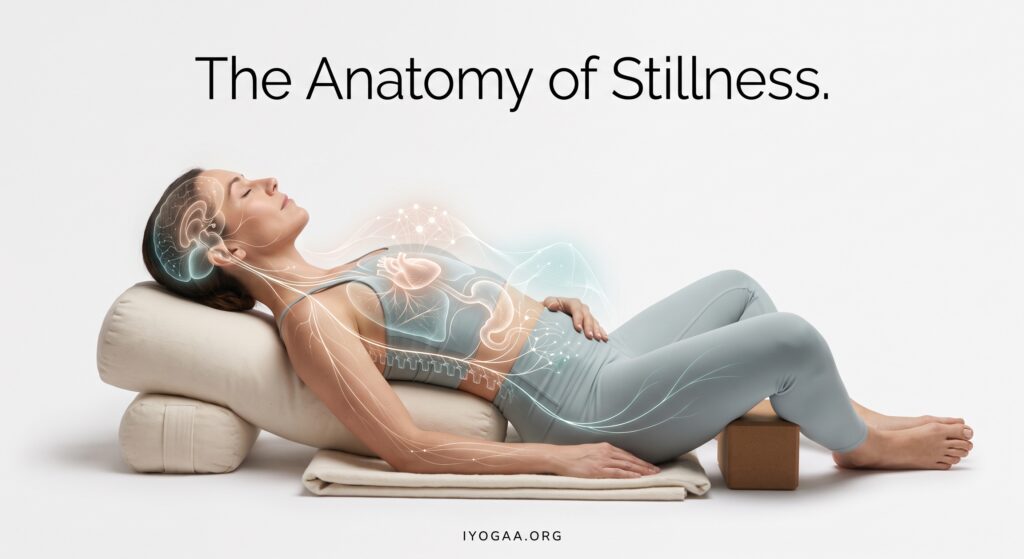
Burnout is frequently mischaracterized as a failure of time management or psychological resilience. In reality, chronic burnout is a state of severe physiological dysregulation. It occurs when prolonged exposure to stress keeps the sympathetic branch of the autonomic nervous system locked in a high-arousal state, continuously flooding the body with cortisol and proinflammatory cytokines.
Over time, this sensory overstimulation causes the brain to dull its internal alarm system to survive. This phenomenon—the degradation of interoception, or the brain’s ability to sense and interpret internal visceral signals—is the core biological driver of burnout.
When you can no longer accurately register subtle internal signals like heart rate variability, muscular tension, or shallow breathing, your body loses its capacity to self-regulate. Healing burnout requires more than passive rest; it demands a clinical, bottom-up recalibration of the nervous system. Here is how the anatomy of stillness uses interoception to repair burnout at the cellular level.
The Neurobiology of “Unchecked” Stress
Under normal conditions, your nervous system operates like a dynamic pendulum. The sympathetic system ramps up energy for action, and the parasympathetic system—regulated largely by the vagus nerve—down-regulates arousal to foster rest, digestion, and cellular repair.
In chronic burnout, this pendulum breaks. The prefrontal cortex attempts to “think” its way out of exhaustion (a top-down approach), forcing the body to keep performing despite systemic fatigue. Because top-down cognitive strategies do not address the physiological state of the tissues, the brainstem remains convinced that safety is absent.
To break this loop, we must recruit the insular cortex—the neural hub of interoception. By directing conscious, non-judgmental attention to visceral bodily sensations, interoceptive yoga re-establishes the sensory pathway between body and brain.
Step 1: Retraining Visceral Sensitivity through Passive Stillness
In conventional yoga, stillness is often treated as an endgame—a brief Savasana at the conclusion of a rigorous physical practice. In interoceptive clinical yoga, stillness is the primary therapeutic mechanism.
When you settle into a fully supported, long-held posture (such as Supta Baddha Konasana or supported Viparita Karani), you eliminate the demand for postural adjustment. With external movement neutralized, the nervous system can redirect its bandwidth inward.
- The Interoceptive Shift: Rather than focusing on how a pose looks, you focus on visceral sensation—the sensation of gravity compressing the fascia, the subtle pulse of blood in the fingertips, or the temperature of air at the nostrils.
- The Biological Impact: This granular awareness activates the anterior insular cortex. This neural stimulation signals to the amygdala that the present moment is safe, actively dampening the sympathetic stress response and lowering circulating baseline cortisol.
Step 2: Re-Engaging the Vagal Brake
The vagus nerve acts as the primary “brake” on the heart and endocrine system. When vagal tone is high, heart rate variability (HRV) increases, signaling high autonomic flexibility and resilience to stress. Burnout severely suppresses vagal tone.
Interoceptive stillness leverages the respiratory sinus arrhythmia (RSA)—a natural phenomenon where heart rate speeds up slightly on inhalation and slows down on exhalation.
- The Clinical Intervention: Practicing stillness accompanied by extended, smooth exhalations (such as a 4-second inhalation paired with a 7-second exhalation).
- The Biological Impact: Prolonged exhalations mechanically stimulate the stretch receptors in the pulmonary tissue, sending immediate signals down the afferent vagal fibers to the brainstem. The brain responds by releasing acetylcholine, instantly slowing heart rate and initiating systemic parasympathetic recovery.
Step 3: Reclaiming the Homeostatic Baseline
Restoring a burned-out system requires moving from performance to presence. When stillness is applied systematically, the brain slowly relearns the baseline of physiological equilibrium. You begin to recognize subtle signals of depletion before they manifest as catastrophic fatigue or illness.
At iyogaa.org, we view stillness not as absence of movement, but as an active, high-precision biological state. By grounding your practice in interoceptive mapping, you provide your nervous system with the exact biological conditions it requires to repair cellular damage, restore vagal tone, and permanently overcome chronic burnout.
Research References
- Craig, A. D. (2009). How do you feel—now? The anterior insula and human awareness. Nature Reviews Neuroscience, 10(1), 59-70. (Establishes the neural basis of interoception within the insular cortex and its role in biological self-regulation).
- Porges, S. W. (2011). The Polyvagal Theory: Neurophysiological Foundations of Emotions, Attachment, Communication, and Self-regulation. W. W. Norton & Company. (Provides the foundational clinical model for autonomic nervous system states and vagal tone regulation).
- Taylor, A. G., Goehler, L. E., Galper, D. I., Innes, K. E., & Bourguignon, C. (2010). Top-down and bottom-up mechanisms in mind-body therapies: Implications for levels of central nervous system functioning. Neurochemical Research, 35(12), 2008-2019. (Explains how bottom-up somatic practices shift autonomic regulation to alleviate chronic stress and exhaustion).