
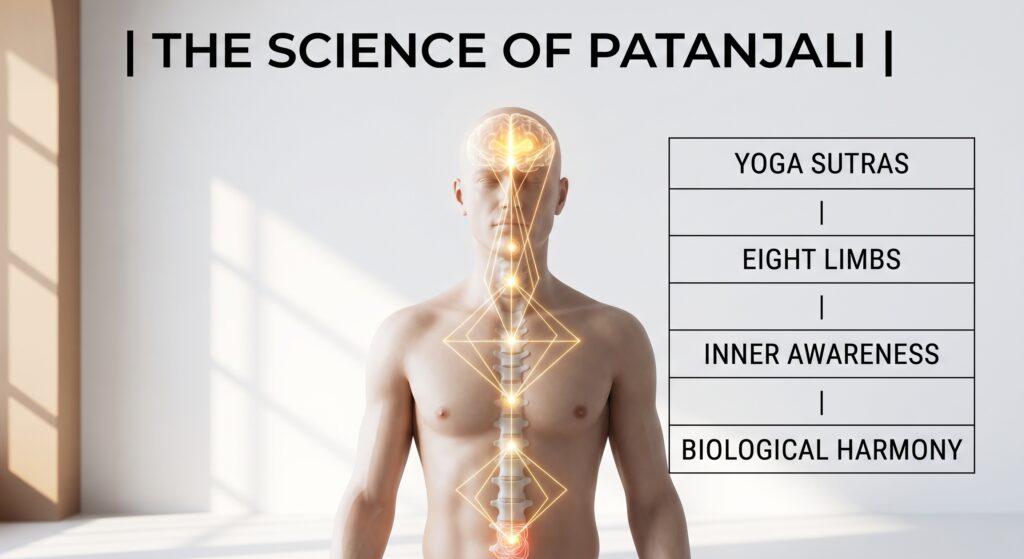
Interoceptive Neuroscience & Patanjali’s Yoga Sutras
In the modern pursuit of health, we often separate ancient philosophy from biological function. At IYogaa.org, we approach the classical teachings through the lens of interoceptive neuroscience. Patanjali’s Yoga Sutras are not merely metaphysical texts; they constitute a systematic, high-precision manual for mapping the internal state of the body, achieving inner awareness, and restoring biological harmony.
As a Research Scientist, Doctor of Natural Medicine, and Yogi, I view the Yoga Sutras as a pragmatic protocol for neural retraining and self-mastery.
Patanjali’s Eight Limbs as Neural Architecture
Patanjali outlines Ashtanga (the eight limbs) as a progressive framework. From the perspective of interoceptive neuroscience, each limb serves a specific physiological and cognitive function:
- Yamas and Niyamas (Ethical Disciplines): These behavioral anchors reduce systemic stress and lower baseline sympathetic arousal, creating a stable internal environment.
- Asana (Posture): Physical alignment provides a consistent framework for somatic mapping, training the nervous system to process proprioceptive and interoceptive signals accurately.
- Pranayama (Breath Control): Rhythmic breath regulation directly stimulates the vagus nerve and modulates autonomic tone.
- Pratyahara (Sensory Withdrawal): By intentionally dampening external sensory inputs, the brain redirects computational power inward toward the insular cortex—the core hub for interoception.
- Dharana, Dhyana, and Samadhi (Focus, Meditation, Integration): These advanced stages train the brain to sustain high-resolution inner awareness without distraction, resulting in complete functional integration and biological harmony.
Research and Evidence: Bridging Text and Lab
Scientific investigation into contemplative practices validates Patanjali’s ancient structural model:
- Insular Cortex Plasticity: Neuroimaging studies confirm that long-term contemplative practices associated with the Yamas, Pranayama, and Dhyana lead to structural thickening of the insular cortex, enhancing our ability to process internal bodily signals.
- Autonomic Regulation: Research on traditional breath and posture protocols demonstrates significant improvements in heart rate variability (HRV) and stress-response modulation.
- Embodiment vs. Attention: Clinical inquiries into interoception—such as my research published in the International Body Psychotherapy Journal—demonstrate that disciplined internal focus bridges the gap between passive attention and true physical embodiment.
Interoceptive Yoga: The Pragmatic Application
At IYogaa.org, we utilize the philosophy of the Yoga Sutras to drive measurable health outcomes.
| Classical Limb | Neuro-Somatic Action | Functional Result at IYogaa.org |
|---|---|---|
| Asana | Structural stabilization. | Eliminates biological friction and musculoskeletal strain. |
| Pranayama | Autonomic modulation. | Optimizes respiratory efficiency and neural alertness. |
| Pratyahara | Internal sensory redirection. | Sharpens the brain’s interoceptive mapping capabilities. |
By treating Patanjali’s text as a manual for biological efficiency, the modern practitioner moves beyond vague wellness concepts into absolute power and authority over their internal state.
Reclaiming Your Authority
The Yoga Sutras offer a timeless blueprint for self-regulation. By integrating these philosophical pillars with modern interoceptive science, you unlock peak performance and maintain a lean, resilient biological vessel. Visit IYogaa.org to explore our clinical programs and start your journey toward true systemic mastery.
Dr. Nitasha Buldeo
Research Scientist, Doctor of Natural Medicine, and Yogi
References
- Buldeo, N. Interoception: A Measure of Embodiment or Attention? International Body Psychotherapy Journal.
- Lazar, S. W., et al. (2005). Meditation experience is associated with increased cortical thickness. NeuroReport.
- Telles, S., et al. (2020). Changes in Autonomic Variables Following Traditional Yogic Practices.