
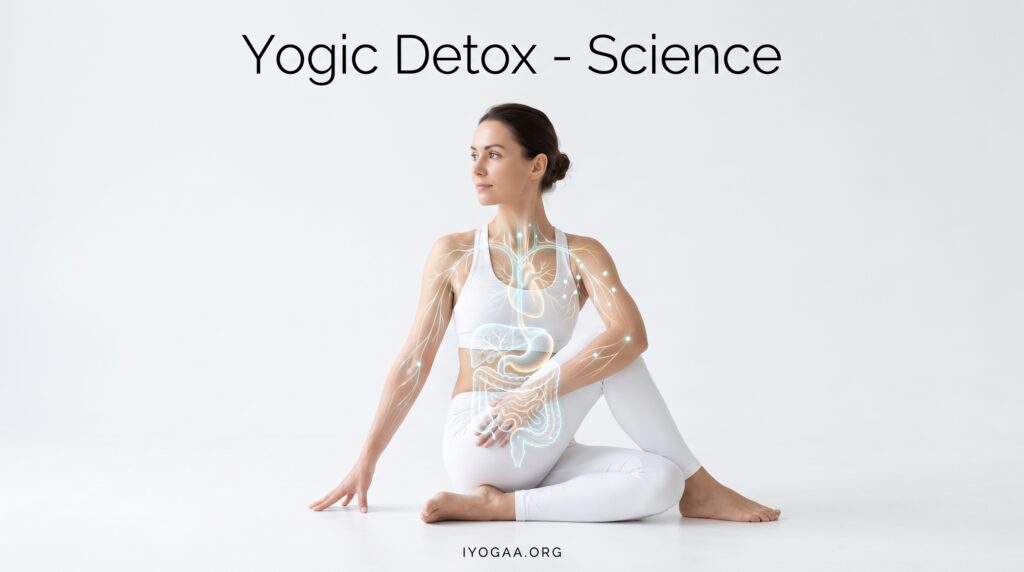
In today’s wellness landscape, the word “detox” is everywhere, usually attached to expensive supplements, restrictive diets, or aggressive exercise plans. This external, “fix-it-from-the-outside” approach often leaves us feeling depleted rather than purified. It overlooks a fundamental scientific truth: your body possesses an incredibly sophisticated, built-in detoxification system that runs 24/7.
At iyogaa.org, we approach purification not as a seasonal subtraction, but as an ongoing addition of awareness.Traditionally, yoga refers to this concept as Saucha (purity). From a modern, clinical perspective, we understand this process through interoception—our ability to sense the internal state of the body.
True yogic purification is the science of supporting your biological hardware by tuning in to your physiological software.
The Myth of “Toxin Removal” vs. Biological Reality
The liver, kidneys, lungs, digestive tract, skin, and lymphatic system constitute your body’s dedicated “detox team.” They don’t need magic potions; they need optimal conditions to perform their jobs.
Modern stress creates physiological noise that deafens us to our internal signals. We miss the cues of digestion, thirst,inflammation, and fatigue. When we live solely “in our heads,” we ignore the subtle physical “residue” created by metabolic processes and stress hormones like cortisol.
Traditional Hatha Yoga utilizes specific techniques known as Shatkarmas (six cleansing actions) to support these organs.While some traditional techniques are advanced, the underlying science is accessible to every practitioner through an interoceptive lens.
Autonomic Regulation: The Master Key to Purification
The foundation of biological purification is the state of your nervous system. When you are in a chronic sympathetic state (fight-or-flight), your body deprioritizes elimination, digestion, and repair to focus on immediate survival.
This is where standard fitness-based yoga and interoceptive yoga diverge regarding “detox.”
Clinical research demonstrates that yoga practice rooted in slow movement and breath awareness is unparalleled at regulating the autonomic nervous system, increasing vagal tone, and shifting the body into the parasympathetic (rest-and-digest) state (Streeter et al., 2012).
Through interoception, we monitor the subtle shifts—the slowing heart rate, the softening of the jaw, the ease in the breath. This feedback loop is essential because elimination cannot happen optimally until the body signals that it is safe.We do not force a detox; we create the neurological prerequisites for it to occur naturally.
The Shatkarmas Through an Interoceptive Lens
While iyogaa.org honors traditional practices, we view them through the lens of modern physiology and self-sensing.
Kapalabhati (Breath of Fire): Supporting Metabolism
Traditionally used to clear the respiratory passages, Kapalabhati involves strong, rhythmic diaphragmatic contractions.From a scientific perspective, this breathing technique supports purification via respiratory alkalosis (mild) and enhances the mechanical movement of the diaphragm.
When practiced interoceptively, you are not just forcing air. You are sensing the internal ripple effect—feeling the pump of the breath moving lymphatic fluid in the thoracic duct and massaging the digestive organs, supporting mechanical elimination.
Mindful Twists: The Myth of “Wringing Out”
Fitness yoga often uses twists with the narrative of “wringing out toxins” from the organs like a sponge. Physiology tells us this is an oversimplification. Your organs don’t get squeezed dry.
The actual purification benefit of a twist lies in blood flow dynamics. As you enter a twist slowly, paying close attention to the internal resistance, you create a mild, temporary restriction in circulation. The moment you release the pose, observing the feeling of release (this is the interoceptive key), a rush of fresh, oxygenated, nutrient-rich blood floods back into the area. This “flush” supports the liver and digestive organs in doing their dedicated cleansing work (McCall, 2007).
Interoception: Your Homeostatic Guide
The ultimate scientific mechanism of yogic detox is homeostatic regulation. Chronic accumulation of physical and mental residue occurs because we ignore internal data. We push through hunger, hold tension, and ignore fatigue.
Interoception gives you the early warning data to adjust before stagnation occurs. When you feel a tight diaphragm, you know to breathe. When you feel digestive sluggishness, you adjust your food or movement. Yoga refines your interoceptive accuracy, turning you from a passive observer into an active participant in your body’s regulatory chemistry (Farb et al., 2015).
Traditional yogic purification is not a punishment or a marketing gimmick. It is the sophisticated, internal science of coming home to your body, listening closely, and removing the physiological and neurological obstacles that hinder its natural, brilliant ability to renew itself from the inside out. Practice with us at iyogaa.org to discover this sustainable,empowered path to purity.
Research References
- Farb, N., et al. (2015). Interoception, contemplative practice, and health. Frontiers in Psychology, 6, 763.
- McCall, T. (2007). Yoga as Medicine: The Yogic Prescription for Health and Healing. Bantam.
- Streeter, C. C., et al. (2012). Effects of yoga on the autonomic nervous system, gamma-aminobutyric-acid, and allostasis in epilepsy, depression, and post-traumatic stress disorder. Medical Hypotheses, 78(5), 571-579.