
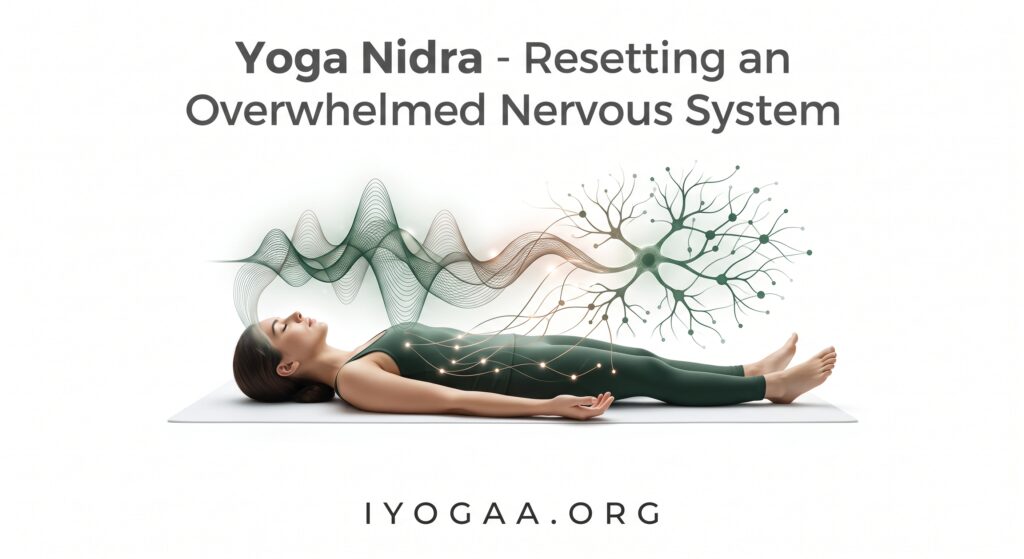
We are living through an epidemic of nervous system fatigue. Between the constant influx of digital information, high-pressure careers, and the inescapable speed of modern life, our biological hardware is burning out. We try to fix this exhaustion by sleeping more, but many of us wake up feeling just as drained.
This happens because sleep and rest are not the same biological states. You can be unconscious but still locked in a state of neurological stress.
At IYogaa.org, we utilize Yoga Nidra—often referred to in clinical settings as Non-Sleep Deep Rest (NSDR)—as a highly targeted interoceptive intervention. It is not just a guided nap. It is a precise, scientifically validated method for down-regulating an overwhelmed autonomic nervous system, clearing out the backlog of stress hormones, and returning your brain to a baseline of deep physiological safety.
The Interoceptive Sweep
The core mechanism of Yoga Nidra is the body scan, a continuous rotation of consciousness through different physical quadrants of the body. From an interoceptive perspective, this is a highly active neurological process.
When you are guided to bring your awareness to your right thumb, you are not just thinking about your thumb. You are actively engaging your somatosensory cortex and your insula—the brain regions responsible for mapping physical sensation and internal bodily states.
By rapidly and systematically moving your attention from your thumb, to your wrist, to your elbow, you are forcing the brain to process raw interoceptive data without attaching emotional narratives to it. This continuous, focused internal tracking interrupts the brain’s default mode network (the region responsible for rumination and anxiety), abruptly halting the production of stress hormones like cortisol and adrenaline.
Hacking Your Brainwaves
Your brain operates on different electrical frequencies depending on your state of arousal. Most of us spend our waking lives in a Beta state—highly alert, analytical, and often stressed. When we are constantly in Beta, the nervous system begins to fray.
Yoga Nidra serves as a manual override for your brainwaves. As you lie in complete physical stillness (Savasana) and follow the interoceptive cues, your brain begins to shift gears:
- Alpha Waves: As your external focus softens and you tune into the internal landscape, your brain shifts into an Alpha state, initiating deep muscular relaxation and mental calm.
- Theta Waves: As the practice deepens, you cross the threshold into Theta. This is the elusive twilight state between wakefulness and sleep. In Theta, your brain begins to process and clear out emotional backlog, and neuroplasticity—the brain’s ability to rewire itself—is drastically enhanced.
- Delta Waves: Advanced practitioners can reach Delta states while remaining consciously aware. This is the most restorative frequency, where cellular repair, immune system boosting, and profound biological healing occur.
The Parasympathetic Reset
The true power of Yoga Nidra lies in its ability to manipulate the autonomic nervous system. Chronic stress keeps us locked in sympathetic overdrive (fight-or-flight). Your heart rate variability drops, your digestion slows, and your body braces for impact.
By utilizing interoceptive awareness in absolute physical stillness, Yoga Nidra sends a massive, continuous signal of safety up the vagus nerve to the brainstem. This forces a systemic shift into parasympathetic dominance (rest-and-digest). Blood flow is redirected to the internal organs, the resting heart rate plummets, and systemic inflammation begins to subside. You are essentially pressing the factory reset button on your biology.
Practicing at IYogaa.org
To experience the neurological benefits of Yoga Nidra, your approach must be intentional. Here is how to prepare your hardware for the reset:
- Commit to Absolute Stillness: Every time you move, you pull the brain out of its descent and back into active Beta waves. Find a comfortable position, use props for support, and commit to not moving a single muscle.
- Track, Do Not Visualize: When guided to feel a body part, do not picture it in your mind. Feel the actual sensation—the temperature, the weight, the tingling. This distinction is what activates the interoceptive network.
- Let Go of Doing: There is nothing to achieve in this practice. If you fall asleep, your body needed the sleep. If you stay awake, you are training your nervous system. Surrender entirely to the process.
You cannot always control the stressors in your external environment, but you can control how your nervous system responds to them. Through Yoga Nidra, profound rest is no longer a luxury; it is a vital, accessible upgrade for your brain and body.
Research References & Citations
- Datta, K., Tripathi, M., & Mallick, H. N. (2017). Yoga Nidra: An innovative approach for management of chronic insomnia—A case report. Sleep Science and Practice, 1(1), 7.
- Desai, R., Tailor, A., & Bhatt, T. (2015). Effects of yoga on brain waves and structural activation: A review. Complementary Therapies in Clinical Practice, 21(2), 112-118.
- Parker, S., Bharati, S. V., & Fernandez, M. (2013). Defining yoga-nidra: Traditional accounts, physiological research, and future directions. International Journal of Yoga Therapy, 23(1), 11-16.