
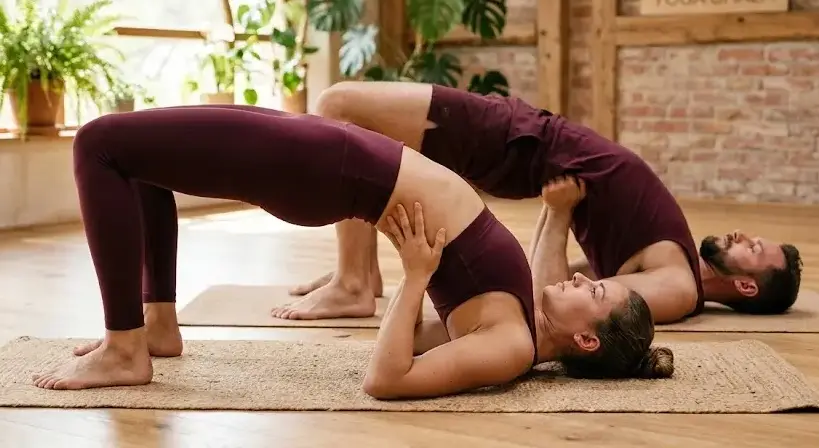
Couples yoga poses refer to coordinated movement patterns performed with a partner, where load distribution and timing are shared across two bodies. In most home routines, these movements are introduced before stabiliser systems are neurologically primed. This results in spinal loading occurring on an unstable base, which explains why stiffness returns within hours despite consistent practice.
Key Takeaways
- Couples yoga poses fail due to sequencing, not pose selection
- Stabiliser activation must precede any shared spinal loading
- Breath mechanics regulate intra-abdominal pressure before movement
- Partner support can mask instability instead of correcting it
- Correct sequencing reduces stiffness recurrence within the same day
- Skipping stabilisation saves time but maintains the underlying issue
Where do couples yoga poses fail in morning sequencing?
Couples yoga poses typically fail at the transition point between passive mobility work and active load-bearing. The issue is not the pose selection, but the absence of pre-load stabilisation.
In home practitioners aged 30–55, stiffness recurrence correlates with early spinal flexion or extension before deep stabilisers—particularly transverse abdominis and multifidus—are engaged. When two-person yoga poses involve shared balance or assisted leverage, this instability compounds due to external force input.
Common structural errors observed:
- Spinal loading introduced within first 3–5 minutes of practice
- No isolated breath-driven activation phase before movement
- Reliance on partner support instead of internal stability
- Movement tempo dictated externally, not by breath cycle
In a morning setting, intervertebral discs are more hydrated, increasing sensitivity to compressive force. Loading at this stage without stabilisation increases micro-instability, not flexibility.
What stabiliser systems must be activated before partner yoga poses?
Couples yoga poses require pre-activation of deep stabilisers to create load tolerance before shared movement begins.
The sequence must prioritise:
- Transverse abdominis activation
Measurable via ability to maintain abdominal tension during slow exhale without rib flare (minimum 5-second hold) - Multifidus engagement
Assessed through segmental spinal control during minimal pelvic tilt movements - Diaphragmatic breath control
Required to regulate intra-abdominal pressure before load transfer - Pelvic floor coordination
Observable through timing with exhalation rather than isolated contraction
Without this phase, partner yoga poses introduce force into an unregulated system. For example, in assisted forward folds, the partner’s downward pressure increases lumbar flexion demand without segmental support, leading to compensatory stiffness later in the day.
How should breath mechanics prime two person yoga poses?
Two person yoga poses should only begin after breath establishes a predictable stabilisation pattern.
The required method is a 3-phase breath primer:
- Supine controlled exhale (2–3 minutes)
Focus: slow exhale to engage transverse abdominis
Measure: exhale duration ≥ 6 seconds without chest collapse - Quadruped breath with limb loading (2 minutes)
Focus: maintaining spinal neutrality under light limb movement
Measure: no visible spinal shift during arm/leg lift - Standing breath under axial load (1–2 minutes)
Focus: maintaining pressure during upright posture
Measure: consistent breath rhythm under bodyweight load
This sequence creates neurological readiness. Without it, partner yoga introduces unpredictable force patterns that the body compensates for through superficial muscle tension.
Why do partner yoga poses increase stiffness despite regular practice?
Partner yoga poses increase stiffness when external support replaces internal control.
This creates a dependency pattern:
- The partner stabilises the movement instead of the core system
- The spine moves through range without segmental control
- The nervous system does not register the movement as stable
Non-obvious insight:
In solo practice, instability leads to visible loss of balance. In couples yoga poses, the partner masks instability, allowing poor mechanics to continue undetected.
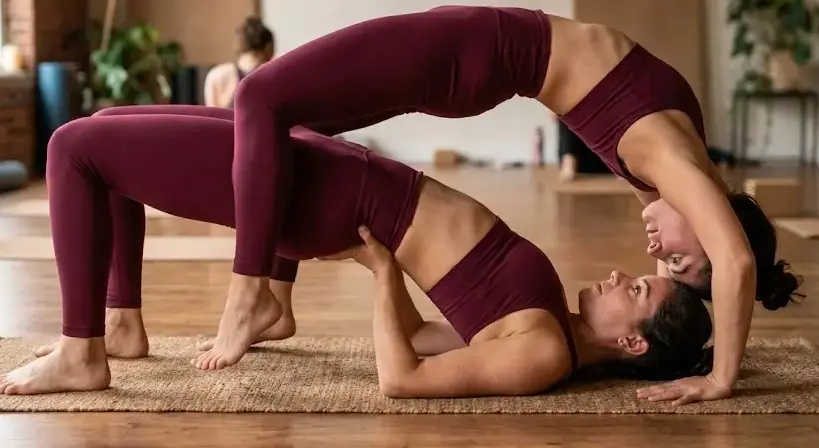
For example, in shared backbends, the assisting partner reduces perceived effort, but lumbar segments absorb uncontrolled extension. The result is delayed stiffness rather than immediate discomfort.
How should couples yoga poses be sequenced for spinal loading safety?
Couples yoga poses must follow a strict progression where stabilisation precedes shared load.
Correct sequencing model:
| Phase | Duration | Primary Function | Load Type | Outcome |
| Breath activation | 4–6 min | Neurological priming | No external load | Stabiliser engagement |
| Isolated control | 3–5 min | Segmental movement | Bodyweight only | Motor control |
| Solo load introduction | 3–4 min | Controlled spinal loading | Self-generated | Load tolerance |
| Partner integration | 5–8 min | Shared load patterns | External force | Coordinated stability |
Deviation from this order leads to early spinal loading under unstable conditions.
In home practice settings, this restructuring alone reduces stiffness recurrence because load is introduced only after control is established.
When does this method not resolve stiffness recurrence?
This method does not resolve stiffness when the limitation is not stabiliser-related.
Conditions where it is insufficient:
- Structural disc pathology requiring clinical intervention
- Persistent nerve-related symptoms (radiating pain, numbness)
- Inability to maintain neutral spine under minimal load
Trade-off:
This sequencing reduces stiffness recurrence but increases session duration by 8–12 minutes. For practitioners with limited time, skipping the stabilisation phase reintroduces the original problem.
Conclusion
Couples yoga poses must be preceded by breath-driven stabiliser activation before any shared spinal loading occurs. This restructuring applies specifically to home-based morning yoga routines where stiffness returns despite consistency. Change the sequence, not the poses.
FAQs
Why do couples yoga poses cause stiffness later in the day?
Because spinal loading occurs before stabilisers are activated, creating micro-instability that the body compensates for afterward.
Can partner yoga poses replace core activation work?
No, external support reduces the need for internal stabilisation, preventing proper engagement.
How long should the stabilisation phase last before two person yoga poses?
A minimum of 6–10 minutes is required to establish effective neuromuscular control.
Are two person yoga poses unsafe for lower back stiffness?
They are safe only when introduced after stabiliser activation and controlled loading phases.
What is the main mistake in sequencing partner yoga poses?
Introducing shared load before establishing internal spinal stability.
Sources
https://www.purewow.com/wellness/couples-yoga-poses
https://www.tummee.com/yoga-poses/partner-yoga-poses
https://myyogateacher.com/articles/partner-yoga-poses
https://www.yogakawa.com/blog/couples-yoga-poses
https://welltech.com/content/yoga-sex-positions/