
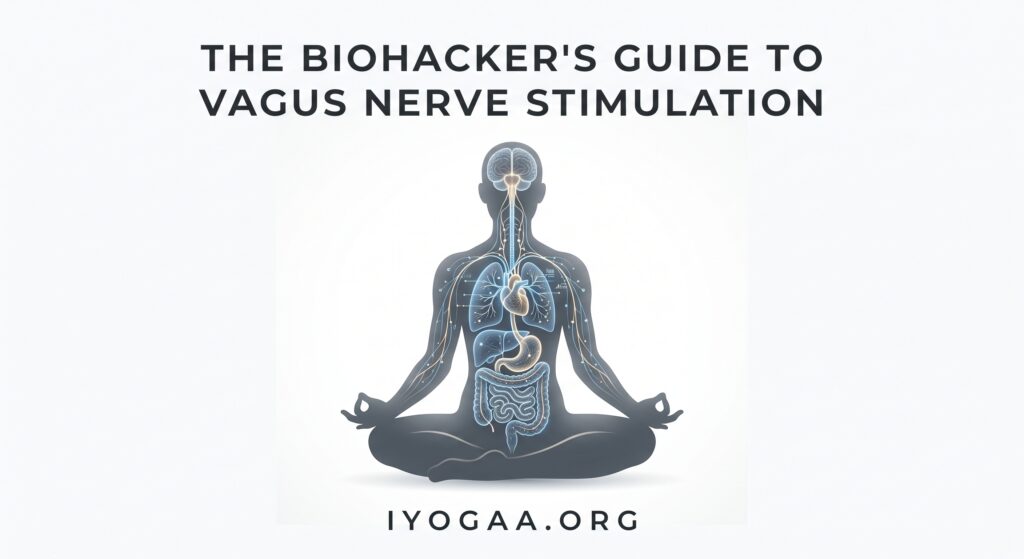
Biohacking is fundamentally about identifying the most efficient inputs to generate the highest possible biological output. You track your sleep cycles, optimize your macros, plunge into ice baths, and measure your Heart Rate Variability (HRV) with clinical obsession. But what if the most powerful lever for biological optimization isn’t a wearable device or a synthesized supplement, but a built-in neural pathway you already possess?
Welcome to the vagus nerve.
At IYogaa.org, we treat yoga not as a mystical stretching routine, but as a precise, interoceptive technology designed to hack your nervous system. Here is how you can use mindful movement to manually stimulate your vagus nerve and optimize your human hardware.
The Vagus Nerve: Your Biological Master Switch
To biohack the body, you must understand the machinery. The vagus nerve (cranial nerve X) is the superhighway of your parasympathetic nervous system. It wanders from your brainstem down through your neck, wrapping around your heart, lungs, and digestive tract.
In the biohacking community, high vagal tone is the holy grail of recovery. It indicates that your body can seamlessly transition from high-stress states (sympathetic arousal) to deep, restorative states (parasympathetic rest). Conversely, low vagal tone is clinically linked to chronic inflammation, brain fog, poor digestion, and delayed recovery times.
Fascinatingly, 80% of the vagus nerve’s fibers are afferent—meaning they send information from the body to the brain, rather than the other way around. This structural reality proves that you cannot simply “think” your way out of stress. You must use your physical body to signal safety to your brain.
The Interoceptive Interface
How do you actively stimulate this vital nerve? You cannot massage it directly, but you can access it through the mechanism of interoception.
Interoception is your brain’s ability to sense, interpret, and integrate the internal state of your body. It is how you detect a racing heart, shallow breath, or muscular tension. If the vagus nerve is the physical hardware, interoception is the software. By fine-tuning your interoceptive awareness on the yoga mat, you gain manual control over otherwise automated biological processes.
Interoceptive Yoga vs. Standard Stretching
Most conventional fitness-based yoga classes focus heavily on biomechanics—achieving a specific aesthetic or maximizing physical flexibility. Interoceptive yoga entirely flips this script, prioritizing neurobiology over muscular stretching.
When you place your body under the mild physical stress of an asana (posture) and consciously regulate your breath and internal awareness, you send a potent, bottom-up signal via the vagus nerve to the brain. You are actively teaching your nervous system to remain adaptable, clear, and calm under pressure. This is targeted Vagus Nerve Stimulation (VNS) without the need for electronic neuromodulation devices.
The IYogaa.org Protocol for Vagal Tone
Ready to biohack your time on the mat? Here is how to apply interoceptive principles to your next practice to maximize natural Vagus Nerve Stimulation:
- Implement the 1:2 Breath Ratio: The most direct mechanical way to stimulate the vagus nerve is through the movement of the diaphragm. During your practice, intentionally make your exhalations twice as long as your inhalations. This deliberate mechanical action slows your resting heart rate and fires up vagal pathways.
- Track the Micro-Sensations: Biohackers love tracking data. Treat your internal physical sensations as vital data points. When holding a challenging pose, scan for internal resistance, fluctuations in heart rate, and localized temperature shifts. Observing these metrics calmly trains the insular cortex, upgrading your brain’s emotional regulatory capacity.
- Master the Rebound: The magic of VNS does not just happen during physical exertion; the most critical adaptation occurs in the release. After a sequence, lie in Savasana (Corpse Pose) and actively track the sensation of your nervous system down-regulating. This conscious, tracked relaxation cements neuroplastic changes.
True biological optimization requires more than just external inputs; it demands internal mastery. By integrating the rigorous science of interoception with mindful movement, you can manually upgrade your autonomic nervous system.
Research References & Citations
- Porges, S. W. (2011). The polyvagal theory: neurophysiological foundations of emotions, attachment, communication, and self-regulation. W. W. Norton & Company.
- Streeter, C. C., Gerbarg, P. L., Saper, R. B., Ciraulo, D. A., & Brown, R. P. (2012). Effects of yoga on the autonomic nervous system, gamma-aminobutyric-acid, and allostasis in epilepsy, depression, and post-traumatic stress disorder. Medical Hypotheses, 78(5), 571-579.
- Gerritsen, R. J., & Band, G. P. (2018). Breath of Life: The Respiratory Vagal Stimulation Model of Contemplative Activity. Frontiers in Human Neuroscience, 12, 397.