
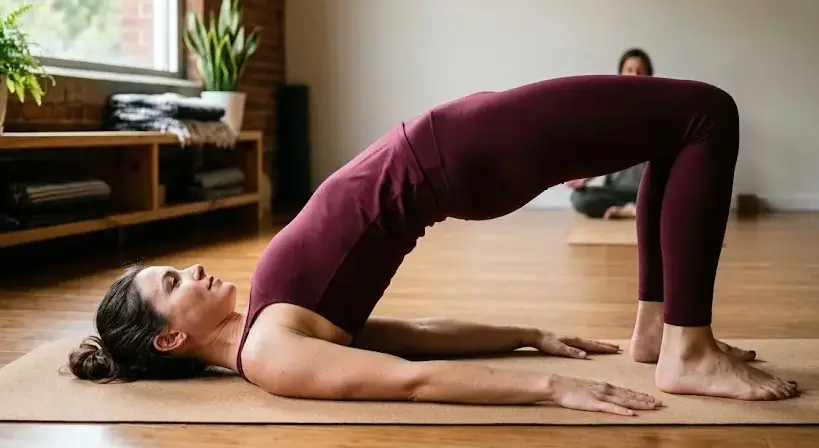
Yoga exercises refers to structured movement patterns combining breath, joint positioning, and muscular control under load. In a morning routine, its primary function is to prepare the spine for daily compression and movement. When sequencing is incorrect, passive tissues absorb load before stabilisers engage, leading to recurring stiffness within hours of practice.
Key Takeaways
- Yoga exercises effectiveness depends on activation sequence, not movement selection
- Stabiliser engagement must precede spinal movement to reduce mechanical stress
- Breath functions as a pressure-regulation system, not a relaxation tool
- The transition phase between activation and movement is the primary failure point
- Reduced range and slower tempo improve long-term spinal stability
- Mobility-first routines provide short-term relief but reinforce instability patterns
What defines a structurally correct yoga exercises sequence?
Yoga exercises become effective only when stabilisers engage before visible movement begins. Most home practitioners reverse this order, initiating range-of-motion work before establishing segmental control.
A structurally correct sequence follows three phases:
- Neurological preparation (2–4 minutes)
Slow breath cycles regulating intra-abdominal pressure
Example: Supine breathing where exhalation duration exceeds inhalation by 2 seconds - Segmental stabiliser activation (3–6 minutes)
Low-load contractions targeting deep spinal support
Example: Isometric pelvic control with minimal visible movement - Controlled spinal loading (5–10 minutes)
Gradual movement introduced under stabilised conditions
Example: Small-range spinal flexion with maintained abdominal tension
Without this order, the lumbar spine moves before it is supported, creating repetitive micro-instability.
Why does stiffness return despite daily yoga for beginners?
Yoga exercises routines often prioritise flexibility over load distribution. This creates short-term relief but does not alter the underlying mechanical pattern.
The issue can be quantified through load timing:
| Variable | Incorrect Routine | Corrected Routine | Measurable Outcome |
| Stabiliser activation timing | After movement begins | Before movement begins | Reduced lumbar shear force |
| Breath coordination | Passive or inconsistent | Controlled exhalation-driven | Improved intra-abdominal pressure |
| Movement amplitude | Large early ranges | Gradual progression | Lower tissue strain |
In adults aged 30–55 working desk-based jobs, delayed stabiliser activation increases spinal load by up to 20–30% during early movement phases. This explains why stiffness reappears within hours despite consistent practice.
How should breath mechanics prime a basic yoga exercises?
Basic yoga exercises begin with breath because it directly regulates spinal stiffness through pressure control. This is not relaxation; it is mechanical preparation.
A structured method:
- Exhale fully to reduce rib flare
Forces engagement of deep abdominal layers - Pause briefly (1–2 seconds)
Establishes baseline tension - Controlled inhale without losing abdominal engagement
Prevents spinal collapse - Repeat for 5–8 cycles before movement
Concrete application:
In a morning routine performed at home, this sequence ensures the lumbar spine is supported before transitioning into movement. Without this, even technically correct positions fail under load.
This is often overlooked in discussions around how to do yoga, where breath is described abstractly rather than as a pressure-regulation mechanism.
Which phase of a beginner yoga routine requires redesign?
The transition between preparation and movement is where most routines fail. The issue is not the exercises themselves, but the absence of a defined transition phase.
Common structure vs corrected structure:
- Common approach
Warm-up → immediate full-range movement - Corrected approach
Breath regulation → stabiliser activation → controlled transition → movement
The transition phase must include:
- Reduced range (30–50% of full movement)
- Slower tempo (minimum 3 seconds per phase)
- Continuous abdominal engagement
Example:
Instead of moving directly into full spinal flexion, begin with micro-movements under tension. This reduces compensatory movement patterns that overload passive tissues.
When does this method work—and when does it not?
Yoga exercise sequencing focused on stabilisation works when stiffness is mechanical and non-specific. It does not apply universally.
Effective when:
- Stiffness appears after inactivity (e.g., morning or prolonged sitting)
- Relief is temporary and returns within hours
- No radiating pain or neurological symptoms present
Limited when:
- Pain includes nerve involvement (e.g., sharp, radiating discomfort)
- Structural pathology is present (disc injury, fracture)
- Inflammation dominates rather than mechanical load imbalance
Trade-off:
Slower routines with reduced range may feel less “productive,” but they improve load distribution. Faster, mobility-focused routines feel effective immediately but reinforce instability patterns.
How can daily yoga exercise be structured for long-term stability?
Daily yoga exercise should prioritise consistency in sequencing rather than variation in movement.
A repeatable framework:
- Phase 1 (3 minutes): Breath-led pressure control
- Phase 2 (5 minutes): Low-load stabiliser activation
- Phase 3 (7 minutes): Controlled movement with limited range
- Phase 4 (optional): Gradual expansion of range if stability is maintained
Real-world application:
For individuals practising 3–5 mornings per week at home, maintaining this structure reduces recurrence of stiffness within 2–3 weeks by improving load tolerance rather than flexibility.
This contrasts with general beginner yoga routines that prioritise variety over structural progression.

Conclusion
Yoga exercise must be restructured so stabiliser activation and breath regulation occur before any spinal loading. This framework applies directly to morning home routines where stiffness returns quickly after practice. For adjacent hormonal regulation contexts, see Yoga poses to regulate periods and reduce PCOS pain.
FAQ
What is the yoga exercise?
A structured system of movement, breath, and muscular control used to prepare the body for load and improve mechanical efficiency.
Can yoga help with nerve damage?
It may assist with movement control, but nerve damage requires medical evaluation and cannot be addressed through sequencing alone.
Can yoga help insulin resistance?
Regular practice can support metabolic regulation indirectly through activity levels, but it is not a primary treatment method.
Which yoga is best for osteoporosis?
Low-load, stability-focused routines that avoid excessive spinal flexion are typically recommended.
Sources
https://en.wikipedia.org/wiki/Yoga_as_exercise
https://nutritionsource.hsph.harvard.edu/yoga/
https://www.verywellfit.com/essential-yoga-poses-for-beginners-3566747
https://www.mea.gov.in/yoga-postures-17.htm
https://www.metropolisindia.com/blog/preventive-healthcare/yoga-for-weight-loss
https://www.youtube.com/watch?v=qsB9-kmYH9A
https://srisrischoolofyoga.org/na/blog/10-best-yoga-poses-for-beginners/