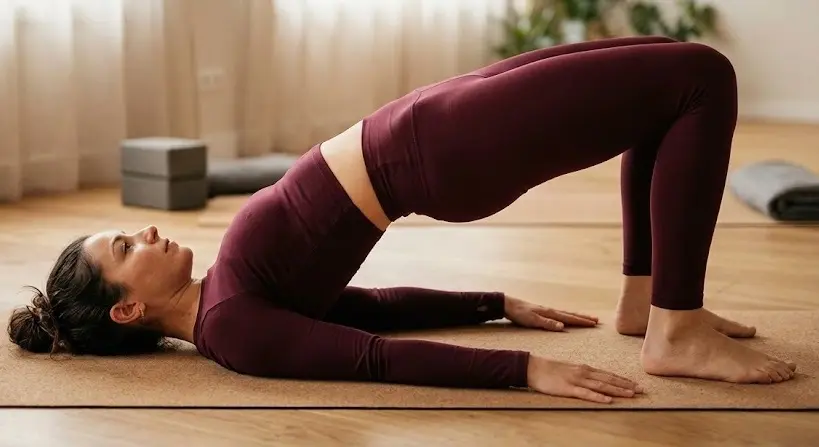
Yoga for beginners is the structured application of breath, stabilisation, and movement to manage load across joints and soft tissue. When stiffness returns within hours, the issue is not effort or consistency but sequence design. Most home routines begin with mobility under insufficient stabilisation. This creates short-term range increase without positional control, leading to repeat stiffness after routine daily activities such as sitting or walking.
Key Takeaways
- Sequence error—not lack of flexibility—causes recurring stiffness
- Breath mechanics function as a neurological stabilisation primer
- Movement order determines load distribution across the spine
- Stability-first sequencing improves duration of relief, not just intensity
- Evaluation must track post-practice outcomes, not immediate sensation
What exactly fails in yoga for beginners routines at home?
Yoga for beginners at home typically fails at the point where spinal movement begins before stabiliser systems are engaged. The lumbar spine then compensates for missing control from the deep abdominal and pelvic units.
Observed pattern in home practitioners (30–55 age group):
- Movement starts within 60–90 seconds of waking
- No preparatory breath cycles under low load
- Repeated spinal flexion without segmental control
- Relief lasts 1–3 hours, followed by stiffness during sitting
This is a sequencing failure, not a flexibility limitation. For example, a desk-based professional practising 20 minutes each morning may report reduced stiffness immediately after practice, but stiffness returns during the first prolonged sitting block (30–45 minutes). The system has increased motion but not improved load tolerance.
How should breath mechanics be used as a neurological primer?
In yoga for beginners, breath must establish intra-abdominal pressure before any visible movement occurs. This is a neurological preparation phase, not relaxation.
Application sequence (pre-movement phase):
- Supine or supported position for 2–3 minutes
- Nasal inhale (4 seconds) expanding lower rib cage
- Controlled exhale (6–8 seconds) maintaining abdominal tension
- Maintain neutral pelvis throughout cycles
This creates measurable outcomes:
- Increased trunk stiffness (stability, not rigidity)
- Reduced unnecessary spinal motion during initial movements
- Improved load distribution during early morning transitions
In clinical rehabilitation settings for non-specific low back stiffness, this phase typically lasts 90–180 seconds before introducing movement. Skipping this step reduces the effectiveness of all subsequent beginner yoga poses.
Why does movement sequencing matter more than pose selection?
How to do yoga for beginners is often misinterpreted as pose selection, but sequence order determines outcome more than individual movements.
Comparison of two common approaches:
| Variable | Mobility-First Routine | Stability-First Routine |
| First 5 minutes | Repetitive spinal movement | Breath + stabiliser activation |
| Initial outcome | Increased range | Controlled range |
| 3-hour outcome | Stiffness returns | Reduced recurrence |
| Load distribution | Lumbar dominant | Distributed across trunk |
| Suitable for | Already stable individuals | Individuals with recurring stiffness |
A practitioner performing identical movements in a different order will experience different outcomes. For example, performing forward bending early increases lumbar strain, whereas delaying it until after activation distributes load more evenly.
What sequence structure should replace typical beginner yoga routines?
Yoga for beginners at home should follow a three-phase structure that prioritises control before range.
Corrected sequence model:
- Phase 1: Regulation (2–3 minutes)
Breath cycles establishing intra-abdominal pressure - Phase 2: Activation (3–5 minutes)
Low-range, slow movements maintaining trunk stability - Phase 3: Controlled mobility (10–15 minutes)
Gradual increase in spinal range under maintained control
Practical application:
An individual practising at 6:30 AM should delay any large spinal movement until at least minute 5. This aligns with observed neuromuscular readiness patterns where stabilisers respond more effectively after initial respiratory priming.
This is where beginner yoga poses become effective—not because of the pose itself, but because the system is prepared to control it.
When does this method work and where does it fail?
Yoga for beginners using this sequencing works when stiffness is driven by underactivation and poor load distribution. It does not address stiffness caused by structural pathology.
Applicability conditions:
- Works for: morning stiffness resolving with movement, desk-based lifestyles
- Limited effect for: inflammatory conditions, acute injury, nerve-related pain
Trade-off:
- Slower perceived progress in flexibility
- More consistent reduction in stiffness recurrence
For example, a recreational runner with morning stiffness but no clinical diagnosis benefits from this method. In contrast, someone with diagnosed disc pathology requires medical supervision beyond sequence adjustment.
How can beginners evaluate if their sequence is working?
In beginner yoga, effectiveness is measured by post-practice stability duration, not immediate flexibility.
Evaluation metrics:
- Time before stiffness returns (target: >4 hours)
- Ability to sit 45–60 minutes without discomfort
- Reduced need for repeated stretching throughout the day
A practical benchmark: if stiffness returns before midday despite morning practice, the sequence remains incorrect.
Conclusion
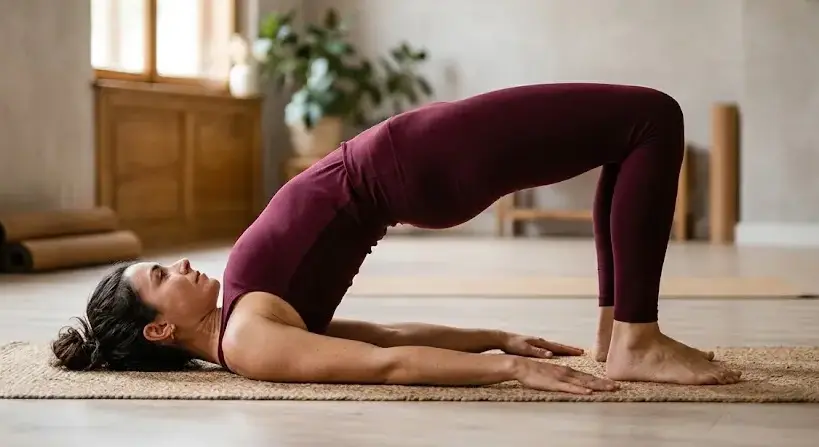
The failure in yoga for beginners lies in starting movement before stabilisation. Reordering the routine into regulation, activation, then controlled mobility resolves recurring stiffness in home practice. This structure applies directly to self-guided morning routines across different types of yoga where sequencing governs outcome.
FAQ
How should a beginner start yoga?
Begin with breath-driven stabilisation for 2–3 minutes before introducing any spinal movement.
Which yoga is best for beginners?
A method that prioritises activation before mobility, regardless of style classification.
Which yoga is best for osteoporosis?
Controlled, low-load sequences with emphasis on spinal stability rather than range.
Can I learn yoga on my own?
Yes, if sequence structure is correct and progression is controlled.
Sources
https://www.yogajournal.com/practice/beginners/yoga-for-beginners/
https://www.yogabasics.com/practice/yoga-for-beginners/
https://www.goodhousekeeping.com/health/fitness/a42396941/yoga-for-beginners/
https://www.cult.fit/live/fitness/yoga-for-beginners/FIT_SERIES_34/s
https://www.youtube.com/watch?v=5s978KzFvOg
https://www.youtube.com/playlist?list=PLui6Eyny-UzzWwB4h9y7jAzLbeuCUczAl