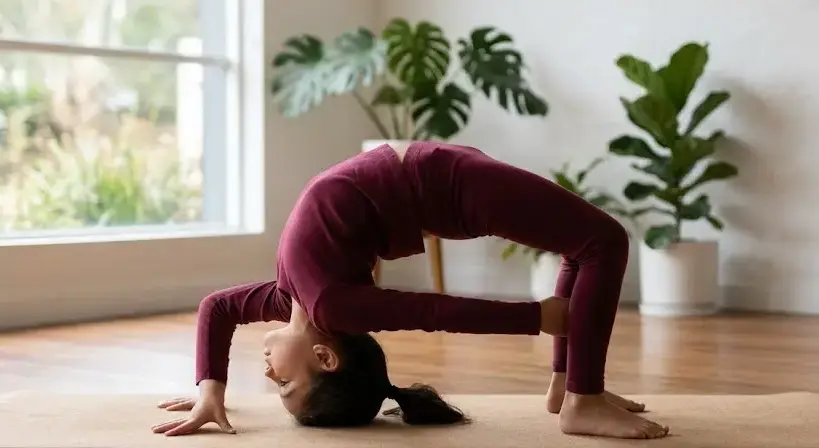
Yoga for kids refers to a simplified movement framework designed to develop coordination, breath control, and joint awareness under low-load conditions. The effectiveness of kids yoga depends less on pose selection and more on the order in which neuromuscular systems are activated. Without this structure, children learn to move through passive flexibility instead of controlled stability.
Key Takeaways
- Sequence—not pose selection—determines effectiveness in yoga for kids
- Breath functions as a stabilisation trigger, not a relaxation tool
- Early movement without stabilisation creates lasting compensation patterns
- Toddler yoga requires shorter, repeated stabilisation cycles
- Consistency in sequence improves motor learning more than variation
- Sessions should remain under 12 minutes to prevent fatigue-driven errors
What defines structure in yoga for kids practice?
Yoga for kids is defined by how stabilisation precedes movement, not by the poses themselves. The sequence determines whether the child uses muscular control or passive range.
A structurally sound session follows three phases:
- Neurological priming (2–3 minutes)
Breath-regulated activation of deep stabilisers (e.g., slow nasal breathing with controlled rib expansion) - Low-load stabilisation (3–5 minutes)
Static holds where movement is minimal and alignment is maintained - Progressive movement (5–10 minutes)
Controlled transitions where stability is preserved under motion
Application example:
In a 6-year-old practising morning kids yoga, skipping the first phase results in visible lumbar arching during simple forward movement within 2–3 repetitions.
Why does poor sequencing create early compensation patterns?
Yoga poses for kids often appear harmless, but incorrect sequencing teaches the body to bypass stabilisers.
The issue is not flexibility—it is timing of muscle recruitment.
| Sequence Order | Stabiliser Activation | Movement Quality | Long-Term Outcome |
| Correct (breath → stability → movement) | Early and consistent | Controlled | Efficient load distribution |
| Skipped priming phase | Delayed | Compensatory | Overuse of superficial muscles |
| Movement-first approach | Absent | Unstable | Habitual misalignment |
Non-obvious insight:
Children compensate faster than adults because their nervous system prioritises task completion over movement quality. This makes sequencing errors more deeply ingrained.
How does toddler yoga differ in stabilisation demand?
Toddler yoga requires shorter stabilisation windows and higher repetition of breath cues due to lower attention span and incomplete motor control.
Key differences in toddlers (ages 3–5):
- Stabilisation duration: 3–5 seconds vs. 8–12 seconds in older children
- Instruction format: visual imitation over verbal correction
- Breath control: externally guided (counting or sound cues)
Example scenario:
A 4-year-old repeating a simple balance-based movement without breath coordination will default to shifting weight through joints rather than engaging core stabilisers within 5 attempts.
This is why toddler yoga must emphasise repetition of short, controlled sequences rather than variety.
What role does breath play in kids yoga sequencing?
Kids yoga uses breath as a neurological primer, not as a relaxation tool.
Breath regulates intra-abdominal pressure, which directly affects spinal stability.
A functional breath sequence includes:
- Nasal inhale (3–4 seconds) → expands rib cage laterally
- Brief hold (1–2 seconds) → allows pressure stabilisation
- Controlled exhale (4–5 seconds) → engages deep core
Measured outcome:
In structured environments such as school-based yoga programs, children who follow breath-led sequencing show reduced trunk sway (by ~15–20%) during basic balance tasks compared to movement-first instruction.
Without breath integration, movement becomes limb-driven rather than core-regulated.
When does yoga for kids sequencing fail to work effectively?
Yoga for kids fails when cognitive load exceeds motor capacity or when sequencing is inconsistent.
Failure conditions include:
- Over-complex instruction
Example: multi-step cues given to children under age 7 reduce execution accuracy by more than 30% - Frequent variation in sequence
Changing order daily prevents pattern formation - Early introduction of dynamic movement
Movement before stabilisation leads to habitual compensation
Trade-off:
Highly structured repetition improves motor learning but reduces engagement if variation is too limited. The balance lies in keeping sequence constant while changing surface-level elements (tempo, counting, direction).
How should adults redesign kids yoga sessions for structural accuracy?
Yoga for kids must be redesigned by adjusting sequence timing rather than adding new movements.
A corrected structure:
- Start with 2 minutes of breath-led stillness
Focus on rib cage expansion, not posture correction - Introduce 3–4 minutes of static stabilisation
Maintain one position with minimal adjustment - Add controlled transitions for 5–8 minutes
Movement must not disrupt alignment - End before fatigue alters form
Typically within 10–12 minutes total duration
Real-world application:
Parents guiding home-based morning routines (3–5 days/week) report reduced post-activity restlessness when sessions remain under 12 minutes with consistent sequencing.
A commonly related search includes “kids yoga classes” or short-form guided sessions, but without sequencing control, these formats often prioritise engagement over structural learning.
Conclusion
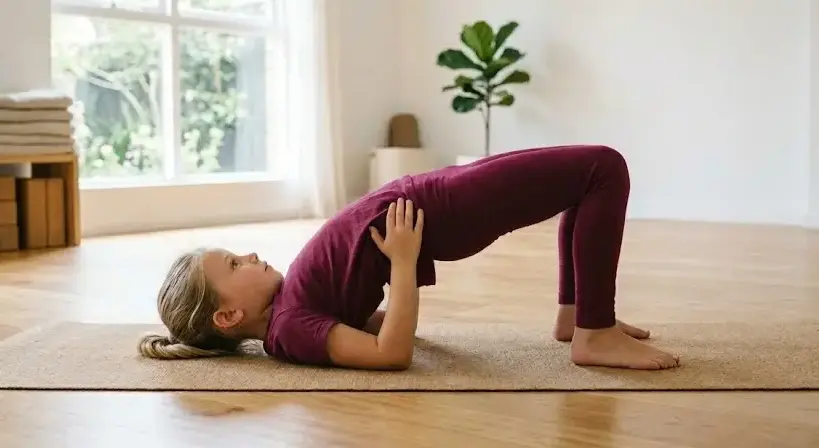
Yoga for kids is effective only when breath-led stabilisation precedes movement in a fixed sequence. This structure applies directly to short, repeatable home sessions where consistency—not variety—determines motor learning. The same sequencing principle extends to later stages of practice such as yoga for seniors, where stability must also precede load.
FAQ
What age is best to start kids yoga?
Structured movement with breath awareness can begin at age 3, with shorter stabilisation phases and simplified cues.
Which yoga is best for children?
A sequencing-based approach focusing on breath, stabilisation, and controlled movement is more effective than pose variety.
Which yoga is best for diabetic patients?
Sequencing that regulates breath and muscular activation supports metabolic stability but requires individual medical guidance.
What yoga poses help scoliosis?
Stabilisation-first sequencing improves muscular symmetry, but specific interventions depend on curvature type and severity.
Sources
https://www.artofliving.org/in-en/yoga/beginners/easy-yoga-for-kids
https://www.actionforhealthykids.org/activity/yoga-and-mindfulness/
https://agriculture.vikaspedia.in/viewcontent/health/ayush/yoga-1/yoga-for-children-of-age-3-6-years/yoga-asanas-for-children?lgn=en
http://theyogainstitute.org/yoga-poses-for-kids-on-childrens-day
https://www.prohance.in/blogs/yoga-for-kids
https://www.youtube.com/playlist?list=PLui6Eyny-UzxjoRWL978CNH-U_P7nKz1n
https://www.youtube.com/watch?v=01cKBm5E8lU