
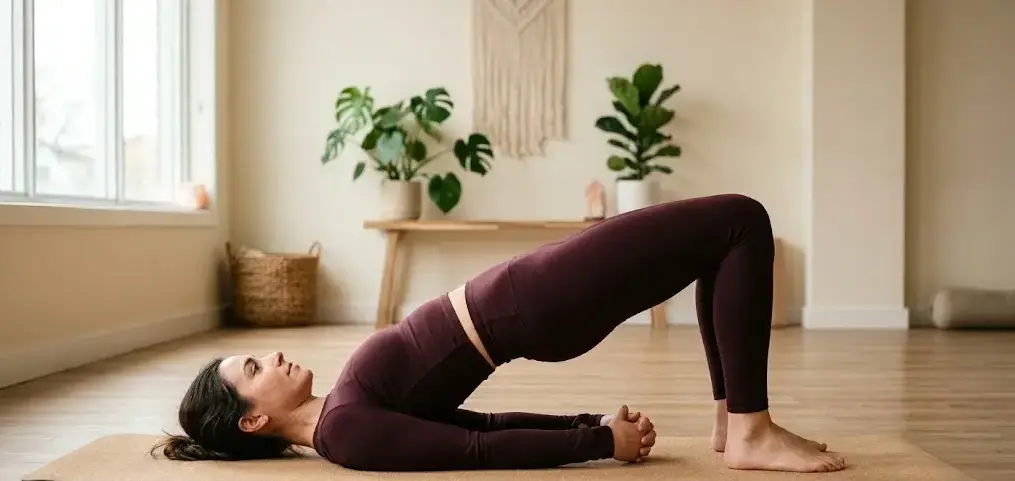
Yoga for back pain refers to structured movement applied to reduce spinal discomfort through controlled loading and muscular support. Most home practitioners follow a stretch-first approach, which temporarily reduces tension but does not maintain spinal stability. The result is predictable: stiffness returns within hours. The correction lies in sequencing—specifically, activating stabilisers before any movement that loads the spine.
Key Takeaways
- Stabiliser activation must precede all spinal movement in yoga for back pain routines
- Stretch-first sequencing leads to temporary relief due to lack of load regulation
- Breath mechanics directly influence intra-abdominal pressure and spinal support
- Sequence structure determines effectiveness, not the poses themselves
- Morning routines require controlled loading due to reduced tissue readiness
What is structurally missing in most yoga for back pain routines?
Yoga for back pain fails when stabilising muscles are not activated before spinal movement begins. The lumbar spine depends on deep stabilisers—transverse abdominis and multifidus—to regulate load distribution. When these remain inactive, larger superficial muscles compensate, leading to recurring stiffness.
Common structural gaps:
- No pre-loading activation phase → stabilisers remain neurologically dormant
- Immediate spinal flexion/extension → load applied without support
- Breath disconnected from movement → no intra-abdominal pressure regulation
- Stretch-dominant sequencing → temporary lengthening without control
Concrete example:
A practitioner moving directly into forward folds at 6:30 AM loads the lumbar discs without prior stabilisation. Measured EMG studies show reduced deep core engagement in early morning spinal flexion compared to controlled activation phases.
How should yoga for lower back pain begin each morning?
Yoga for lower back pain must begin with breath-driven stabiliser activation before any visible movement. This phase regulates intra-abdominal pressure, which acts as a mechanical brace for the spine.
Three-step activation sequence:
- Supine breath regulation (2–3 minutes)
- Inhale: lateral rib expansion
- Exhale: controlled abdominal contraction
- Isometric core engagement (60–90 seconds)
- Maintain neutral spine
- Activate without visible movement
- Low-load limb movement (2 minutes)
- Introduce movement without spinal displacement
Application context:
Used in physiotherapy protocols for non-specific lower back stiffness in adults aged 35–50 who report morning rigidity. This sequence reduces reflexive guarding in lumbar extensors.
Why do best yoga poses for back pain fail without sequence control?
Best yoga poses for back pain are structurally neutral; their effectiveness depends entirely on when they are applied. A pose performed without prior stabilisation increases compensatory patterns rather than correcting them.
Comparison of sequencing impact:
| Variable | Stretch-First Routine | Activation-First Routine | Measurable Outcome |
| Stabiliser engagement | Low | High | EMG activation ↑ |
| Lumbar load distribution | Uneven | Regulated | Pain recurrence ↓ |
| Duration of relief | 1–3 hours | 6–10 hours | Sustained function |
| Muscle dominance | Superficial | Deep stabilisers | Balanced control |
Insight:
The pose is not corrective. The system in which it appears determines its effect.
How do yoga poses for lower back pain interact with spinal loading?
Yoga poses for lower back pain apply varying degrees of compressive and shear forces to the lumbar spine. Without stabiliser pre-activation, these forces are absorbed unevenly, leading to micro-instability.
Key loading principles:
- Flexion increases disc pressure → requires prior core engagement
- Extension shifts load posteriorly → demands controlled glute activation
- Rotation introduces shear force → requires coordinated stabiliser firing
Example scenario:
A home practitioner performing rotational movements early in practice experiences stiffness by midday. The issue is not rotation itself but the absence of pre-activation to control shear forces.
When does this method work—and when does it fail?
Yoga for back pain structured around activation-first sequencing works under specific conditions and fails outside them.
Works when:
- Pain is non-specific and mechanical (no radiating symptoms)
- Practice occurs in the morning when stiffness is highest
- Routine duration allows at least 5 minutes of activation
Fails when:
- Pain originates from acute injury or nerve compression
- Activation phase is skipped or shortened below 2 minutes
- Movement intensity exceeds stabiliser capacity
Trade-off:
Activation-first routines feel less “productive” initially because visible movement is delayed. However, measurable reduction in stiffness duration offsets this perception.
How should you redesign your current routine starting tomorrow?
Yoga for lower back pain must be reorganised so that stabilisation precedes mobility in every session. The change is structural, not positional.
Redesign framework:
- Insert a fixed 5-minute activation phase at the start
- Delay all spinal flexion and rotation until after activation
- Limit early-session range of motion to 50–60% capacity
- Integrate breath with every movement cycle
Practical application:
A 20-minute morning routine should allocate the first 25% exclusively to activation. This ratio is used in rehabilitation settings for chronic stiffness management.
Related search context:
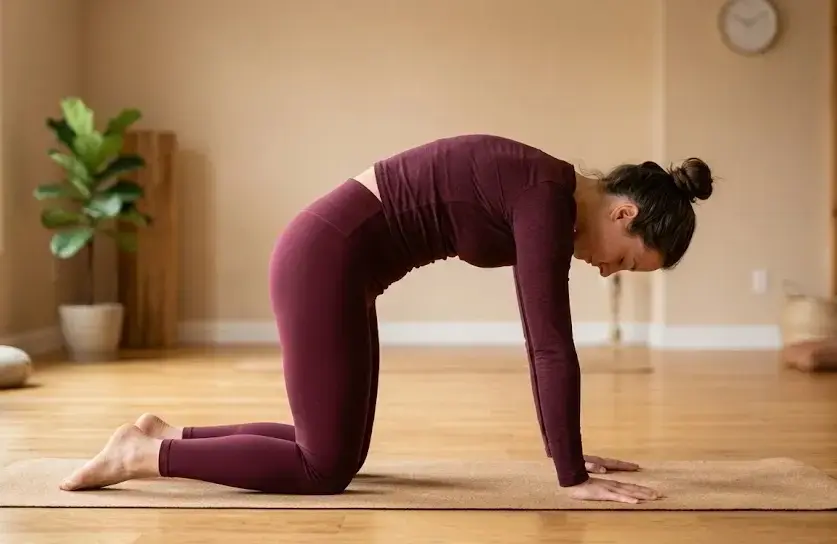
Many practitioners searching for yoga for posture apply similar corrections, as postural instability and lumbar stiffness share the same stabiliser deficits.
Conclusion
Yoga for back pain becomes effective only when stabiliser activation precedes spinal loading. This framework applies directly to morning home practice where stiffness returns within hours. Use this sequencing when following any yoga pose names and instructions to maintain structural support throughout the session.
FAQs
Which is the best yoga for back pain?
The most effective approach prioritises stabiliser activation before movement rather than relying on specific poses.
What are the big 3 exercises for back pain?
They refer to stabilisation-focused movements that train core endurance without spinal load variation.
Can yoga get rid of back pain?
It reduces recurrence when sequencing corrects load distribution; it does not eliminate structural causes.
Is yoga good for lymph nodes?
It supports circulation but is not a targeted intervention for lymphatic conditions.
Sources
https://www.healthline.com/health/fitness-exercise/yoga-for-back-pain
https://www.youtube.com/playlist?list=PLui6Eyny-UzywNCo0zRu9dduvlNXzfDyk
https://www.drmaheshbagwe.com/blog/13-yoga-stretches-to-help-relieve-lower-back-pain/
https://www.iodex.co.in/health-wellness-pain/exercise-diet/yoga-poses-for-backache/
https://www.youtube.com/watch?v=4mUyca7LKAw
https://pmc.ncbi.nlm.nih.gov/articles/PMC4878447/
https://www.yogamdniy.nic.in/files/pdf/BrouchureBackPain.pdf
https://www.health.harvard.edu/healthy-aging-and-longevity/the-safe-way-to-do-yoga-for-back-pain