
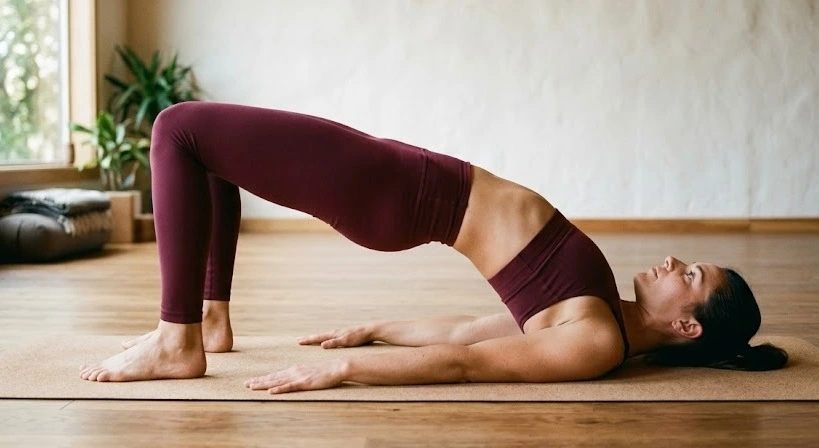
Yoga poses refer to controlled joint positions used to apply load, regulate breath, and organise neuromuscular activity. In morning practice, their effectiveness depends less on selection and more on sequencing relative to stabiliser activation. When spinal loading precedes activation, stiffness returns within hours despite consistent practice.
Key Takeaways
- Sequence, not selection, determines whether yoga poses reduce or reinforce stiffness
- Stabiliser activation must precede any spinal loading by at least 2–3 minutes
- Standing yoga poses increase stiffness if introduced before pressure control is established
- Advanced yoga poses reduce error tolerance and require prior stabiliser endurance
- Breath
Why do yoga poses fail to reduce recurring stiffness?
Yoga poses fail when spinal movement is introduced before stabilisers establish control, creating temporary range without retained support. In home practitioners aged 30–55, this typically appears as initial relief followed by stiffness within 2–4 hours.
Observed pattern in plateaued routines:
- Lumbar flexion or extension introduced within first 2–3 minutes
- No pre-loading breath regulation phase
- Global muscles (erector spinae) dominate before local stabilisers (multifidus) engage
- Movement speed exceeds controlled tempo (faster than 3 seconds per phase)
Application example:
A practitioner performing early forward folds increases passive tissue stretch but delays deep stabiliser engagement. The spine then reverts to protective stiffness once daily load resumes (sitting, driving).
What stabilisers must activate before spinal loading?
Yoga poses require pre-activation of local stabilisers to maintain spinal position under load. These include the transverse abdominis, multifidus, and pelvic floor working in coordinated timing.
Stabiliser activation sequence (pre-loading phase):
- Breath regulation (90–120 seconds): nasal inhale, extended exhale (ratio ~1:2)
- Intra-abdominal pressure setup: gentle abdominal expansion without rib flare
- Segmental awareness: micro-movements isolating lumbar segments
- Low-load isometrics: maintaining neutral spine under minimal load
Measured indicator:
Stable intra-abdominal pressure should be maintained across 5–6 breath cycles without visible rib elevation.
Application context:
In desk-bound professionals, delayed transverse abdominis activation correlates with increased lumbar stiffness during morning mobility work.
How should yoga asanas be sequenced for spinal loading?
Yoga asanas must follow a three-phase structure where load increases only after stabilisation is consistent. Sequence determines whether movement reinforces control or compensates for its absence.
Three-phase structural sequence:
| Phase | Duration | Primary Function | Load Type | Outcome |
| Preparation | 2–3 min | Breath + stabiliser activation | Minimal | Neuromuscular readiness |
| Integration | 4–6 min | Controlled joint movement | Low dynamic | Coordinated movement |
| Loading | 5–8 min | Full pose expression | Moderate | Strength under control |
Non-obvious insight:
Most routines reverse this order by entering movement immediately, treating activation as optional rather than prerequisite.
Application example:
Instead of starting with dynamic standing yoga poses, the practitioner delays them until stabiliser consistency is verified through controlled breathing under light load.
Why do standing yoga poses increase stiffness when mistimed?
Standing yoga poses amplify spinal load through gravity and leverage, exposing any deficit in stabiliser readiness. When introduced early, they shift demand to superficial muscles.
Comparison of timing impact:
| Variable | Early Standing Entry | Delayed Standing Entry |
| Muscle dominance | Global muscles | Local stabilisers first |
| Spinal control | Reactive | Proactive |
| Stiffness return | Within hours | Reduced recurrence |
Application context:
A practitioner entering standing sequences within the first 3 minutes typically reports post-practice tightness during prolonged sitting later in the day.
When do advanced yoga poses reinforce dysfunction instead of control?
Advanced yoga poses increase range and load simultaneously, requiring pre-existing stabiliser coordination. Without it, they amplify compensation patterns.
Conditions where they fail:
- Breath rate exceeds 10–12 cycles per minute during hold
- Loss of neutral spine under load within 5 seconds
- Visible rib flare or pelvic tilt during transitions
Trade-off:
Advanced poses provide higher strength stimulus but reduce error tolerance. They are effective only when stabiliser endurance exceeds 30–45 seconds under low load.
Application example:
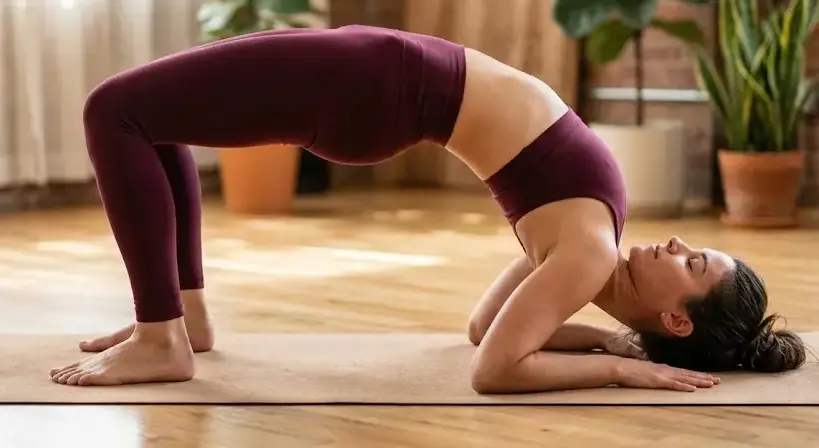
Attempting deeper spinal extension before establishing pressure control leads to perceived flexibility gains but increased stiffness during daily movement.
How should you restructure your morning yoga positions routine?
Yoga positions must be reorganised by sequencing phases rather than replacing poses. The structural change occurs at the start of the routine, not in the pose library.
Redesign framework:
- Shift first 3 minutes: remove all spinal movement; focus on breath + pressure
- Delay dynamic movement: introduce only after stabilisation holds for 5+ breaths
- Control tempo: minimum 3 seconds per movement phase
- Limit early range: prioritise control over depth in first half of session
Related search context (used once):
This differs from common “morning yoga stretches” approaches, which prioritise range increase without sequencing load introduction.
Application scenario:
A 40-year-old home practitioner reduces stiffness recurrence by restructuring the first 5 minutes rather than changing poses, maintaining the same total session length.
Conclusion
Yoga poses must be sequenced so stabiliser activation precedes spinal loading; otherwise, stiffness will recur regardless of pose selection. This framework applies directly to morning routines where early loading disrupts control. For foundational structuring before progression, see yoga for beginners.
FAQs
What are the 12 basic yoga asanas?
They are a standard set of foundational poses used for general mobility, but their effectiveness depends on sequencing rather than inclusion.
What are the 10 most popular yoga poses?
Commonly practised poses include standing, seated, and balance positions, though popularity does not determine structural effectiveness.
What are the 26 traditional yoga poses?
These refer to a fixed sequence used in specific systems, where order is predefined but not always aligned with stabiliser-first principles.
What are the 5 basic yoga poses?
A small group of introductory positions used to teach alignment; their benefit depends on controlled loading rather than repetition.
Sources
https://www.mea.gov.in/yoga-postures-17.htm
https://www.yogajournal.com/poses/
https://www.verywellfit.com/essential-yoga-poses-for-beginners-3566747
https://pocketyoga.com/pose/
https://www.freepik.com/free-photos-vectors/yoga-poses
https://www.youtube.com/watch?v=IVvRL1yA2tY
https://www.youtube.com/playlist?list=PLW0v0k7UCVrmQClv_-a5jCDlun3vXLwjF