
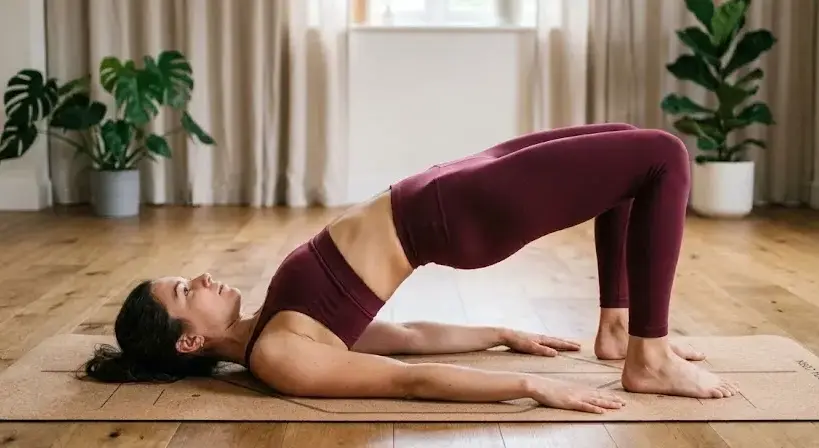
Yoga sculpt is a strength-integrated flow format where load is introduced through repeated transitions and sustained muscular demand. In morning practice, this creates early spinal loading. When stabilisers are not pre-activated, the lumbar spine compensates. The result is temporary mobility followed by rapid stiffness return, typically within 2–4 hours post-practice.
Key Takeaways
- Early spinal loading without stabiliser activation causes stiffness recurrence within hours
- Breath mechanics must establish intra-abdominal pressure before movement begins
- The first 10 minutes of practice determine neuromuscular control outcomes
- Increased intensity amplifies compensation if sequencing is incorrect
- Slower formats succeed due to extended stabilisation phases, not reduced effort
What defines yoga sculpt at a structural level?
Yoga sculpt prioritises load progression over positional precision, which shifts demand toward global movers instead of local stabilisers. In a typical session, repeated transitions under fatigue create cumulative spinal compression before neuromuscular readiness is established.
Key structural components:
- Load introduction timing: External or bodyweight load applied within first 5–10 minutes
- Transition density: High repetition of flexion-extension cycles (20–40 cycles/session)
- Muscle recruitment bias: Dominance of erector spinae and hip flexors over deep stabilisers
- Breath pattern disruption: Shift from diaphragmatic to accessory breathing under load
In home practitioners aged 30–55, this pattern leads to passive tissue reliance instead of active stabilisation, especially during early morning sessions when tissue viscosity is higher.
Why does sequencing failure cause recurring stiffness?
In yoga sculpt, stiffness persists because stabilisers are recruited after spinal loading, not before. This reverses the required order of neuromuscular activation.
Correct sequence vs common sequence:
| Variable | Correct Sequence | Common Yoga Sculpt Sequence | Outcome |
| Breath | Diaphragmatic pre-activation | Unregulated or shallow | Poor intra-abdominal pressure |
| Stabiliser activation | Pre-load (deep core, multifidus) | Post-load or absent | Lumbar compensation |
| Load timing | Gradual progression | Immediate repetition | Early fatigue |
| Movement control | Segmental | Global | Reduced spinal control |
For example, a practitioner performing repeated forward-back transitions within the first 8 minutes without prior stabiliser engagement shifts load directly into lumbar segments. The immediate effect is increased range; the delayed effect is stiffness due to protective muscle guarding.
How should breath mechanics be used as a neurological primer?
In yoga sculpt, breath must establish intra-abdominal pressure before any dynamic loading begins. This is not a relaxation technique; it is a stabilisation mechanism.
3-step breath priming protocol:
- Supine or neutral position: 2–3 minutes of diaphragmatic breathing
- Expansion focus: 360° rib cage expansion, measurable via lateral rib movement
- Integration: Maintain pressure during low-load movements before progression
Measured outcome: a consistent exhalation duration of 6–8 seconds correlates with improved stabiliser engagement. Without this, spinal segments absorb force unevenly during early transitions.
This is often overlooked in formats like powerflow yoga, where continuous movement replaces preparatory control.
Which phase of your routine requires restructuring?
The first 10–12 minutes of yoga sculpt determine whether stabilisation or compensation dominates the session. This phase must shift from movement-driven to activation-driven.
Restructure this phase as follows:
- Minute 0–3: Breath priming (no spinal movement)
- Minute 3–6: Low-load stabiliser activation (static or minimal movement)
- Minute 6–10: Controlled transitions with maintained pressure
- Minute 10+: Introduce load or flow sequencing
Most home practitioners begin directly at minute 6 intensity. This skips stabiliser recruitment, forcing the spine to adapt under load.
A search for “yoga sculpt near me” often surfaces high-intensity formats that compress this preparation phase into under 2 minutes, which is insufficient for neuromuscular readiness in morning conditions.
What is the non-obvious limitation of yoga sculpt formats?
Yoga sculpt improves muscular endurance but reduces segmental control when sequencing is incorrect. The trade-off is between visible strength output and internal stabilisation capacity.
When it works vs when it fails:
| Condition | Works When | Fails When | Observable Effect |
| Time of day | Afternoon/evening sessions | Early morning sessions | Increased stiffness post-practice |
| Experience level | Trained stabiliser awareness | Plateaued home practitioners | Compensation patterns persist |
| Sequence integrity | Activation precedes load | Load precedes activation | Lumbar overuse |
Non-obvious insight: increased effort does not correct the issue. Higher intensity accelerates compensation if sequencing remains unchanged.
How does this differ from vin yoga or slower formats?
Vin yoga and slower formats extend time under low load, allowing stabilisers to engage before progressive demand. The difference is not pace alone, but when load is introduced relative to neuromuscular readiness.
In vin yoga sessions structured for therapeutic outcomes, stabilisation phases often exceed 8–10 minutes before any dynamic flow begins. In contrast, yoga sculpt compresses this into minimal time, prioritising output over preparation.
This distinction explains why slower formats reduce stiffness despite lower intensity.
Conclusion
Yoga sculpt must be restructured at the initial 10-minute phase where breath and stabiliser activation precede load. This adjustment directly reduces post-practice stiffness in morning routines. Apply this sequencing specifically in home sessions before progressing to formats like face yoga.
FAQs
What is yoga sculpt?
A strength-based yoga format combining repeated transitions and load, often introducing spinal demand early in the session.
Is yoga sculpt similar to Pilates?
No; Pilates prioritises stabiliser activation before load, while yoga sculpt often reverses this sequence.
Is yoga sculpt good for fat loss?
It increases energy expenditure, but sequencing errors can limit movement quality and long-term consistency.
Can hot yoga lower cholesterol?
Heat exposure alone does not directly reduce cholesterol; metabolic changes depend on broader activity patterns.
Sources
https://www.corepoweryogaondemand.com/yoga-sculpt
https://www.corepoweryoga.com/blog/yoga-practice/yoga-sculpt-what-is-it-and-am-i-ready
https://www.reddit.com/r/yoga/comments/1o6r29o/yoga_sculpt/
https://www.justdial.com/Bareilly/Sculpt-Yoga-Classes/nct-12463642
https://www.youtube.com/playlist?list=PL7YpEPrqQ3XRred06_FReJKvLHqA28Iwf
https://www.youtube.com/playlist?list=PLS4XfM_aPBIdnGJPf5U3GP3kD_bLEAqOA