
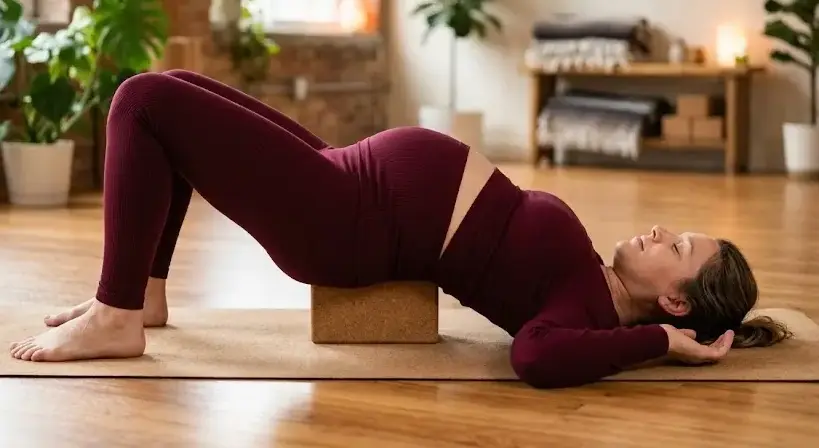
Prenatal yoga is a modified movement system designed to accommodate physiological changes during pregnancy while maintaining spinal control. In practice, most routines prioritise range of motion early in the session. This creates a mismatch between mobility and stabilisation, particularly in morning practice when spinal discs are more hydrated and mechanically vulnerable.
Key Takeaways
- Prenatal yoga effectiveness depends on sequence, not pose selection
- Morning stiffness is a load management issue, not a flexibility deficit
- Breath must function as a stabilisation trigger, not relaxation
- First 5–8 minutes of practice determine outcome sustainability
- External daily load patterns can override correct practice sequencing
What defines prenatal yoga as a stabilisation system?
Prenatal yoga becomes structurally effective only when stabiliser activation precedes any spinal movement. Most routines reverse this order, introducing motion before control.
In early morning conditions, lumbar discs exhibit up to 240% higher hydration compared to evening baselines. This increases compressive sensitivity. Without pre-activation of deep stabilisers (transversus abdominis, pelvic floor), passive structures absorb load.
Required sequencing structure:
- Phase 1: Neuromuscular priming (2–4 minutes)
Low-load breath cycles to initiate deep stabiliser engagement - Phase 2: Static load acceptance (3–5 minutes)
Controlled holds with minimal spinal movement - Phase 3: Gradual mobility introduction (5–10 minutes)
Only after stability is established
This structure is standard in physiotherapy-led prenatal conditioning programs, not general yoga classes.
Why does stiffness return after morning practice?
Prenatal yoga routines fail when they treat stiffness as a muscular tightness issue instead of a load management problem.
When mobility precedes stabilisation:
- The spine moves without segmental control
- Passive tissues (ligaments, discs) compensate
- Temporary relief occurs due to movement, not correction
Observed pattern in home practitioners (30–55 age group):
| Phase | What Happens | Outcome After 2–3 Hours |
| Immediate post-practice | Increased flexibility | Temporary relief |
| Midday | Reduced stabiliser engagement | Gradual stiffness return |
| Evening | Compensatory tension | Recurring discomfort |
This is not a flexibility limitation. It is a sequencing error.
How should breath mechanics be used as a primer?
Prenatal yoga requires breath to act as a neurological trigger for stabiliser recruitment, not relaxation.
Most practitioners use diaphragmatic breathing passively. In this context, breath must be regulated with mechanical intent.
Functional breath protocol:
- Inhale (3–4 seconds): Lateral rib expansion without spinal movement
- Pause (1–2 seconds): Maintain expansion, no collapse
- Exhale (5–6 seconds): Controlled abdominal tension engagement
- End-range hold (2 seconds): Stabiliser activation maintained
This creates:
- Intra-abdominal pressure regulation
- Pelvic floor synchronisation
- Reduced shear force during subsequent movement
In clinical antenatal programs, this phase is used before any loading task, including simple positional changes.
What phase of your routine requires redesign?
Prenatal yoga routines need restructuring at the transition between rest and movement — not within the movement itself.
Most home practitioners begin with:
- Stretching sequences
- Dynamic spinal articulation
- Range-focused flows
This is the incorrect entry point.
Replace your first 5–8 minutes with:
- Breath-led stabilisation (as defined above)
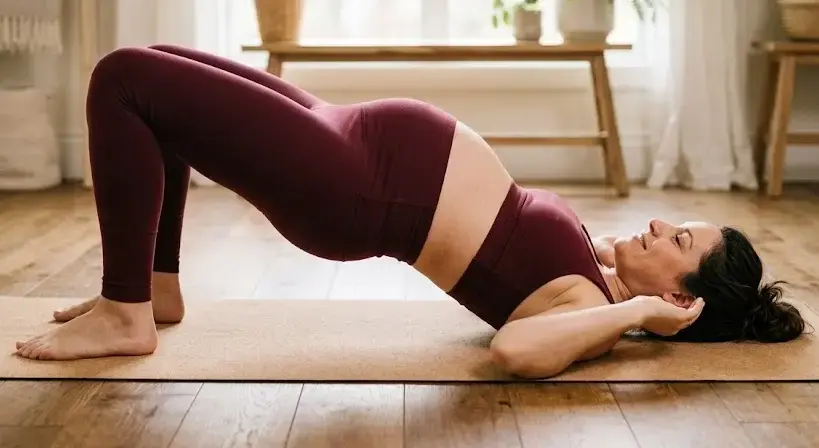
- Static positional holds with neutral spine
- Zero dynamic spinal flexion or rotation
Comparison of routine structures:
| Variable | Conventional Routine | Redesigned Prenatal Yoga |
| Entry phase | Mobility first | Stabilisation first |
| Breath role | Relaxation | Activation |
| Load timing | Immediate | Delayed |
| Outcome | Temporary relief | Sustained stiffness reduction |
The difference is not in poses. It is in sequence logic.
When does this approach fail or require modification?
Prenatal yoga structured around stabilisation does not resolve stiffness if the issue is load accumulation outside practice.
This method is limited when:
- Daily sitting exceeds 8–10 hours without interruption
- Carrying asymmetrical loads (e.g., single-side lifting of a toddler)
- Sleep positioning introduces prolonged spinal rotation
Trade-off:
- Stabilisation sequencing improves load tolerance
- It does not eliminate external mechanical stress
In such cases, practice must be paired with:
- Midday unloading intervals (2–3 minutes every 2 hours)
- Symmetrical load management
- Neutral sleep alignment
Without this, morning corrections are overridden by daytime behaviour.
How do prenatal yoga classes near me differ from home routines structurally?
Prenatal yoga classes near me typically include guided pacing and supervised sequencing, but still often prioritise flow over preparation.
Structural differences:
| Variable | Home Practice | Guided Class Setting |
| Sequence control | Self-directed | Instructor-led |
| Stabilisation emphasis | Often skipped | Inconsistent |
| Feedback loop | None | Immediate correction |
| Load progression | Unregulated | Moderately structured |
However, even structured pregnancy yoga classes frequently underemphasise stabiliser priming.
A related search often appears here: people compare prenatal routines with general back pain yoga protocols. The difference is that pregnancy-specific practice must account for ligament laxity and altered load distribution, not just discomfort.
Conclusion
Prenatal yoga must begin with stabiliser activation and delayed spinal loading to prevent recurring stiffness. This applies specifically to morning home practice where disc hydration increases vulnerability. The correct redesign replaces early mobility with controlled preparation, a principle that holds across populations, including adaptations seen in yoga for kids.
FAQ
When should we start prenatal yoga?
Once cleared for physical activity, practice should begin with stabilisation-focused sequencing rather than mobility-based routines.
What are prenatal yoga exercises?
They are controlled movement and breath patterns designed to regulate spinal load, not increase flexibility.
Which yoga pose is best for high BP?
No single pose is sufficient; controlled breathing with minimal strain is prioritised to avoid pressure spikes.
Can yoga help with pelvic pain?
Only when stabilisers are engaged before movement; otherwise, symptoms may persist.
Sources
https://www.healthline.com/health/fitness/prenatal-yoga-poses
https://www.youtube.com/playlist?list=PLP7Ou7uUiYzCNqFEYEZcPxHifLzqAacIj
https://www.whattoexpect.com/pregnancy/prenatal-yoga/
https://www.nhs.uk/live-well/exercise/pilates-and-yoga/prenatal-and-postnatal-exercise/
https://www.artofliving.org/in-en/yoga/yoga-sequences-for/yoga-for-pregnant-women
https://www.lifecell.in/blog/general/prenatal-yoga-poses-during-pregnancy
https://www.verywellfit.com/pregnancy-yoga-4013139